


Choosing between a 12V and 24V dc pump seems like a minor detail. But the wrong decision can lead to overheating, inefficient wiring, and premature failure, jeopardizing your entire system’s performance.
A 24V DC air pump is generally better because, for the same power, it draws half the current of a 12V pump. This fundamental electrical advantage results in higher efficiency, less heat, increased reliability, and a longer lifespan, especially for high-performance and industrial applications.
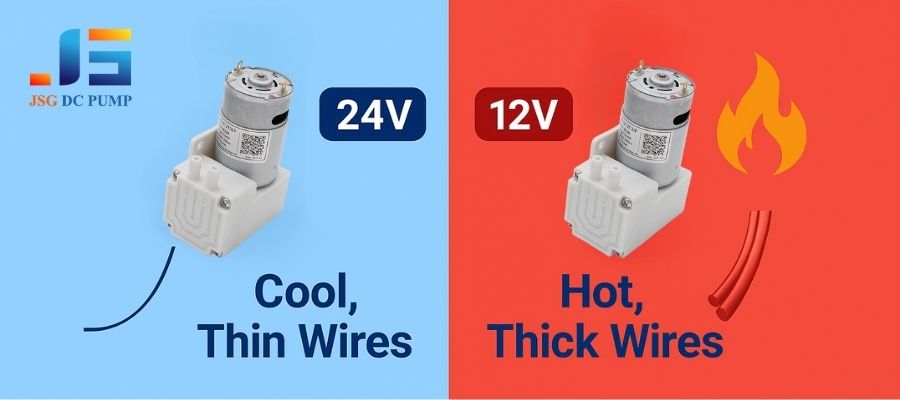
As an engineer at JSG DC PUMP for over two decades, I’ve seen countless projects where the choice between 12V and 24V was the pivot point for success or failure. It’s far more than just matching a power supply voltage. This decision impacts everything from the thickness of your wires to the operational lifespan of the pump itself. Below, I’ll break down exactly why moving to a 24V system is often the more professional and robust engineering choice.
What’s the Real Difference Between 12V and 24V DC Air Pump?
You see 12V and 24V pumps with similar performance specs. It’s easy to assume they are interchangeable, but this oversight can lead to an inefficient and over-stressed electrical system.
The core difference lies in their relationship with current, governed by the power formula: Power (P) = Voltage (V) × Current (I). For the same power output, a 24V pump draws exactly half the amperage of a 12V pump. This simple fact has profound implications for the entire system design.
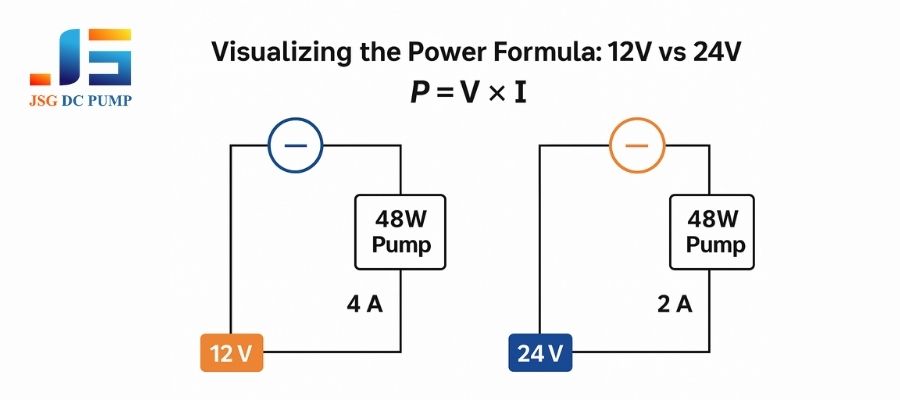
The fundamental principle of P = V × I is the first thing we discuss when a client is deciding on a system voltage. Think of it like water in a pipe: voltage is the pressure, and current is the flow rate. To deliver the same amount of power (water), you can use high pressure and a low flow rate (24V) or low pressure and a high flow rate (12V). The 24V approach is almost always more efficient.
Electrical Characteristics at a Glance
For a hypothetical pump requiring 48 Watts of power:
- 12V System: To achieve 48W, the pump must draw 4 Amps (48W / 12V = 4A). This high current requires thicker wires and puts more thermal stress on components. It’s best suited for low-power, compact devices where power demands are minimal.
- 24V System: To achieve the same 48W, the pump only needs to draw 2 Amps (48W / 24V = 2A). This lower current allows for thinner, lighter wiring and creates a more efficient, stable system, making it the standard for industrial equipment and high-performance applications.
Voltage Suitability
| Voltage | Ideal Applications | Rationale |
|---|---|---|
| 12V DC | Automotive systems, small portable devices, low-power consumer electronics. | Aligns with standard battery systems; sufficient for low current demands. |
| 24V DC | Industrial automation, medical equipment, continuous-duty analyzers, high-load machinery. | Lower current draw leads to higher efficiency, stability, and reliability. |
Why Do 24V DC Air Pumps Offer Better Efficiency?
Your high-performance 12V pump gets surprisingly hot and requires thick, expensive cables. These are symptoms of wasted energy, turning precious power into useless heat and increasing your material costs.
A 24V DC air pump is more efficient because lower current significantly reduces two major sources of energy loss: resistive heating and wire loss. With half the current, heat generation (proportional to I²R) is cut by 75%, leading to a cooler, more efficient pump and less voltage drop over long wires.
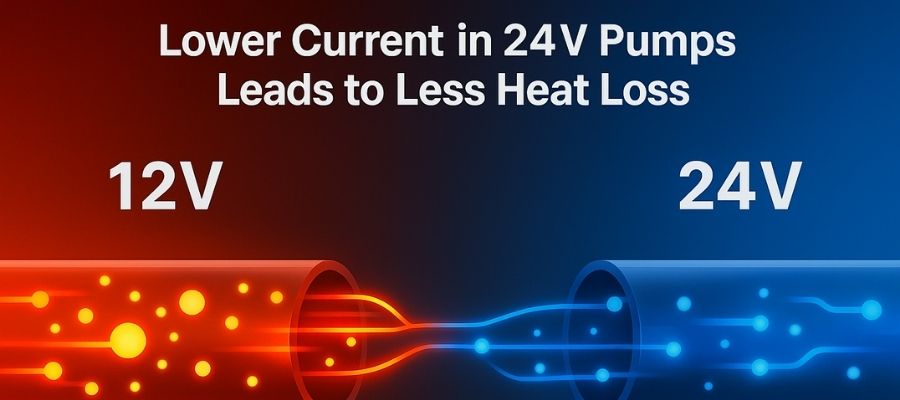
I’ve seen engineers struggle with voltage drop issues in large machines where the pump is located far from the power supply. A 12V pump might see its voltage drop to 10V by the time it reaches the motor, causing it to underperform. By simply switching to a 24V system, the voltage drop becomes negligible because the current is so much lower. This is not a small tweak; it’s a fundamental improvement in system efficiency and stability, especially crucial for any equipment that needs to run for long periods.
The Three Pillars of 24V Efficiency
- Reduced Resistive Heating: Electrical components have internal resistance (R). The heat generated is calculated by P = I²R. Since a 24V pump has half the current (I), the heat generated is (0.5)² = 0.25, or 75% less than a 12V pump for the same task. This means more energy is used for pumping air and less is wasted as heat.
- Minimized Wire Loss: Lower current allows for the use of thinner, more flexible, and less expensive copper wires without significant voltage drop or heat buildup. This is a huge advantage in complex industrial machinery or when the pump is located far from the power source.
- Enhanced Stability: A cooler-running system is a more stable system. Components operating below their maximum temperature limits perform more consistently and are less prone to degradation, making 24V the superior choice for long-term, continuous operation.
How Do 24V Pumps Improve Reliability and Lifetime?
You need a pump for a medical device that will run continuously for years. A premature failure is not an option, so you must choose the most reliable components available.
A 24V pump enhances reliability because the lower operating current reduces stress on every component in the electrical path. For brushed motors, this means significantly less arc and wear on the carbon brushes. For all pumps, it means less thermal load on the electronic controller and motor windings, preventing degradation and extending the overall lifespan.
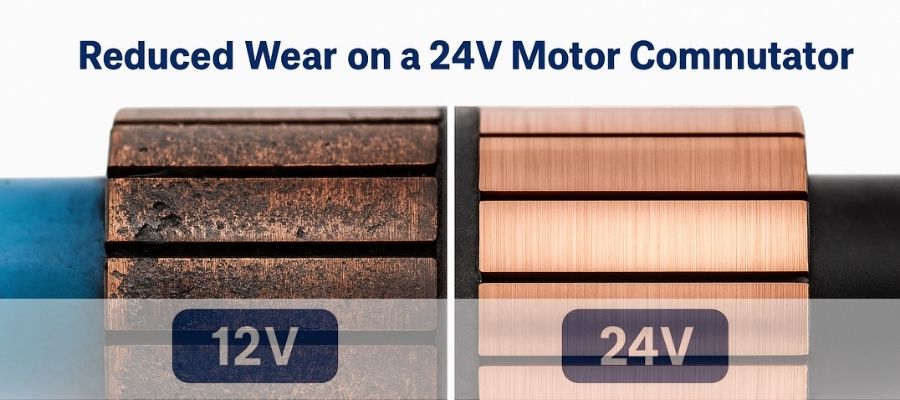
When we design a 24V brushless diaphragm pump for continuous use in an air quality analyzer, lifetime is the number one priority. These devices need to operate flawlessly for 20,000 hours or more. The choice of 24V is deliberate. The lower current means the motor’s electronic control board (especially the power MOSFETs) runs much cooler. Heat is the main enemy of electronics, so by minimizing it from the start with a 24V design, we are building a foundation for extreme reliability and a long service life.
Reliability Advantages of 24V Systems
| Component | Impact of Lower Current (24V) | Result |
|---|---|---|
| Motor Windings | Lower I²R heat generation. | Cooler operation, preventing enamel insulation breakdown and motor burnout. |
| Motor Brushes (if applicable) | Reduced electrical arcing during commutation. | Slower wear on carbon brushes, dramatically extending the life of brushed motors. |
| Electronic Controller | Less thermal stress on MOSFETs, capacitors, and other driver components. | Significantly extends the lifespan and reliability of the control electronics. |
| Overall System | Cooler, more stable operation. | Ideal for continuous-duty equipment like medical devices, gas analyzers, and industrial controls. |
When Should You Still Choose a 12V Pump?
Despite the clear advantages of 24V, you notice that 12V pumps are still incredibly common. There must be situations where 12V is the better, or only, choice.
You should still choose a 12V pump when your system’s power source is inherently 12V, such as in vehicles or battery-powered portable devices. It is also a practical choice for low-cost, low-power applications where the benefits of 24V efficiency are outweighed by the need to minimize component cost and complexity.
It’s a matter of practicality. If you’re designing a tire inflator that plugs into a car’s cigarette lighter, you have to use a 12V pump. There’s no other option. Similarly, if you are building a small, battery-operated perfume diffuser that only runs for a few seconds at a time, the high current draw is not a major issue. In these cases, using a simple 12V motor without the need for a voltage converter (a buck-boost converter) makes the design simpler and cheaper. The key is to match the pump voltage to the application’s constraints and performance demands.
The Right Scenarios for a 12V Pump
- Existing Power Infrastructure: The most common reason. Automotive, marine, and many off-grid solar systems are standardized at 12V. Using a 12V pump avoids the need for a voltage converter, which adds cost, complexity, and another point of potential failure.
- Portability and Battery Power: Many small, rechargeable battery packs are based on 12V systems. For portable devices, leveraging this existing voltage is the most direct and efficient design choice.
- Low-Power, Intermittent Use: For applications where the pump only runs for short periods and the power demands are very low, the efficiency losses of a 12V system are negligible. The lower cost of a 12V motor and power supply might be the deciding factor.
How Do JSG 24V DC Air Pumps Deliver Superior Performance?
You now understand the theoretical benefits of 24V pumps, but you need to see how this translates into real-world, high-performance hardware for your industrial or OEM project.
At JSG DC PUMP, we leverage 24V architecture to create pumps that meet the highest demands of industrial systems. Our 24V models are engineered for higher efficiency and longer life, making them the ideal choice for developers of high-performance equipment.
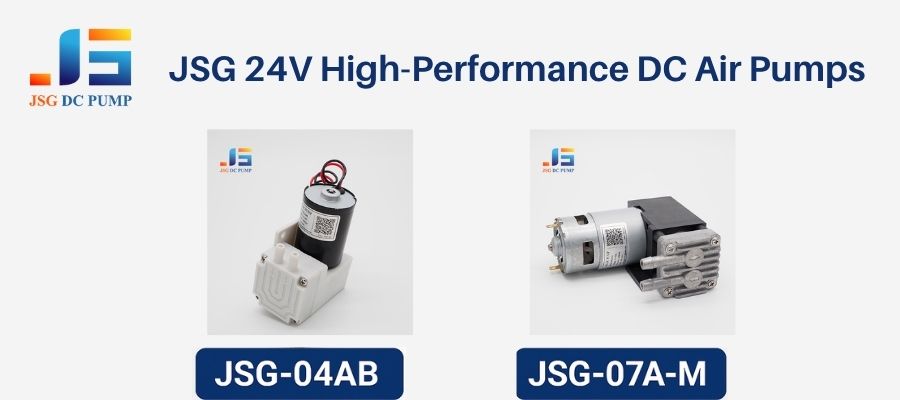
When a client comes to me with a demanding application—for example, a high-speed packaging machine that needs a reliable compressor—I almost always recommend one of our 24V models. These pumps aren’t just 12V models with a different motor winding; their entire design from the bearings to the electronic controller is optimized to take full advantage of the 24V architecture. The result is a pump that not only performs better on day one but also maintains that performance over years of continuous operation.
Showcase: JSG’s 24V Lineup
Here are two examples of how we apply the 24V advantage:
| Model | Type | Key Specifications | Ideal Application |
|---|---|---|---|
| JSG-04AB | 24V Brushless Diaphragm Pump | Flow: 20 L/min, Pressure: 350 kPa | Medical analyzers, environmental samplers, and any device needing a clean, long-life. The brushless motor and 24V efficiency guarantee extreme reliability. |
| JSG-07A-M | 24V Compressor Pump | Flow: 35 L/min, Pressure: 7 bar (700 kPa) | Industrial automation, pneumatic control systems, and machinery requiring high-pressure air in a compact form factor. The 24V design ensures it can handle high loads. |
Conclusion
When system performance, efficiency, and long-term reliability are priorities, a 24V DC air pump is the superior engineering choice. If your system allows, opting for 24V is always the more professional, robust, and forward-thinking decision.
 For OEM projects requiring long-life and efficient air pumps, contact admin@dc-pump.com.
Explore our full 24V DC Air Pump solutions at dc-pump.com.
