


You want to design a portable health device, but bulky, noisy pumps make it impossible. This limitation compromises user freedom and your product’s market appeal.
Advanced small air pumps enable compact health devices by delivering high pressure and flow in a tiny, lightweight, and energy-efficient package. Their low noise and vibration are essential for user comfort, while their long lifespans guarantee reliability for critical medical applications.
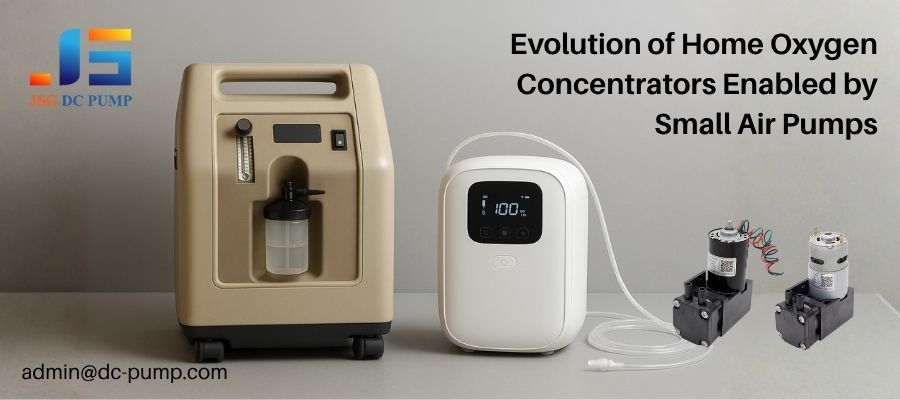
Drawing on JSG DC PUMP’s engineering and manufacturing experience dating back to 2003, we have witnessed this transformation firsthand. The shift from bulky, noisy machines to quieter portable devices has been driven by continuous innovation in micro pump technology. These developments make it possible to deliver stronger performance within a compact footprint. It starts with solving a key engineering challenge: generating sufficient pressure in a very small space.
How Can a Small Air Pumps Generate High Pressure for an Oxygen Concentrator?
Your compact device needs high pressure to function. But tiny pumps usually mean low pressure, forcing you to increase the product size and abandon your sleek design goals.
Small air pumps achieve high pressure through multi-stage designs and advanced diaphragm technology. By using dual heads or piston mechanisms in series, the pump compresses air incrementally, reaching pressures that a single-stage pump of the same size could not, all while remaining compact.
I remember when the idea of a portable oxygen concentrator (POC) that a person could carry around was just a dream. The main barrier was the pump. We needed to generate over 200 kPa to force air through the molecular sieve beds that separate oxygen, but any pump that could do that was the size of a brick. The breakthrough came from rethinking the compression process. Instead of one big push, we designed pumps that made two smaller, sequential pushes. This multi-stage approach was the key that unlocked the door to true portability for these life-changing devices.
The Principle of Multi-Stage Compression
This design is elegant in its simplicity. Instead of one large diaphragm or piston trying to do all the work, a multi-stage pump uses two or more working in series.
- Stage 1: The first pump head draws in ambient air and compresses it to an intermediate pressure.
- Stage 2: This moderately-pressurized air is then fed directly into the inlet of the second pump head, which compresses it further to the final, high output pressure.
This method dramatically increases the maximum pressure capability without needing a massive, powerful motor or a huge pump body.
Pressure Capabilities: Single vs. Multi-Stage
| Pump Design | Typical Max Pressure | Key Advantage | Best Use Case |
|---|---|---|---|
| Single-Stage Micro Pump | 80 – 100 kPa | Simplicity, Low Cost | Blood pressure monitors, aroma diffusers. |
| Multi-Stage Micro Pump | 200 – 350+ kPa | High Pressure in a Compact Size | Home oxygen concentrators, nebulizers. |
Why is Low Noise a Critical Feature for Home Health Devices?
You’ve designed a functionally perfect health device. But in user testing, everyone complains that it’s too loud, making it annoying to use and impossible to sleep near.
Low noise is essential because these devices operate in close proximity to the user, often for hours at a time or even overnight. A noisy pump creates stress, disrupts sleep, and leads to poor user compliance and dissatisfaction, regardless of how well the device performs its medical function.
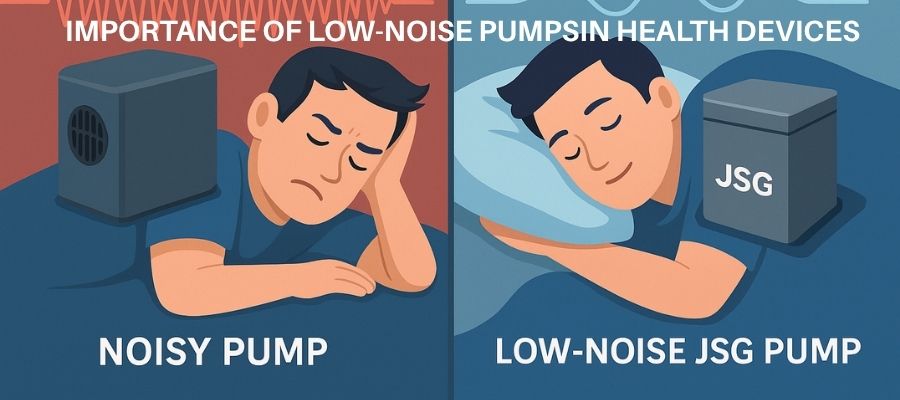
A client developing a high-end nebulizer for asthmatic children approached me with a familiar problem. Their prototype worked, but the vibration and noise frightened the kids, making treatment time a battle. Our approach wasn’t to just sell them a replacement. Instead, we worked closely with their engineers to analyze their real needs. We had to find the perfect balance between airflow for effective treatment and a noise level that wouldn’t cause distress. By matching the optimal parameters with the right configuration of our low-noise brushless diaphragm pumps, we found that balance. The final success came from this partnership, not just the hardware.
Engineering for Silence
Achieving low noise and vibration is a multi-faceted engineering challenge.
- Brushless DC Motor: The number one source of high-frequency whine and electrical noise is the friction of carbon brushes in a traditional motor. Brushless motors are electronically commutated, making them inherently quieter and longer-lasting.
- Precision Balancing: The small eccentric weight on the motor shaft that drives the diaphragm must be perfectly balanced. Any imbalance creates vibration, which translates directly into audible, low-frequency noise.
- Advanced Diaphragm Design: The shape and material of the diaphragm influence the sound of the airflow. We use high-grade elastomers and computer modeling to create a diaphragm that moves air efficiently and quietly.
How Does Micro Pump Efficiency Impact Battery Life in Portable Devices?
Your new battery-powered device has great features. But the battery only lasts for an hour because the air pump consumes too much power, making it impractical for users on the go.
Pump efficiency directly determines battery life. An efficient pump converts more electricity into airflow and less into wasted heat. By using a high-efficiency brushless motor and low-friction mechanics, a small air pump can perform its task while drawing minimal current, maximizing the device’s runtime.
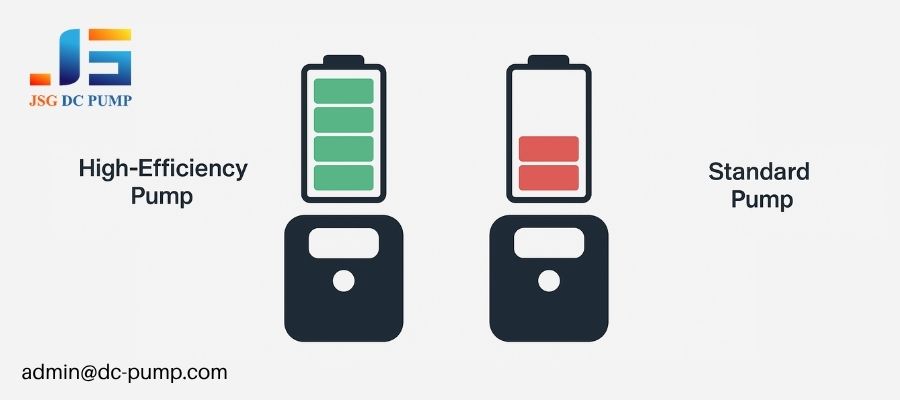
I often explain this to our OEM partners with a simple analogy: it’s like the difference between a modern LED light bulb and an old incandescent one. Both produce light, but the incandescent bulb wastes most of its energy as heat. A low-efficiency pump is like that old bulb—it gets hot and drains the battery. Our high-efficiency pumps are like the LED; they run cool and make every milliamp of current count. For a portable oxygen concentrator user who wants to spend a day out with family, this efficiency difference is everything. It’s the difference between 4 hours of freedom and just 1 hour of being tethered to a power outlet.
The Components of Efficiency
Efficiency is not a single feature but the result of a well-designed system. Every part must be optimized to reduce energy loss.
- Motor Technology: Brushless DC (BLDC) motors are significantly more efficient than their brushed counterparts. They lack the friction of brushes and have better power-to-weight ratios.
- Mechanical Design: Using high-quality ball bearings instead of cheaper sleeve bearings reduces rotational friction. A well-designed eccentric and connecting rod translate motor rotation into diaphragm movement with minimal energy loss.
- Pneumatic Optimization: The design of the pump head, valve system, and airflow path is critical. Our engineers use fluid dynamics simulation to ensure air moves through the pump with the least possible resistance.
What Makes a Small Air Pump Reliable Enough for Medical Use?
You’re selecting a pump for a life-supporting medical device. A pump failure is not just an inconvenience; it could be a critical safety issue, leading to reputational damage and liability.
A pump’s medical-grade reliability comes from its core components: a long-life brushless motor, high-endurance ball bearings, and a diaphragm made from advanced materials. These elements ensure the pump can run continuously for thousands of hours without degradation in performance.
Reliability is non-negotiable in the medical field. At JSG DC PUMP, our quality control is rigorous. I’ve personally overseen lifetime tests where our brushless diaphragm pumps run continuously for well over 10,000 hours. The key is never cutting corners on materials. We use high-quality ball bearings from Japan, not cheap sleeve bearings that wear out. Our diaphragms are made from specially formulated EPDM rubber that can withstand constant flexing without fatiguing. It’s this commitment to using only the best components that allows us to confidently supply pumps for critical applications like oxygen concentrators and patient monitors.
The Pillars of Pump Longevity
If a pump is to be trusted for medical use, it must be built on a foundation of durable components.
| Component | Standard Pump | Medical-Grade Pump | Lifespan Impact |
|---|---|---|---|
| Motor | Brushed DC | Brushless DC (BLDC) | 1,500 hours vs. 10,000+ hours |
| Bearings | Sleeve Bearings | Sealed Ball Bearings | Prone to early wear vs. Long-term precision |
| Diaphragm | Basic Rubber | High-Endurance EPDM | Resists fatigue and tearing from repeated flexing |
How Does JSG DC PUMP Support OEM Micro Air Pump Development?
Finding the right micro air pump for your OEM project is frustrating. Standard models don’t fit, forcing design compromises and project delays that threaten your product’s success.
We support OEM customers with more than 400 pump prototypes and parameter configurations as a basis for collaborative development. Our team can adjust performance, select suitable materials, and customize motor parameters according to the device’s size, power, noise, duty cycle, and integration requirements.
Some of our most rewarding work has come from collaborating with OEM partners. We do not simply take an order; we work as an extension of your design team. Our process is built on collaboration from the beginning. It starts with a detailed consultation to understand your application, including target pressure, flow, noise level, and power budget. By understanding your goals and technical challenges, we can develop the right solution together.
Our Collaborative Development Process
From there, we select a suitable starting model from our library of more than 400 pump prototypes and parameter configurations. We then refine flow, pressure or vacuum, motor parameters, diaphragm materials, noise, power consumption, and installation details according to the application requirements. This collaborative development approach supports different OEM and ODM project needs.
Cooperation Models
| Model | Description | Best For |
|---|---|---|
| OEM | We manufacture a pump based on your exact design and specifications. | Clients with a complete, validated pump design. |
| ODM | We modify one of our existing pump designs to meet your unique requirements. | Clients needing a custom solution with a fast development cycle. |
| OBM | You can integrate our standard, proven JSG-branded pumps directly into your products. | Clients who need a reliable, off-the-shelf solution immediately. |
Conclusion
Small air pumps have completely reshaped the design of modern home health devices. By delivering high pressure, ultra-low noise, and exceptional energy efficiency within an extremely compact footprint, they enable engineers to build lighter, quieter, and more user-friendly medical products. Their medical-grade reliability, driven by long-life BLDC motors, high-endurance diaphragms, and precision mechanics, is the foundation that supports today’s portable oxygen concentrators, nebulizers, monitoring systems, and other life-supporting applications.
At JSG DC PUMP, we don’t just provide pumps—we support your entire product development process. From early concept evaluation to prototype customization and final mass-production tuning, our team ensures that your device achieves the perfect balance of performance, size, and reliability.
📩 Ready to Develop Your Custom Micro Air Pump?
If your project requires a custom high-pressure, low-noise, or long-life micro pump, our engineering team is ready to support you.
👉 Contact JSG DC PUMP:
admin@dc-pump.com
Let’s build your next-generation health device together.
