


You’re designing a portable device, but power is a constant headache. Using a high-voltage pump means complex power conversion, larger batteries, and shorter runtime, compromising your product’s mobility and user experience.
12V electric vacuum pumps are the preferred choice because they align perfectly with standard battery technologies, vehicle power systems, and mobile power modules. This simplifies design, improves energy efficiency, and enables smaller, more compact product footprints for OEM equipment.
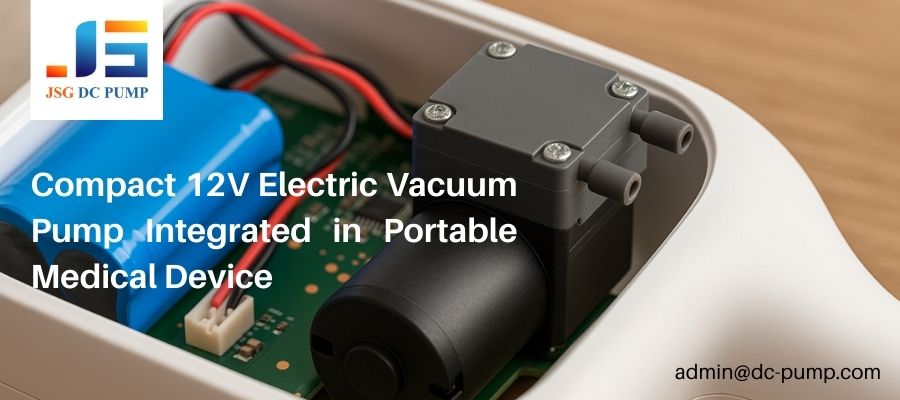
As a JSG engineer who has spent over two decades helping OEMs design portable solutions, I’ve seen firsthand how an early decision on voltage can make or break a project. The 12V DC platform isn’t just a random number; it’s a globally recognized standard that brings an entire ecosystem of components with it. Choosing 12V means you’re tapping into a massive supply chain of batteries, chargers, and power management ICs. This simplifies your bill of materials, shortens development time, and ultimately makes your product more reliable and easier to service. Let’s explore why this seemingly simple choice has such a profound impact on mobile and battery-powered equipment design.
Why Is 12V the Standard Power Platform for Battery-Driven Equipment?
You need a power source for your new mobile device. Navigating the world of different voltages and battery chemistries is complex, and making the wrong choice could mean a costly redesign or a product that’s incompatible with its intended environment.
12V is the standard because it perfectly matches the nominal voltage of common battery architectures, including lead-acid, 3-cell lithium-ion (3S Li-ion), and 4-cell LiFePO₄ packs. This direct compatibility simplifies circuit design and makes integration into vehicle and mobile power systems seamless.
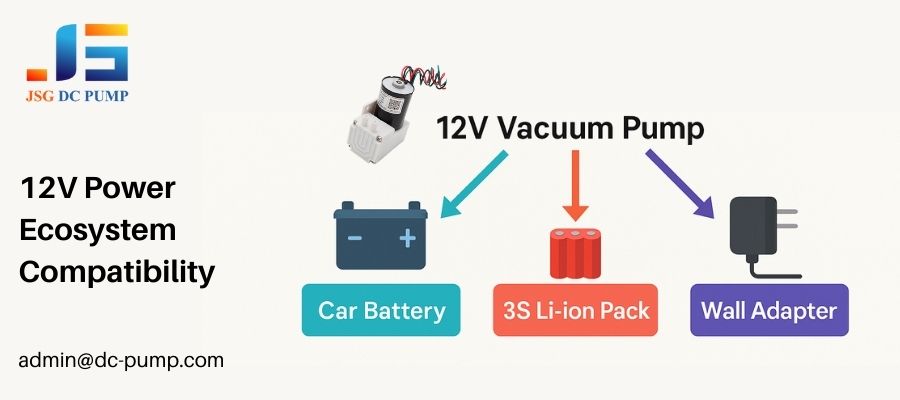
I like to call 12V the “universal language” of mobile power. This standardization offers several key advantages for OEM engineers, primarily by removing complexity from the design process. You can power the pump directly from the system’s main battery bus without needing inefficient DC-to-DC converters. This inherent simplicity and interoperability are why the 12V platform reigns supreme for mobile applications.
Key Reasons for 12V Standardization
- Direct Battery Compatibility: Perfectly aligns with the voltage of mainstream battery packs (3S Li-ion, 4S LiFePO₄, Lead-Acid), eliminating the need for voltage conversion circuits.
- Vehicle System Integration: It is the native voltage for automotive and marine systems, allowing for direct connection in vehicular applications.
- Global Component Ecosystem: A vast and mature supply chain exists for 12V components, including batteries, chargers, connectors, and power management ICs.
- Simplified OEM Design: Reduces component count, saves PCB space, and increases overall system reliability by eliminating potential points of failure.
How Does 12V Improve Energy Efficiency and Battery Runtime in Mobile Systems?
Your battery-powered device runs out of juice too quickly. The pump seems to be a major power hog, and every minute of lost runtime is a major drawback for your users, making your product less competitive.
A 12V system improves efficiency by allowing for better current control and minimizing energy loss. The higher voltage results in lower current draw for the same amount of work (Power = Voltage x Current), reducing resistive losses in wiring and extending battery life, especially in intermittent-duty applications.
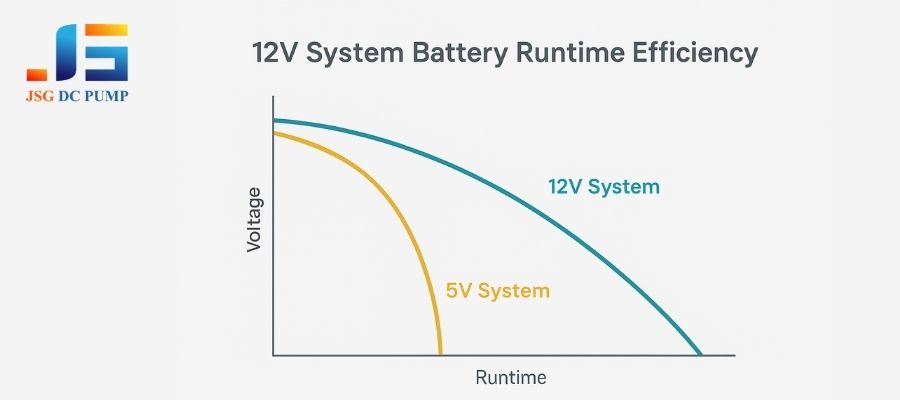
It all comes down to basic physics. For a given power requirement, a higher voltage means lower current. In a compact device where every milliwatt counts, this is a huge advantage. Intelligent power management, made easy by the 12V platform and PWM control, is the key to maximizing battery runtime.
How 12V Boosts Efficiency
| Feature | Impact on Efficiency | Benefit for Mobile Devices |
|---|---|---|
| Lower Current Draw | For the same power output, 12V requires less current than 5V or 3.7V systems. | Less strain on the battery, allowing for longer operational periods between charges. |
| Reduced Resistive Losses | Lower current significantly reduces energy wasted as heat in wires and connectors (I²R losses). | More of the battery’s power goes to doing useful work, improving overall system efficiency. |
| Efficient Motor Control | Allows for precise speed control via PWM, matching power consumption exactly to the required load. | In start-stop cycles, the pump only uses the energy it needs, dramatically extending battery life. |
Why Do 12V Electric Vacuum Pumps Enable Smaller, Lighter, and More Compact Designs?
You’re trying to shrink your product, but the vacuum pump and its associated power components are taking up too much space. The bulky design is compromising ergonomics and making your device feel clunky and outdated.
12V pumps allow for smaller and more power-dense motors compared to their lower-voltage counterparts. This, combined with miniaturized driver boards and a lower thermal load, gives engineers the structural flexibility to design incredibly compact and lightweight handheld and embedded equipment.
The physics of motor design favors slightly higher voltages. I’ve seen clients shave critical millimeters and grams off their products by migrating to a 12V pump, transforming a tabletop device into a truly portable one.
Factors Contributing to Compact Design:
- Higher Motor Power Density: A 12V motor is often smaller and lighter than a lower-voltage motor that delivers the same pneumatic performance.
- Miniaturized Electronics: Lower current allows for thinner PCB traces and smaller, more efficient MOSFETs on the driver board.
- Reduced Thermal Load: Less current means less waste heat (I²R), reducing or eliminating the need for bulky heatsinks or cooling fans.
- Greater Design Freedom: The combined space savings from the motor, PCB, and thermal management give engineers more flexibility in product layout.
How Do 12V Electric Vacuum Pumps Maintain Stable Vacuum Under Fluctuating Battery Conditions?
As your device’s battery drains, the vacuum performance starts to fade. This inconsistent operation can ruin a medical procedure or corrupt an analytical sample, making your product unreliable when it matters most.
12V pumps are robust against typical battery voltage drops. They are designed to operate consistently across a wide voltage range (e.g., 9V to 14V), allowing them to maintain a stable vacuum and compensate for small leaks even as the battery discharges.
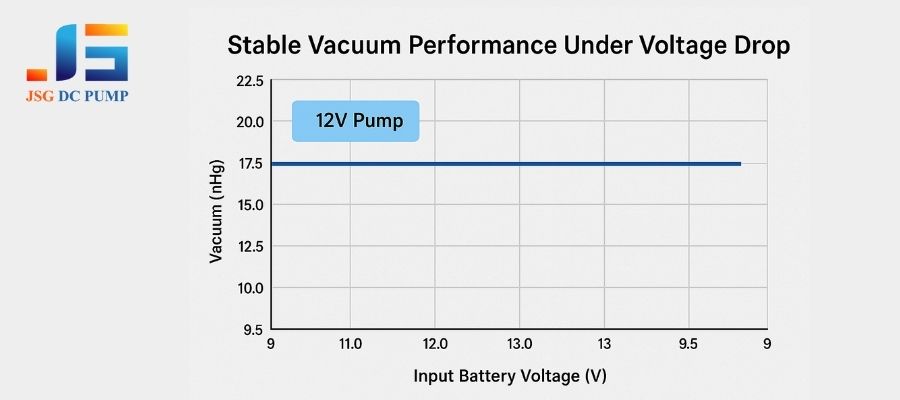
This is a critical point for real-world reliability. A lithium-ion battery is not a static 12V source; its voltage sags under load and drops as it discharges. A well-designed 12V pump accounts for this, ensuring consistent performance from a full charge down to the last few percent of battery life.
Hallmarks of 12V Vacuum Stability
- Wide Operating Voltage Range: Functions reliably even when the battery voltage sags under load or nears depletion.
- Consistent Torque Delivery: The motor is wound to provide sufficient torque even at the lower end of the voltage range.
- Rapid Vacuum Recovery: Quickly re-establishes the target vacuum after a valve is opened or a new cycle begins.
- Effective Leak Compensation: Has enough power in reserve to overcome minor system leaks without a noticeable drop in performance.
Why Are 12V Electric Vacuum Pumps Better for Low-Noise and Low-Vibration Mobile Applications?
Your portable medical device is failing acoustic testing. The noise and vibration from the vacuum pump are exceeding limits and creating a poor user experience for both patients and clinicians.
12V pumps, especially brushless models, offer significant acoustic advantages. Their smooth operation and the ability to be precisely controlled via PWM allow engineers to minimize mechanical resonance and tune the pump’s speed to an optimal point, drastically reducing noise and vibration.
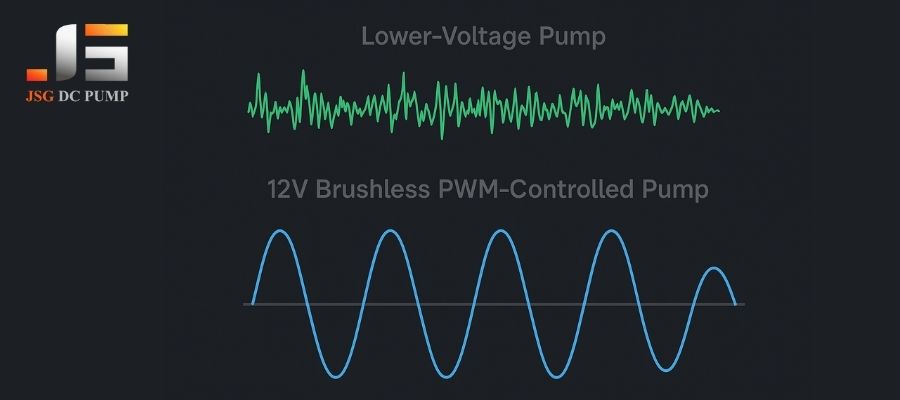
In applications like patient monitoring or handheld diagnostic tools, noise is a critical design specification. The 12V platform excels here. By using a PWM signal, we can avoid running the pump at its full, and often loudest, speed.
How 12V Pumps Reduce Noise and Vibration
| Method | Description | Benefit |
|---|---|---|
| PWM Speed Control | Allows the pump to be run at the slowest possible speed for the required task. | Lower speed equals lower noise and vibration. |
| Resonance Avoidance | The speed can be “tuned” to avoid frequencies that cause a device’s chassis to resonate and amplify noise. | Leads to a significantly quieter end product. |
| Brushless Motor Tech | Eliminates the mechanical friction and electrical arcing noise of carbon brushes. | Provides the lowest possible noise floor for the pump itself. |
JSG DC PUMP: Your Partner for 12V Electric Vacuum Pump Solutions
You need a reliable 12V vacuum pump, but you also need expert support to ensure you choose the right one. Partnering with a non-specialist supplier can lead to integration problems and project delays.
Established in 2003, JSG DC PUMP specializes in 12V micro vacuum pump solutions for OEM applications. We offer oil-free designs, long service life, and stable performance in a compact structure, making us a reliable partner for product development and system integration.
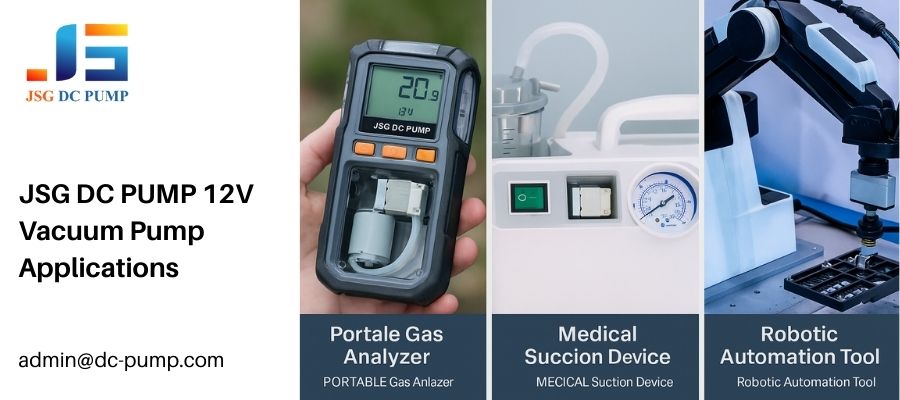
We are experts in micro pumps. Our focus is providing robust solutions for OEM engineers building portable analyzers, medical suction devices, and automated tools.
- Oil-Free Operation: Prevents sample contamination and ensures clean air delivery.
- Extended Service Life: Brushless models offer over 10,000 hours of reliable operation.
- Stable & Reliable Performance: Consistent vacuum and flow across the battery’s entire discharge cycle.
- Compact & Lightweight Structure: Designed for tight integration into portable and handheld devices.
Recommended 12V Models from Our Portfolio:
| Pump Category | Key Features | Ideal For |
|---|---|---|
| High-Vacuum Compact Type | Small footprint, deep vacuum (-85 kPa), low power consumption. | Handheld gas detectors, medical diagnostic tools, atmospheric samplers. |
| High-Flow 12V Vacuum Pump | >20 L/min flow, rapid evacuation, robust construction. | Medical aspirators, automated pick-and-place, vacuum packaging. |
| Brushless 12V Vacuum Pump | >10,000-hour lifespan, PWM speed control, very low noise/vibration. | 24/7 continuous duty medical devices, lab instruments, critical applications. |
What Should OEM Engineers Focus on When Selecting a 12V Electric Vacuum Pump?
You’re ready to select a 12V pump, but you want to be sure you don’t miss any critical details. Overlooking a key parameter now could lead to performance issues in your final product.
To make the right choice, you must create a selection checklist. This ensures you systematically evaluate a pump’s performance under real-world battery load, consider motor type, verify control compatibility, and match its life expectancy to your product’s reliability targets.
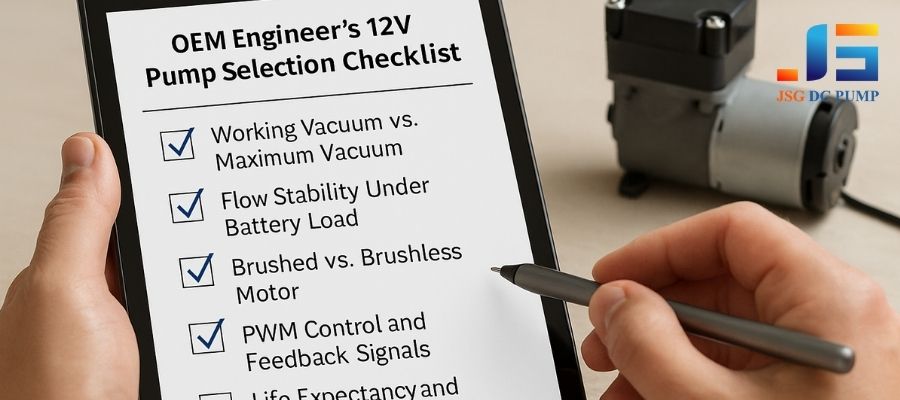
After thousands of customer consultations, I’ve refined the selection process into this simple but effective checklist. Use it when you review any datasheet for a 12V pump.
12V Pump Selection Checklist:
- Working Vacuum vs. Maximum Vacuum:
- Define your required working vacuum.
- Check the P-Q curve for adequate flow at that specific point.
- Flow Stability Under Battery Load:
- Confirm performance as voltage drops from full charge (e.g., 14V) to cutoff (e.g., 9V).
- Brushed vs. Brushless Motor:
- Brushed: For intermittent use or cost-sensitive projects.
- Brushless: For long life, continuous duty, low noise, or precise control.
- PWM Control and Feedback Signals:
- Does your controller require a PWM input for speed control?
- Do you need an FG (tachometer) signal for speed monitoring?
- Life Expectancy and Reliability Targets:
- Match the pump’s rated lifespan (hours) to your product’s service life and duty cycle.
Conclusion
Choosing a 12V electric pump is a strategic design decision. It simplifies integration, boosts efficiency, and enables the compact, reliable, and quiet mobile devices that today’s markets demand. By following a systematic selection process, you can ensure your product’s success.
Ready to Select the Right 12V Vacuum Pump for Your Project?
JSG DC PUMP specializes in high-performance 12V electric vacuum pump solutions for OEM and industrial applications, including portable gas analyzers, medical suction devices, and automated equipment. With manufacturing experience dating back to 2003, we provide:
-
Stable vacuum and flow performance
-
Long-life brushed and brushless options
-
PWM speed control and feedback signal support
-
Compact OEM-ready designs with full customization support
📧 Contact our engineering team: admin@dc-pump.com
Our engineers are ready to help you select, test, and customize the optimal 12V vacuum pump for your system.
