


Your new dc diaphragm pump matches the specs perfectly, but it’s failing in your device. Now your project is delayed, and you have no idea why you can’t trust the numbers.
Buyers fail because datasheets represent ideal lab conditions, not real-world system resistance, thermal stress, or manufacturing inconsistencies. True reliability comes from evaluating the pump within your actual application, considering materials, system design, and the manufacturer’s quality control.
Drawing on JSG DC PUMP’s micro pump engineering and application experience dating back to 2003, we have seen this situation occur repeatedly. An OEM buyer selects a pump based on promising datasheet values for maximum flow or maximum vacuum, but the pump later performs poorly after being integrated into the actual device. The datasheet may not be incorrect, but it often does not reflect tubing resistance, filters, valves, leakage, working pressure, temperature, voltage variation, and duty cycle. This article explains the hidden factors that standard specifications may not fully reveal.
Why Do Datasheet Numbers Create a False Sense of Security for Global Buyers?
You found a pump with a datasheet that promises 10 L/min flow and -80 kPa vacuum. It seems perfect. But after integration, you’re only getting 4 L/min at -50 kPa, and your project stalls.
Datasheet values are measured in a perfect, zero-resistance lab environment. These “max” ratings are not simultaneous and don’t account for your system’s load, operating temperature, or tubing resistance, creating a dangerously misleading picture of real-world performance.
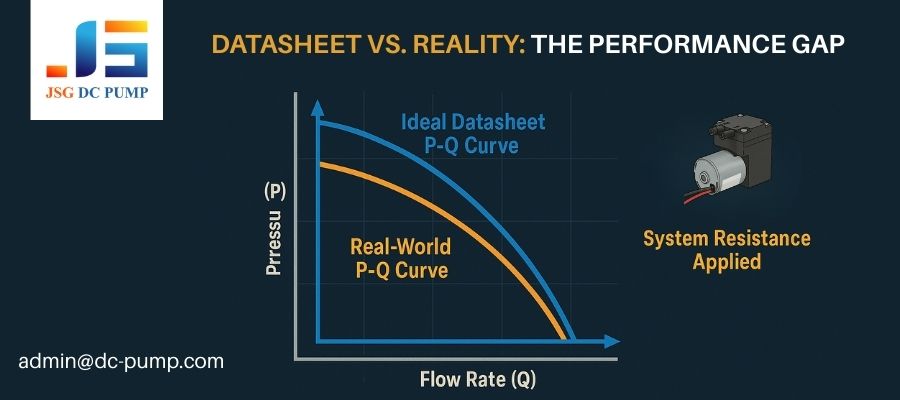
Think of a datasheet as a car’s top speed. It’s a number achievable only on a special track under perfect conditions. It tells you nothing about how the car will perform in city traffic, up a steep hill, or with a full load of passengers. The same is true for a pump. The maximum flow is measured with zero vacuum or back pressure, and the maximum vacuum is measured at zero flow. Your application operates somewhere in the middle, in the “real world,” where conditions are far from ideal.
Lab Conditions vs. Real-World Application
| Parameter | Datasheet (Lab) Condition | Real-World Condition |
|---|---|---|
| Flow | Measured with open inlet/outlet (zero resistance). | Restricted by filters, valves, and long, narrow tubes. |
| Vacuum | Measured with a blocked inlet (zero flow). | Must work against leaks and system volume. |
| Temperature | Tested at a stable ambient temp (e.g., 25°C). | Operates in a hot, enclosed space, altering performance. |
| Voltage | Powered by a stable, clean lab power supply. | Receives fluctuating voltage from a battery or noisy SMPS. |
How Does System Back Pressure and Tubing Design Quietly Destroy DC Diaphragm Pump Performance?
Your pump is powerful when tested on the bench. But once it’s connected to your device’s network of tubes and filters, the performance dies. You’re left wondering where all the power went.
System resistance from tubing, filters, valves, and fittings creates back pressure that forces the pump to work much harder. Every component you add pushes the pump’s operating point away from the ideal datasheet values, drastically reducing its effective flow and vacuum.
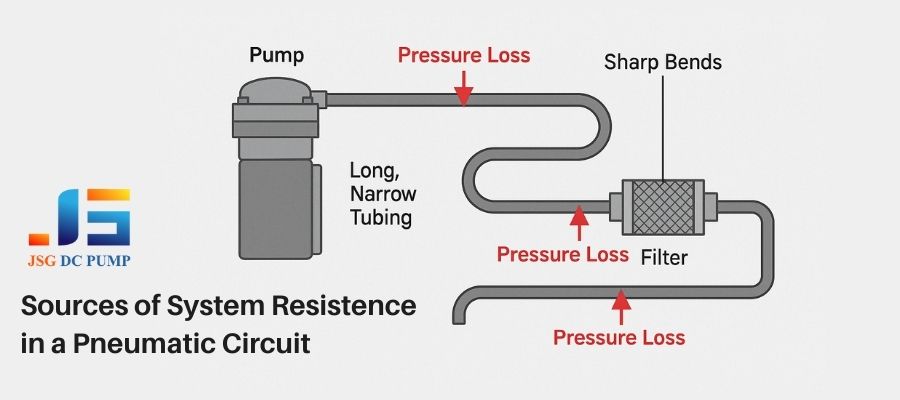
I always tell my clients that the system is just as important as the pump. You can have the best pump in the world, but if you connect it to poorly designed plumbing, you will get poor performance. It’s like trying to breathe through a long, thin straw. The main culprits are often overlooked in the early design stages, but they have a massive impact on the final outcome. Understanding these factors is the first step to designing a system that works with your pump, not against it.
Common Sources of Performance-Killing Resistance:
- Tubing Length: The longer the tube, the higher the frictional losses.
- Tubing Diameter: A small reduction in diameter dramatically increases resistance (Poiseuille’s law).
- Filters & Check Valves: Each component adds a fixed pressure drop that the pump must overcome.
- Sharp Bends & Fittings: 90-degree elbows and T-fittings create turbulence and restrict flow far more than gentle curves.
- System Leaks: Even a tiny leak forces the pump to work continuously just to maintain vacuum, robbing it of useful performance.
Why Does “Same Specifications” Never Mean “Same Manufacturing Quality”?
You’re comparing two pumps with identical specs and one is much cheaper. It seems like an easy decision. But the cheaper pump fails in three months, while the other runs for years.
The datasheet never shows the quality of the materials inside. Critical differences in diaphragm rubber, valve elasticity, motor bearings, and machining tolerances determine a pump’s reliability and lifespan, and these are the first things to be compromised to lower the price.
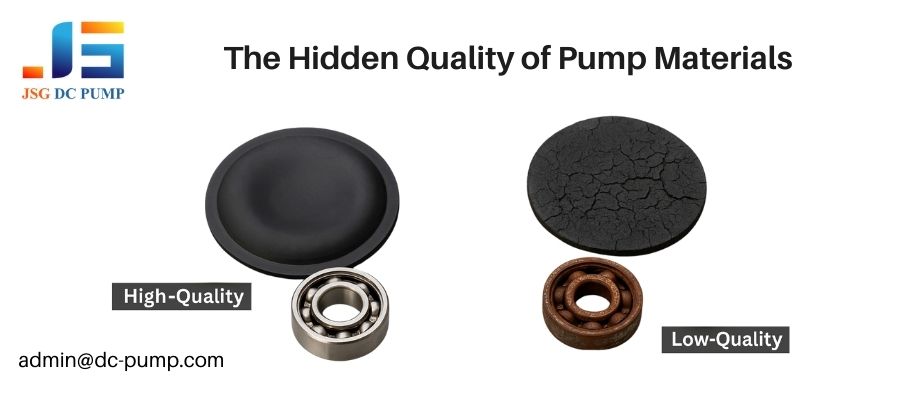
This is the most common trap I see buyers fall into. They assume that if the performance numbers match, the pumps are the same. But the reality is that long-term reliability is determined by what’s inside. A premium EPDM diaphragm will endure millions of cycles, while a cheap one will crack. High-quality valves will seal perfectly every time, while low-quality ones will leak. These are details you can’t see on a spec sheet, but they are the difference between a successful product and a field full of failures.
Micro Pumps Internal Quality: High-End vs. Low-End
| Component | High-Quality Manufacturer (e.g., JSG DC PUMP) | Low-Cost Manufacturer |
|---|---|---|
| Diaphragm | Premium EPDM/FKM rubber, engineered for flex life. | Low-grade recycled rubber, prone to hardening and cracking. |
| Valves | High-elasticity imported rubber, precise molding. | Inconsistent material, poor sealing, prone to sticking. |
| Motor Bearings | Shielded, brand-name ball bearings with high-temp grease. | Cheap, unsealed sleeve bearings that wear out quickly. |
| Machining | Tight tolerances (e.g., ±0.05mm) for consistent performance. | Loose tolerances, leading to batch-to-batch variation. |
How Do Thermal Accumulation and Duty Cycle Collapse the Theoretical Lifespan?
Your pump is rated for 5,000 hours, but it’s failing at just 1,000 hours in the field. The pump runs fine in your open-air lab test, but not inside your product’s compact enclosure.
A pump’s lifespan is rated under ideal thermal conditions and a specific duty cycle. Heat buildup from continuous operation or poor ventilation inside an enclosure accelerates material aging and lubricant breakdown, causing premature failure long before the datasheet lifespan is reached.
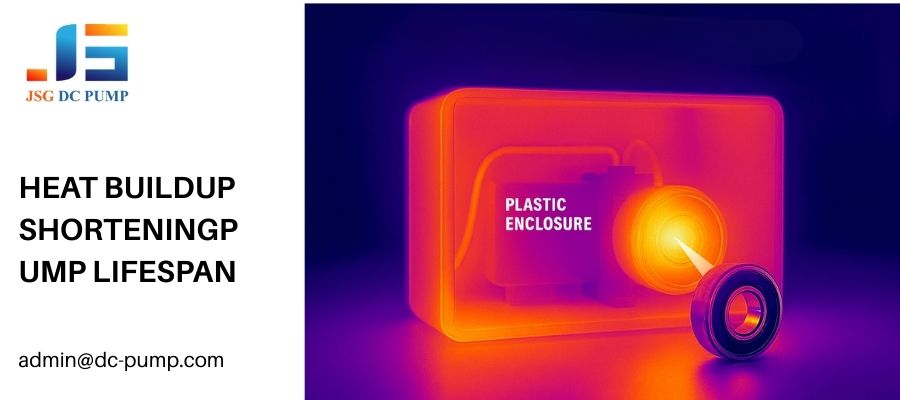
Heat is the number one enemy of mechanical and electrical components. The motor generates heat, and the flexing diaphragm generates heat. In an open-air test, this heat dissipates easily. But when you seal that pump inside a small plastic box with other heat-generating electronics, the temperature rises dramatically. This elevated temperature can be the single biggest factor in reducing the pump’s actual service life. The lifespan on the datasheet is not a guarantee; it’s a benchmark achieved under very specific, controlled conditions that rarely exist in the real world.
Factors That Accelerate Aging:
- Continuous Operation (100% Duty Cycle): Never allowing the pump motor to cool down.
- Poor Ventilation: No airflow within the product enclosure to carry heat away.
- High Ambient Temperature: Operating the device in a hot environment adds to the thermal load.
- High System Load: The harder the pump works against resistance, the more heat it generates.
Why Is Media Compatibility the Most Underestimated DC Diaphragm Pumps Risk?
Your pump worked perfectly with dry air. But when deployed in a humid environment or used with chemical vapors, the diaphragm swells, the valves stick, and the pump fails catastrophically.
The standard materials in a pump (like NBR or EPDM rubber) are not universally compatible with all media. Humidity, corrosive gases, solvents, and ozone can cause chemical reactions that degrade the diaphragm and valves, leading to failure that has nothing to do with mechanical wear.
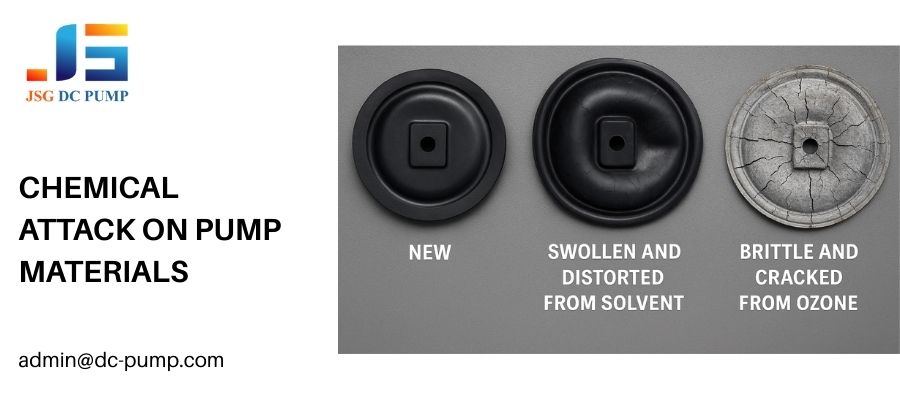
This is a silent killer. An engineer might perform a 1,000-hour life test with clean, dry air and approve the pump. But the end customer uses it to sample industrial exhaust gas or in a coastal, high-humidity environment. Suddenly, you have mass failures in the field. It’s absolutely critical to identify every chemical, gas, and vapor the pump will be exposed to and select materials, like FKM or a custom-coated diaphragm, that can withstand them. Assuming “air” is just “air” is a dangerous oversimplification.
Common Media Compatibility Issues
| Media Type | Potential Problem | Recommended Material |
|---|---|---|
| High Humidity / Water Vapor | Can cause swelling in some rubber compounds. | EPDM |
| Ozone (O₃) | Quickly cracks standard rubber like NBR. | EPDM or FKM |
| Solvents / Hydrocarbons | Causes severe swelling and degradation of most rubbers. | FKM (Viton®) |
| Acids / Corrosive Gases | Leads to chemical attack and material breakdown. | FFKM or specialized coatings. |
Why Professional OEMs Choose JSG DC PUMP as a Long-Term Micro Diaphragm Pump Manufacturing Partner in China
You’re tired of the risks and uncertainty. You need more than a component supplier; you need a manufacturing partner in China who understands these hidden failure modes and can help you navigate them.
Professional OEMs choose JSG DC PUMP because we are an engineering-driven manufacturer. We focus on providing reliable, customized solutions that account for real-world conditions, not just ideal datasheet specs. We act as your expert partner from prototype to mass production.
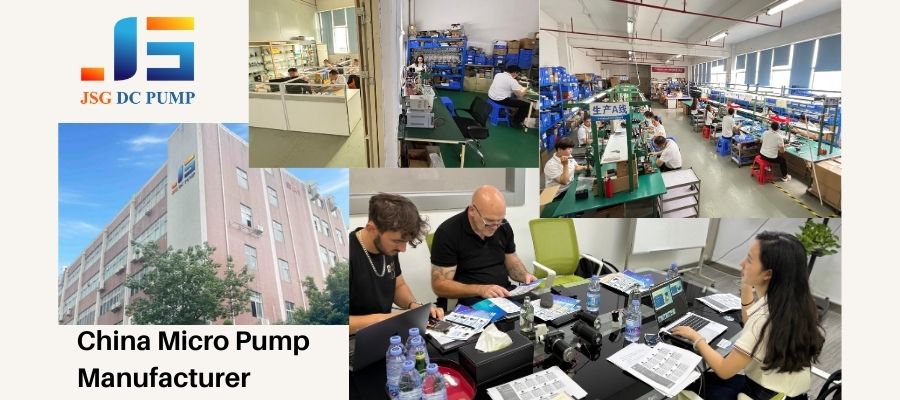
Established in 2003, JSG DC PUMP has built its reputation by addressing the application factors that datasheets often omit. We do not simply supply pumps; we help solve integration problems. Our process begins by confirming your application, system resistance, duty cycle, thermal conditions, and working medium. We then use our experience in materials and manufacturing to recommend or customize a pump for the actual operating conditions and required service-life target. This engineering-focused approach supports OEM customers in medical, automotive, and instrumentation applications.
The JSG DC PUMP Advantage: Beyond the Datasheet
| Our Process | How It Solves Your Problem |
|---|---|
| Engineering-Driven Design | We analyze your system to recommend a pump that works under your real load, not just ideal conditions. |
| Media Compatibility Verification | We help you select the right diaphragm and valve materials (EPDM, FKM, etc.) to prevent chemical degradation. |
| Load-Based Life Testing | We test our pumps under loads that simulate your application to provide a realistic lifespan estimate. |
| Batch Aging & QC Control | We implement strict process controls and aging tests to ensure the 10,000th pump is as good as the first sample. |
| Full Project Support | Our global support team works with you from initial prototype builds all the way to stable mass production. |
Conclusion
Evaluating a DC diaphragm pump by its datasheet alone is a recipe for failure. To succeed, you must look beyond the numbers to the manufacturer’s quality, testing methods, and engineering support. Partnering with an expert ensures your product’s long-term reliability and success.
