

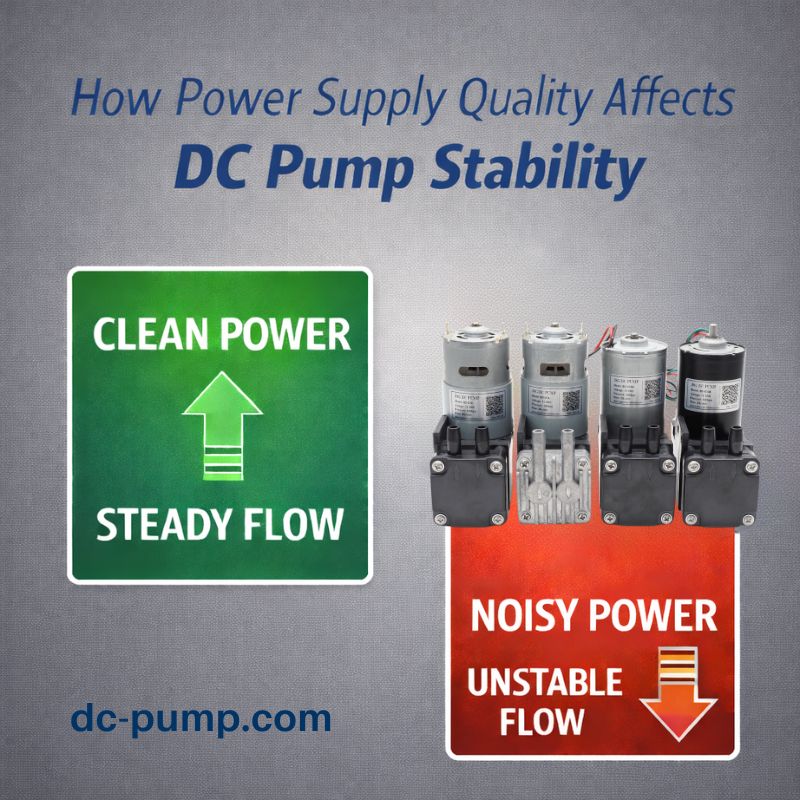
Your small DC pump’s performance is all over the place. The flow rate is inconsistent, and you suspect the pump is faulty. But what if the problem is hiding in plain sight, in the power you’re feeding it?
Poor power supply quality is a hidden risk that causes instability in pump speed, flow, and vacuum. Engineers often overlook issues like voltage ripple, noise, and insufficient current, mistakenly blaming the pump itself for performance problems.
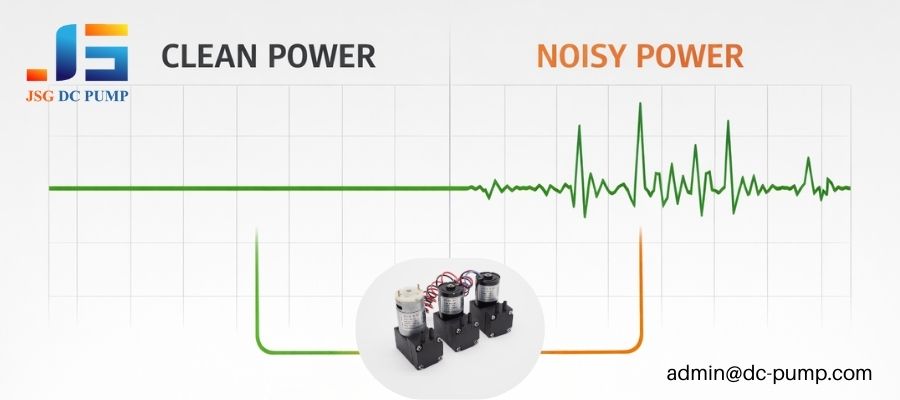
As an engineer at JSG DC PUMP, I’ve seen this scenario play out countless times. A client will send us a “defective” pump, claiming it’s unstable. We’ll test it in our lab on a high-quality power supply, and it performs perfectly. The problem isn’t the pump; it’s the power. Many engineers focus only on the nominal voltage, like 12V or 24V, and assume that as long as the multimeter reads correctly, the power is fine. But a pump’s motor is a dynamic, demanding load. It’s sensitive to fluctuations your multimeter can’t see. Let’s dig into what “power supply quality” really means and how it directly impacts your system’s stability.
What Does “Power Supply Quality” Really Mean for a Small DC Pump?
You’ve confirmed your power supply outputs 12V, yet the pump connected to it acts erratically. It seems “12V” means different things, but you’re not sure what to look for beyond that number.
Power supply quality refers to the stability and cleanliness of its output, not just its voltage accuracy. It includes low ripple, minimal noise, and the ability to handle sudden current demands without voltage sags or transient drops.
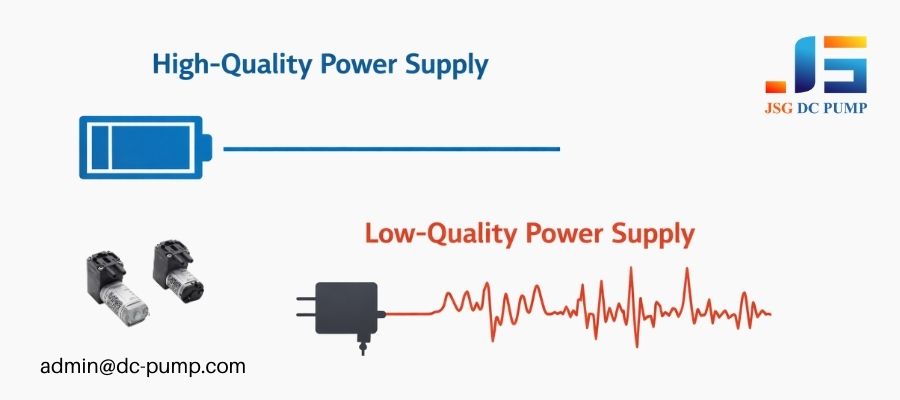
When we talk about power quality for a motor, we’re looking at its dynamic behavior. A small DC pump isn’t a simple resistor; its current draw changes instantly as its load changes or as it starts up. A high-quality power supply must maintain a stable voltage even under these stressful conditions. It’s the difference between a calm lake and a choppy sea. Your system needs that calm lake to function predictably.
Key Aspects of Power Supply Quality
| Parameter | What It Means in Practice | Impact on Pump |
|---|---|---|
| Voltage Accuracy | How close the output is to the nominal value (e.g., 12.0V). | Affects the baseline speed. |
| Voltage Stability | How well the output voltage rejects drops under load. | Prevents speed sags when the pump works harder. |
| Ripple & Noise | Small, high-frequency AC variations on the DC output. | Causes speed jitter, vibration, and flow instability. |
| Transient Response | How quickly the supply recovers from a sudden current draw. | Determines if the pump can start reliably without stalling. |
How Voltage Fluctuation Directly Impacts Small DC Pump Speed and Output?
You notice tiny fluctuations on your power line, only a few millivolts. You assume they’re harmless, but the pump’s flow rate seems to be bouncing around much more than that.
Even minor voltage fluctuations directly cause changes in a DC pump’s motor speed. This speed variation is then amplified into larger, more noticeable instabilities in flow rate or vacuum pressure, especially in sensitive applications.
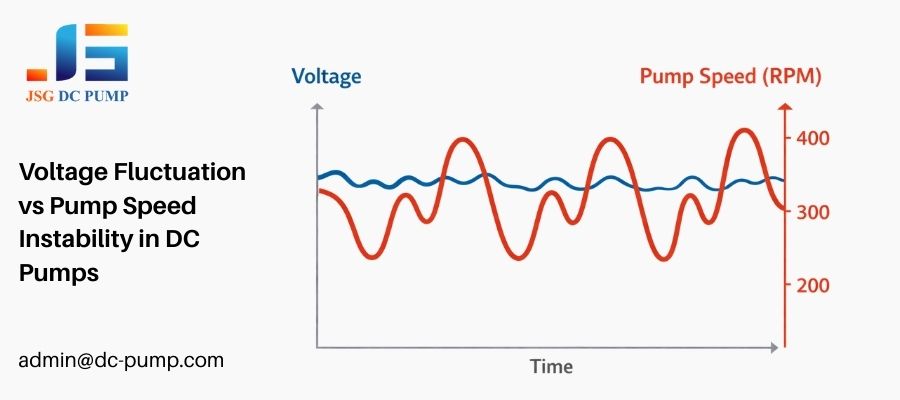
The relationship between voltage and the speed of a simple brushed DC motor is mostly linear. More volts mean more RPMs. This seems straightforward, but it also means that any instability in the voltage supply translates directly into an instability in motor speed. A 1% voltage ripple doesn’t just stay a 1% issue. In a system trying to maintain a precise pressure in a closed volume, this tiny speed jitter can lead to a significant pressure oscillation. The effect is different depending on the system. In an open-loop system just moving air, you might only hear a slight change in motor pitch. In a closed-loop medical device maintaining a specific vacuum level, the same voltage ripple could trigger system alarms.
System Response to Voltage Fluctuation
- Open Systems (e.g., cooling fan): Small speed changes might be acceptable and result only in slightly variable airflow.
- Closed Systems (e.g., pressure cuff): Small speed jitters can cause noticeable pressure oscillations, potentially leading to inaccurate sensor readings or control loop instability.
Why Current Capability Matters More Than Nominal Voltage?
Your 12V, 500mA adapter should be enough for your 12V, 300mA pump, but the pump struggles to start. You are confused because the specs seem to match with a comfortable margin.
A pump’s startup current can be 3 to 8 times its continuous running current. If the power supply cannot provide this brief, high peak current, the pump will fail to start or stall under load, even if the nominal voltage is correct.
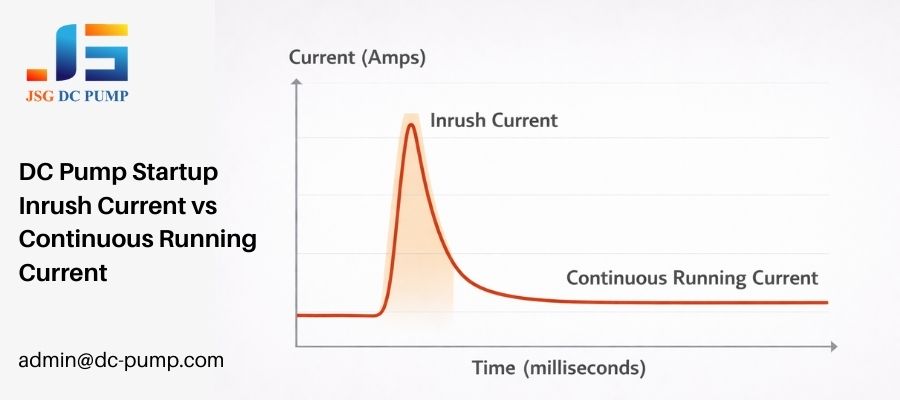
This is one of the most common issues I help engineers troubleshoot. They look at the pump’s datasheet, see “Rated Current: 300mA,” and pair it with a 500mA power supply, thinking they have plenty of headroom. But they’re looking at the wrong number. The critical value for getting a motor moving from a standstill is the startup (or inrush) current. This initial surge of current is needed to overcome inertia and friction. A cheap, small power adapter often has a strict current limit. When the pump tries to draw its high startup current, the adapter’s protection circuit kicks in, dropping the voltage and causing the pump to stall. A good industrial power supply, however, is designed to handle these momentary peaks without flinching.
Understanding Pump Current Demands
| Current Type | Description | Why It Matters |
|---|---|---|
| Startup Current | The high, brief peak current drawn at the moment of power-on. | Must be supplied by the source for the pump to start reliably. |
| Peak Current | The current drawn under maximum load conditions. | The supply must handle this to prevent stalling under stress. |
| Continuous Current | The average current drawn during normal, steady operation. | Used for calculating overall power consumption and thermal load. |
How Power Ripple and Electrical Noise Create Flow Instability?
Your pump system has a constant, low-level “hum” or vibration. The flow rate isn’t wildly unstable, but it’s not perfectly smooth either, and you need higher precision.
Power supply ripple and noise superimpose an AC signal onto the DC supply. The pump’s motor interprets this as a rapidly fluctuating voltage, causing speed jitter. This micro-vibration translates into unstable flow and can increase audible noise.
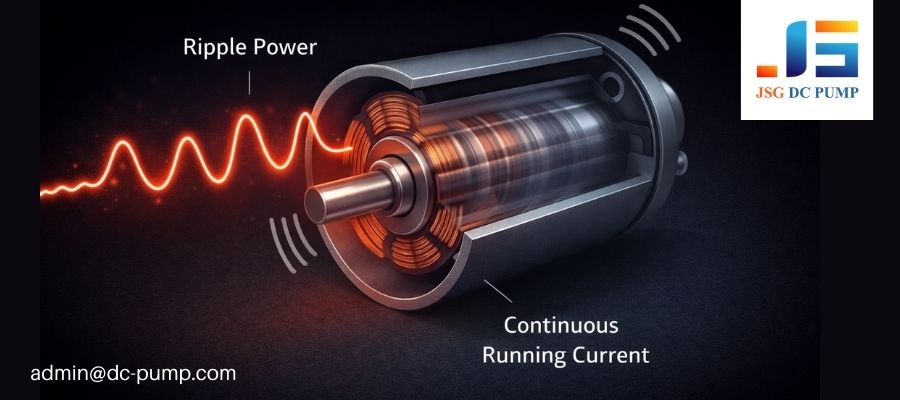
Think of ripple as a small, rapid “wobble” in your power supply’s voltage. A typical switching power supply creates this by its very nature of switching on and off at high frequencies. While the average voltage might be a perfect 12.0V, it’s actually oscillating between, for example, 11.95V and 12.05V thousands of times per second. The pump’s motor tries to follow this wobble, resulting in tiny accelerations and decelerations. You might not see it, but you can often hear it as a high-pitched whine. This is a classic example of the pump being both a victim of noise from the power supply and a source of noise itself through its own commutation process. In precision fluidic systems, this ripple-induced jitter is unacceptable.
Battery Power vs Switching Power Supply: Why Behavior Changes?
Your battery-powered prototype works beautifully smooth and quiet. But the production version, running on a wall adapter, is noisier and less stable. It’s the same pump, so what changed?
A battery provides nearly perfect, ripple-free DC power, which allows a pump to run very smoothly. A switching power supply, in contrast, introduces ripple and noise that can make the same pump’s performance less stable and noisier.
This is a classic “lab vs. field” problem. Engineers often prototype on benchtop power supplies or batteries, which are electrically very “clean.” They are then surprised when the final product, using a cost-effective AC-DC switching adapter, behaves differently. A battery’s chemical process produces a naturally smooth DC voltage. Most wall adapters, however, are switching power supplies that convert AC to DC by switching transistors at high speeds, which is efficient but inherently noisy. If your system requires the smoothness of battery power but must run from an outlet, you may need to add extra filtering (like capacitors) after the power adapter or specify a higher-quality, low-noise power supply. Using DC-DC converters in battery systems can also re-introduce this switching noise, so quality matters there too.
How Poor Grounding and Wiring Layout Amplify Power Issues?
You’ve selected a high-quality power supply and a reliable pump. Yet, in your compact device, you still see instability and noise. Your wiring might be the culprit.
Poor wiring and grounding act like hidden resistors, causing voltage to drop before it even reaches the pump. A long, thin ground wire can also create ground bounce, disrupting control signals and making power issues much worse.
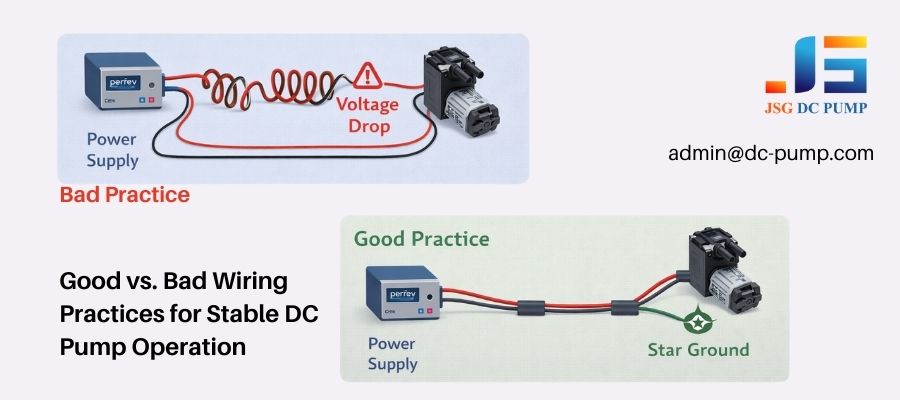
Power doesn’t magically teleport from the supply to the pump. It has to travel through wires, and those wires have resistance and inductance. The longer and thinner the wire, the more voltage is lost along the way. I once had a client whose 24V supply was only delivering 22V at the pump terminals because they used 2 meters of thin-gauge wire. This voltage drop gets worse when the pump draws more current, causing a “soft” or “spongy” power delivery. Furthermore, if the high-current pump shares a long ground wire with a sensitive microcontroller, the pump’s current can cause the ground voltage itself to shift, corrupting sensor readings and creating chaos for your control logic.
Common OEM Wiring Mistakes
- Wires are too thin: Causes significant voltage drop under load.
- Wires are too long: Increases both resistance and inductance, worsening voltage drop and transient response.
- Shared ground return: The pump’s noisy current corrupts the ground reference for control circuits.
How Power Supply Instability Accelerates Pump Aging and Failure?
Your pumps are failing in the field much earlier than their rated lifespan. You’ve checked for overuse and contamination, but the cause is unclear. The problem could be your power supply.
Unstable power, especially with high ripple or frequent voltage sags, forces the pump’s motor to constantly adjust, creating excess heat and mechanical stress. This accelerates wear on brushes and bearings, leading to premature failure.
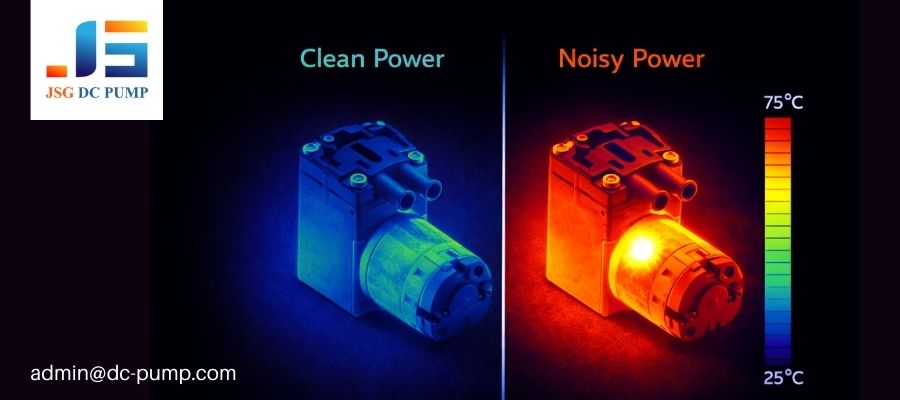
A pump motor is designed to run smoothly at a stable voltage. When you feed it “dirty” power, the internal components are put under constant stress. The voltage ripple causes the motor windings to heat up more than they should, which can degrade the insulation over time. For brushed DC pumps, voltage instability can increase the intensity of the electrical arcing between the brushes and the commutator. This extra sparking literally eats away at the brushes, drastically shortening the pump’s operational life. Just because the pump is spinning doesn’t mean it’s running healthily. Providing stable power is essential for reaching the full lifespan specified on the datasheet.
What Practical Engineering Solutions Improve Small DC Pump Stability?
You’ve diagnosed that your power supply is the root cause of the instability. What are the most effective and practical steps you can take to fix it and stabilize your system?
To improve stability, start by selecting a power supply with 2-3 times the pump’s rated current. Then, add a large electrolytic and a small ceramic capacitor in parallel near the pump’s terminals to filter noise and supply transient current.
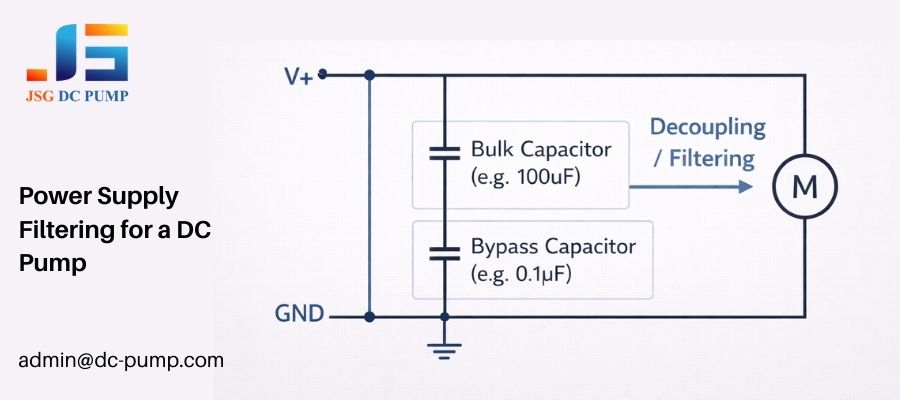
Solving power supply issues is a systematic process. The first and most important step is choosing the right power supply. Don’t just match the voltage and current; provide a generous current margin to handle startup and peak loads. An industrial-grade power supply will almost always outperform a cheap consumer adapter. If changing the supply isn’t an option, add your own filtering. A large bulk electrolytic capacitor (e.g., 100µF – 470µF) acts as a local reservoir of energy to handle the pump’s sudden current demands. A small ceramic capacitor (0.1µF) placed right next to it will filter out high-frequency noise. If ultimate stability is needed, consider switching to a brushless (BLDC) motor or implementing a closed-loop control system with speed feedback, which can compensate for power fluctuations.
What OEM Engineers Should Verify Before Blaming the Pump?
You have an unstable pump, and your first instinct is to call the pump supplier to complain. Before you do, what simple checks can you perform to ensure the problem isn’t in your own system?
Before blaming the pump, verify the power supply’s stability under load with an oscilloscope. Check the voltage directly at the pump’s terminals, not at the power supply, to account for any voltage drop in the wiring.
As pump manufacturers, we want to help you solve your problem as quickly as possible. Helping us by running a few simple checks first can save everyone a lot of time. The single most valuable test is to measure the voltage at the pump while it is running and starting up. A multimeter can show you the average voltage, but an oscilloscope is much better as it will reveal any ripple, noise, or voltage sag during startup. If you see the voltage drop by more than 10% when the pump starts, your power supply or wiring is likely the issue.
Quick Troubleshooting Checklist
- Power Supply: Is its current rating at least 3x the pump’s continuous current rating?
- Wiring: Are the wires short and thick enough? Measure voltage at the pump vs. at the supply.
- Load: Is the pump working against an unexpectedly high pressure or restriction?
- Control: If using PWM, is the frequency appropriate? Is the driving transistor adequate?
- Test: Try running the pump from a different, high-quality source, like a car battery or a lab bench supply. If the problem disappears, you’ve found your culprit.
Conclusion
A truly stable and reliable DC pump system begins with a stable power source. Focusing only on the pump itself is a common mistake that can lead to endless troubleshooting and unreliable products.
To achieve true system stability, engineers must shift their thinking from simple “pump selection” to holistic “system design,” where the power supply and control architecture are given just as much importance as the pump itself.
At JSG DC PUMP, we encourage OEMs to consider the entire power delivery system from the earliest stages of design. This proactive approach ensures that our high-quality pumps can deliver their full performance and reliability in your application.
Looking to stabilize your DC pump system or validate your power supply design?
📩 Contact our engineering team at admin@dc-pump.com to discuss your application and receive professional OEM support.
