You know a brushless pump is the right technology, but staring at datasheets feels like a guessing game. Choosing the wrong pump can doom your design with poor performance, noise issues, or premature failure.
To select the right brushless pump, you must go beyond maximum ratings. The key is to match your application’s working vacuum and flow requirements to the pump’s P-Q performance curve, while also considering motor control, system resistance, and lifetime expectations.

As an engineer at JSG DC PUMP, I’ve seen countless projects succeed or fail based on this one decision. The most common pitfall is choosing a pump based on a single “max vacuum” number on a datasheet. That’s like picking an engine based only on its redline RPM. It tells you nothing about the torque, power curve, or efficiency where you actually need it to work. True success comes from a systematic approach. Let’s walk through the exact process I use to guide engineers to the perfect pump for their application.
What Is a Brushless Vacuum Pump and Why Do Engineers Prefer It?
Your device requires reliable, long-term operation, but traditional brushed pumps wear out, creating field failures and unhappy customers. They’re noisy, create electrical interference, and just aren’t built for demanding, continuous use.
A brushless vacuum pump uses a motor with electronic commutation instead of physical brushes, resulting in a dramatically longer lifespan, lower noise, and greater control. Engineers prefer them for their high reliability, stable performance, and suitability for sensitive or mission-critical OEM devices.

The magic of a brushless pump lies in what it lacks: friction and wear from carbon brushes. Instead of a mechanical switch, a small electronic controller switches the motor’s windings. This single change has a massive impact. It eliminates the primary wear component, extending the pump’s operational life from around 2,000 hours to over 10,000 hours. The smoother operation reduces noise and vibration, which is critical in medical and analytical devices. Furthermore, the electronic controller gives us, as engineers, precise command over the pump’s speed using a PWM signal. This high degree of control and reliability is why brushless technology is the standard in demanding industries.
Key Advantages for OEM Devices
- Long Lifetime: With no brushes to wear out, the lifespan is primarily limited by high-quality bearings, often exceeding 10,000 hours.
- Low Noise and Vibration: The smooth, electronic commutation results in significantly quieter and less vibratory operation.
- Stable Vacuum Output: Consistent motor speed provides a very stable and predictable vacuum and flow.
- Advanced Motor Control: Enables precise speed adjustment (PWM) and performance monitoring (FG feedback).
- High Reliability for Continuous Duty: Designed to run 24/7 without the risk of brush failure or performance degradation.
This technology is essential in fields like medical diagnostics, industrial automation, gas analysis, and smart home appliances.
What Performance Parameters Matter Most When Selecting a Brushless Vacuum Pump?
The datasheet is a wall of numbers for vacuum, flow, and pressure. If you focus on the wrong one, you risk choosing a pump that can’t handle your system’s real-world demands, leading to slow performance or an inability to reach the target pressure.
The most important parameters are the flow rate at your required working vacuum (found on the P-Q curve), motor control compatibility (PWM/FG), duty cycle, and noise level. These factors, not just maximum ratings, dictate a pump’s true suitability.

I always advise engineers to skip the headline specs and go straight to the P-Q curve. This graph tells the true story of the pump’s performance. Here’s a breakdown of what you need to analyze.
Vacuum Level: Max Vacuum vs. Working Vacuum
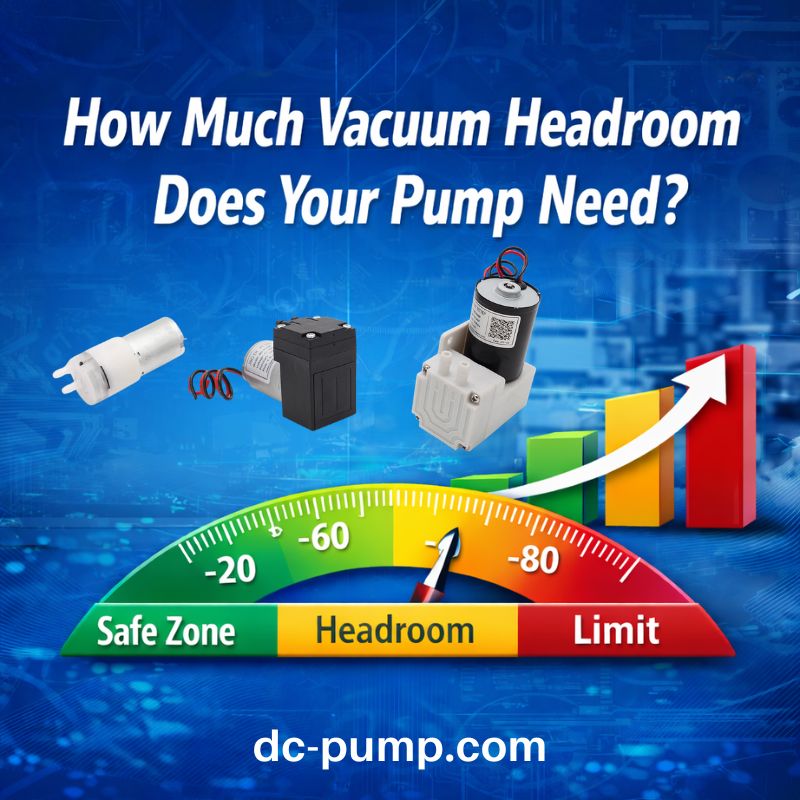
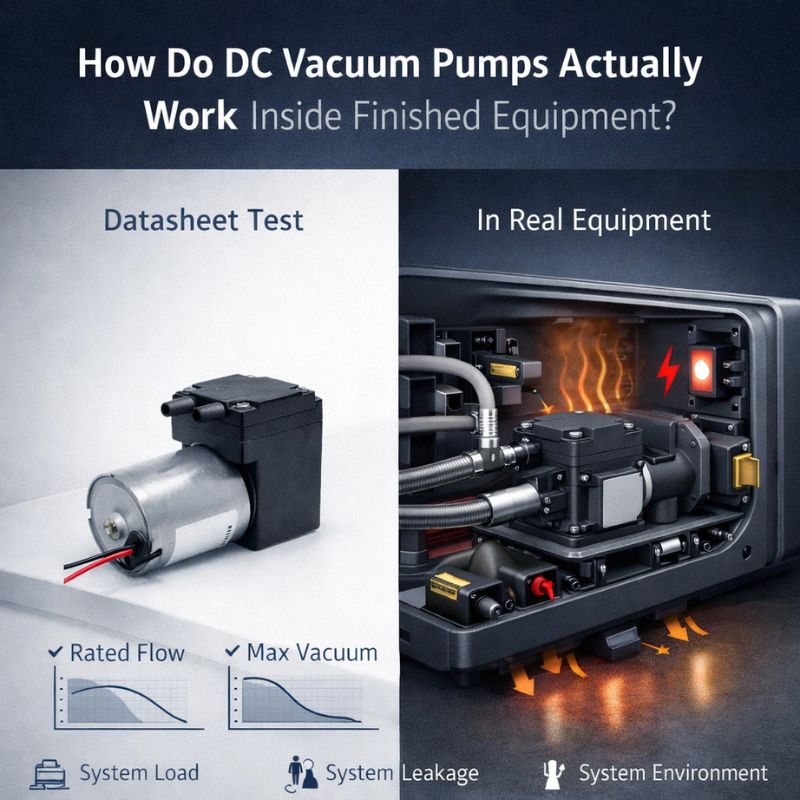
The max vacuum rating is achieved with the inlet completely blocked (zero flow). It’s a useful limit, but your system will never operate there. You must define your working vacuum—the pressure level needed during operation—and use the P-Q curve to see if the pump provides enough flow at that specific point. Always factor in system resistance from tubing and filters, which will make the pump work harder.
Flow Rate Requirements Based on Application
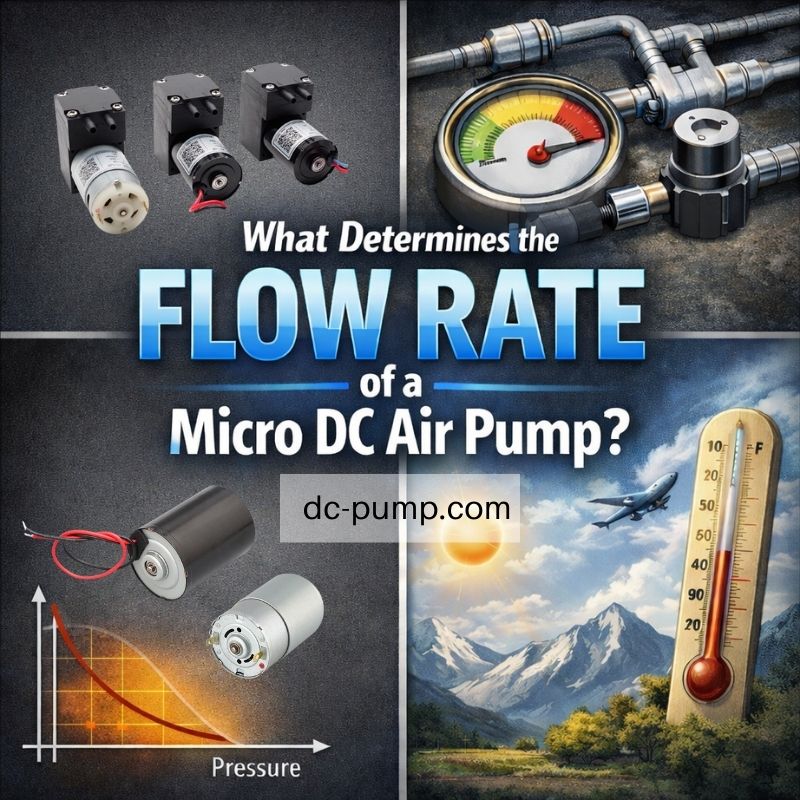
The flow rate determines how fast the pump can evacuate a volume or draw a sample. A gas analyzer needs a low, stable flow (e.g., 1-3 L/min), while a pick-and-place machine in automation needs high flow to generate vacuum quickly. Remember that narrow tubing and fine-micron filters act as restrictions and can significantly reduce the effective flow rate.
Motor Control Options
This is a key benefit of brushless motors.
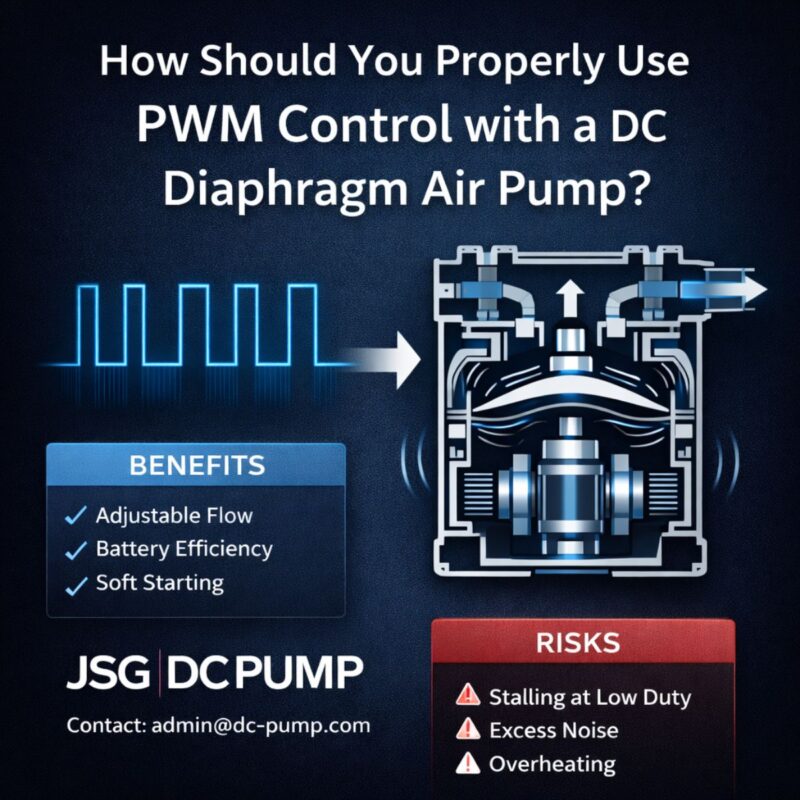
- PWM Speed Control: Allows you to precisely adjust the pump’s speed, saving power, reducing noise, and enabling a closed-loop control system.
- FG (Tachometer) Signal: Provides feedback on the motor’s actual speed, allowing your system to detect stall conditions or confirm proper operation.
Noise and Vibration Levels
In medical or laboratory environments, low noise is critical. Brushless motors are inherently quieter due to the lack of brush friction. Always check the decibel (dB) rating on the datasheet and consider using rubber isolation mounts to dampen any residual vibration.
Duty Cycle and Expected Lifetime
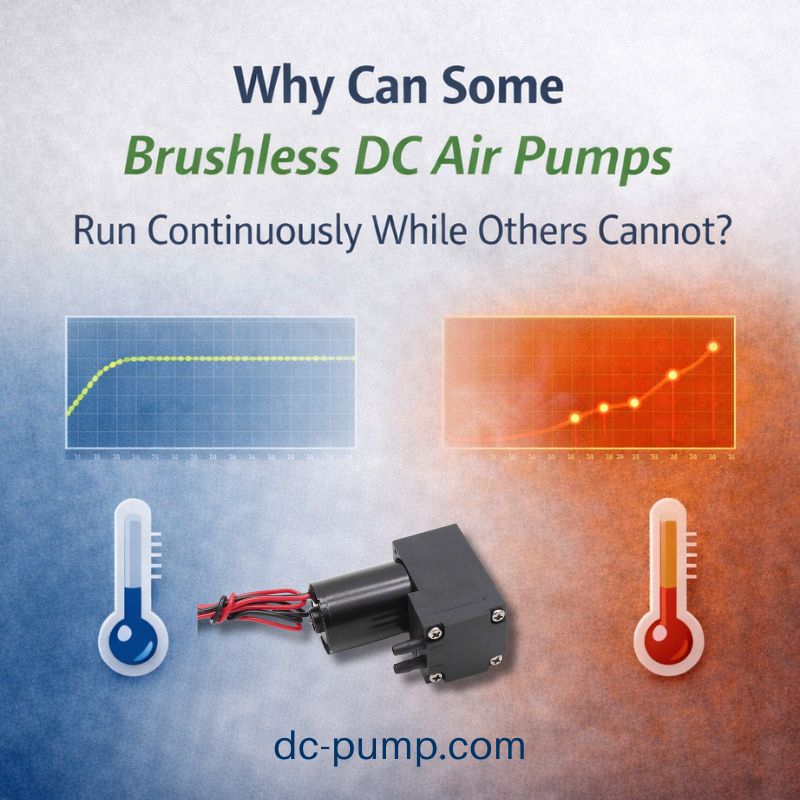
Will your pump run 24/7 or for 1 minute every hour? A pump designed for intermittent duty may overheat and fail under continuous operation. For 24/7 applications, choose a robust model and ensure there is adequate airflow for heat management.
How to Match Your System Requirements with Brushless Pump Specifications?
You’ve defined your system’s needs, but how do you confidently translate that into a specific pump model number? Making a mistake here can mean going back to the drawing board after your prototype fails performance testing.
There is a clear, step-by-step process to ensure a perfect match. It involves methodically defining your needs and comparing them against the pump’s performance data, focusing on real-world conditions rather than ideal specs.

I walk every client through this checklist. It turns a complex decision into a series of simple questions and removes the guesswork. By following these steps in order, you can avoid common pitfalls and select a pump that is not just adequate, but optimal.
- Define Required Working Vacuum and Flow: First, determine the exact vacuum level and flow rate your application needs to function correctly. This is your “operating point.”
- Review the P–Q Curve: Find your operating point on the P-Q curves of potential pumps. Do not select a pump where your point is at the extreme end of the curve. Choose a pump where your point is in the efficient middle range.
- Evaluate Load Conditions: Consider the whole system. How long is your tubing? How restrictive are your filters? This “system resistance” means the pump must be slightly more powerful than your baseline calculations suggest.
- Confirm Electrical Control Requirements: Does your system controller output a PWM signal for speed control? Do you need an FG signal to monitor pump speed? Ensure the pump’s driver is compatible with your electronics.
- Review Environmental Conditions: What is the ambient operating temperature? High temperatures can reduce pump performance and lifespan. Ensure the pump is rated for your environment.
- Evaluate Expected Lifetime and Duty Cycle: Match the pump’s duty cycle rating (intermittent or continuous) to your application’s needs to guarantee long-term reliability.
What Are the Most Common Mistakes Engineers Make When Choosing a Brushless Vacuum Pump?
Your prototype isn’t working. The pump you selected, which looked perfect on paper, can’t provide the stable vacuum you need. You’ve just fallen into one of several common traps that can derail a project.
The most frequent error is selecting a pump based on its maximum vacuum rating instead of its performance at the actual working pressure. Other common mistakes include ignoring system resistance, underestimating noise, or failing to match control signals.

I’ve seen these same mistakes made time and again. They almost always stem from looking at the pump as an isolated component rather than part of a complete system. An engineer will see a “-85 kPa” spec and assume it’s perfect for their -80 kPa requirement, only to find the flow rate at that level is almost zero. Or, they’ll build a beautifully quiet device, then add a pump that sounds like a jet engine because the dB rating was overlooked. By being aware of these pitfalls, you can actively avoid them in your design process.
Top 5 Selection Mistakes to Avoid
- Choosing based on Max Vacuum: Always use the P-Q curve to evaluate performance at your working point.
- Ignoring System Resistance: Long, narrow tubes and filters can kill performance. Model your system’s impedance and select a slightly stronger pump to compensate.
- Underestimating Noise/Vibration: In user-facing devices, NVH (Noise, Vibration, and Harshness) is a critical design feature, not an afterthought.
- Incorrect Tubing or Filter Placement: Placing a restrictive filter on the inlet can starve the pump, severely limiting its vacuum capability.
- Not Evaluating Motor Control Compatibility: Verifying that your controller’s PWM output and the pump’s input requirements (voltage, frequency) match is crucial.
Example JSG Brushless Vacuum Pump Models for Different Applications
Finding the right starting point can be daunting. You need a pump that fits the general scale of your application, whether it’s a small portable device or a large piece of industrial automation.
To help, we’ve categorized some of our most popular brushless models by their performance. This provides a clear starting point for selecting a pump family to investigate further for your specific needs.

At JSG DC PUMP, we offer a wide range of brushless vacuum pumps, each designed for a different performance envelope. This table can help you quickly narrow down the options based on your flow and vacuum requirements. Once you identify a potential family, we can dive deeper into the specific P-Q curve and features to find the perfect match.
| Model | Voltage Options | Flow Rate (L/min) | Vacuum Range (kPa) | Common Applications |
|---|---|---|---|---|
| JSG-02VB | 6V / 12V / 24V | 1 – 3 | -30 to -65 | Portable gas detectors, medical wearables, microfluidics. |
| JSG-03VB | 6V / 12V / 24V | 3 – 6 | -50 to -70 | Medical diagnostics, beauty equipment, atmospheric analysis. |
| JSG-04VB | 12V / 24V | 9 – 20 | -75 to -85 | Lab automation, cup sealing machines, pick-and-place. |
| JSG-07VB | 12V / 24V | 20 – 40 | -80 to -85 | Vacuum packaging, industrial automation, medical aspirators. |
| JSG-08VB-D | 24V | 35 – 70 | -85 | High-speed automation, large chamber evacuation, printing presses. |
Conclusion: How to Ensure You Select the Right Brushless Vacuum Pump?
Your design’s success hinges on making the right component choices. The pump is the heart of your vacuum system, and a poor choice leads to a poor product.
To ensure you select the right pump, adopt a systematic approach. Evaluate the entire system, define your true operating point, and choose a pump that performs efficiently under those real-world conditions, not just at the extremes of a datasheet. When in doubt, consult with us.