You’ve designed a system that requires a pump to run 24/7. But you worry a standard 12V DC pump will overheat and fail, causing critical downtime and damaging your reputation.
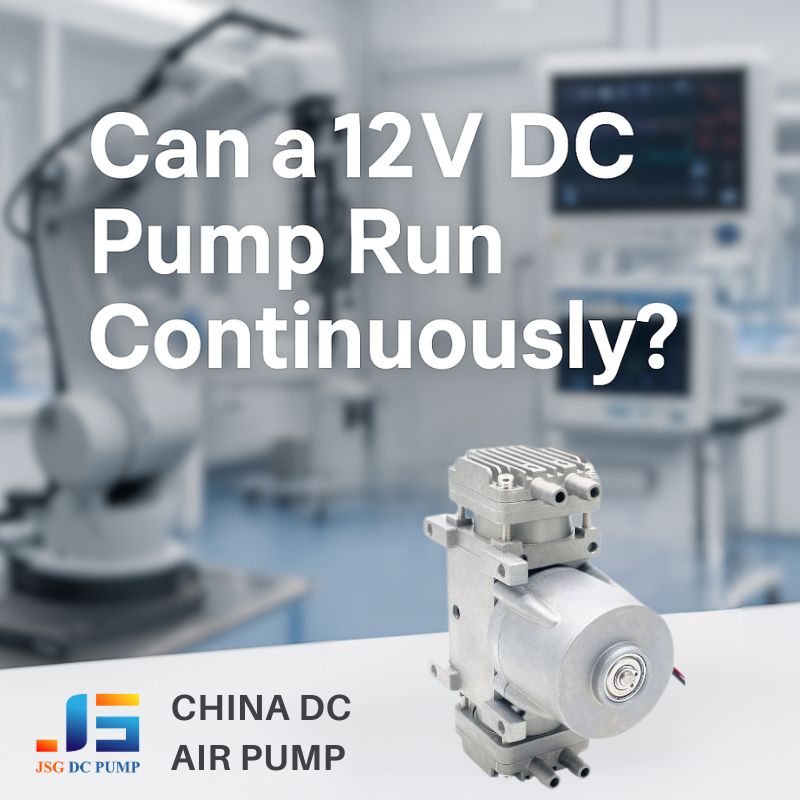
Yes, a 12V DC pump can run continuously, but only if it’s specifically designed for that purpose. The key is choosing a pump with a brushless motor, high-quality components, and a design that effectively manages heat. A standard, low-cost brushed motor pump will not survive.

In my 22 years at JSG DC PUMP, this is one of the most common questions I get from engineers. The “12V” part simply tells you the power source. It doesn’t tell you anything about the pump’s endurance. The real difference between a pump that lasts 1,000 hours and one that lasts over 20,000 hours comes down to its internal design, starting with the motor. Let’s look at what truly makes a 12V DC pump ready for a marathon, not just a sprint.
Why is a Brushless Motor Essential for a Continuously Running 12V DC Pump?
You found a budget-friendly 12V pump for your continuous-duty application. It worked perfectly for a few weeks, but then it died unexpectedly, bringing your entire system to a halt.
The failure was predictable because the pump likely used a brushed motor. Brushed motors rely on physical carbon brushes that wear down with every rotation, giving them a finite lifespan. For continuous 24/7 operation, a brushless (BLDC) motor is the only reliable choice.

I always tell my clients to think of brushed motors as having a built-in expiration date. The brushes are a consumable part, like the tires on a car. They are designed to wear out. For a device that starts and stops infrequently, this is perfectly fine. But for a system that needs to run all day, every day, you are starting a countdown timer to failure from the moment you turn it on. A brushless motor, on the other hand, has no such physical wear parts, making its operational life dramatically longer.
The Fundamental Difference: How They Turn
Understanding the core technology makes the choice obvious.
- Brushed DC Motors: These use small carbon blocks (brushes) that physically press against a spinning part of the motor shaft (the commutator) to deliver electricity. This constant friction creates heat, carbon dust, and a predictable wear pattern. Once the brushes are worn down, the motor stops working.
- Brushless DC (BLDC) Motors: These use an electronic controller instead of physical brushes. The controller precisely energizes coils in the motor’s stationary part (the stator), creating a rotating magnetic field that turns the rotor. The ball bearings act as the primary wear components, designed to operate for tens of thousands of hours without physical contact.
Brushed vs. Brushless for 24/7 Operation
| Feature | Brushed 12V DC Pump | Brushless 12V DC Pump |
|---|---|---|
| Typical Lifespan | 1,000 – 3,000 hours | 20,000+ hours |
| Primary Failure Point | Brush Wear | Bearing Wear |
| Efficiency | Moderate | High |
| Heat Generation | Higher (due to friction) | Lower |
| Suitability for 24/7 | No | Yes |
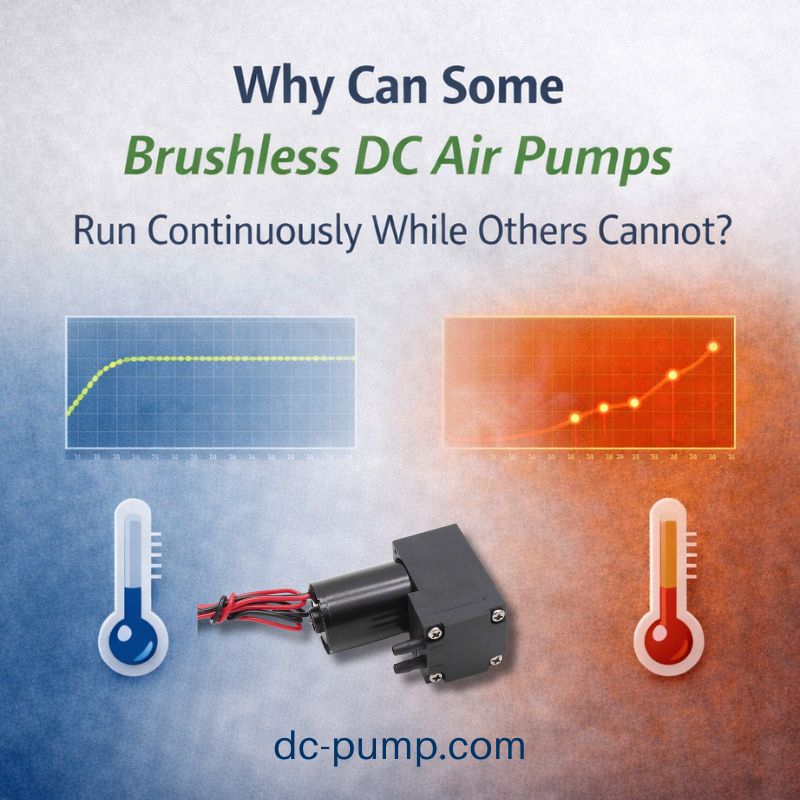
How Does Heat Affect a Continuously Running 12V DC Air Pump?
Your 12V DC air pump is running non-stop in an enclosure. After a few hours, the output pressure starts to drop, and you notice the pump’s housing is extremely hot to the touch.
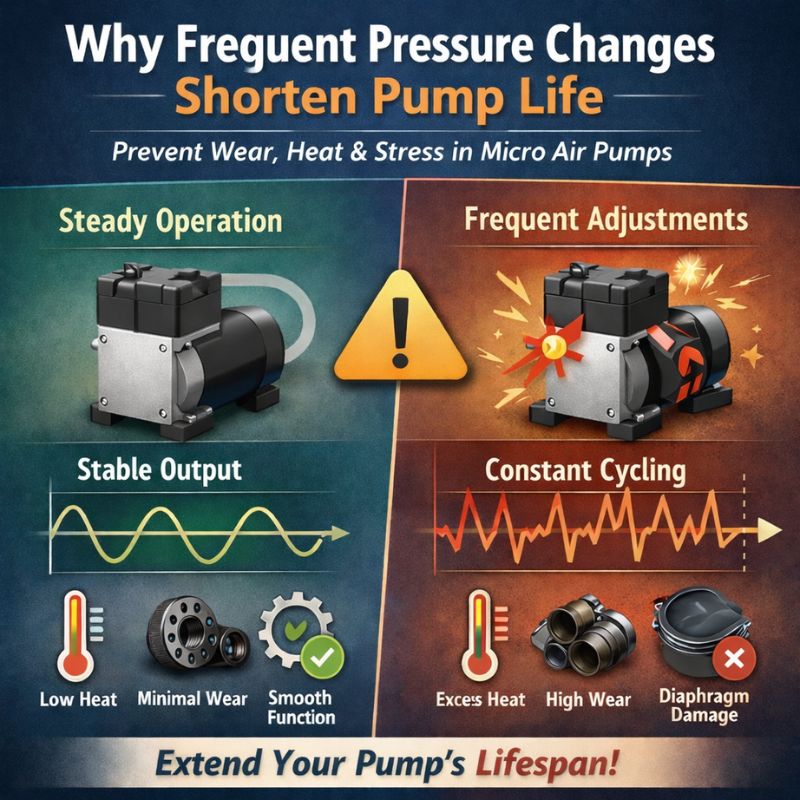
Heat is the silent killer of any continuously operating pump. The motor generates waste heat naturally, and if we don’t remove this heat, it will bake the pump from the inside out. This leads to reduced performance, component degradation, and ultimately, a much shorter lifespan.
An engineer once brought me a failed pump from a piece of environmental monitoring equipment. The device was designed to run for years in the field. He used a powerful pump, but housed it in a thick plastic case without ventilation. It had essentially cooked itself. We replaced it with a higher-efficiency brushless model with an aluminum housing. The new pump generated less heat to begin with, and the housing acted as a heat sink to dissipate the rest. The problem was solved.
The Vicious Cycle of Heat
Excessive heat creates a downward spiral of failure.
- Reduced Efficiency: As the motor’s copper windings heat up, their electrical resistance increases. This means the motor draws more current to do the same amount of work, which in turn generates even more heat.
- Lubricant Breakdown: High temperatures cause the grease inside the motor’s ball bearings to break down and fail, leading to increased friction and eventual seizure.
- Component Degradation: Plastic components within the pump head can warp or soften. The flexible diaphragm can become brittle and crack, causing a complete loss of pressure.
Design Features for Continuous Operation
| Thermal Management Feature | How It Helps a 12V DC Air Pump |
|---|---|
| High-Efficiency Brushless Motor | Generates significantly less waste heat for the same amount of work. |
| Aluminum Motor Housing | Acts as a heat sink, drawing heat away from the motor windings and dissipating it into the air. |
| Proper System Ventilation | Ensuring airflow around the pump in the final product’s enclosure is critical for cooling. |
| Integrated Fan | For high-power applications, a small fan may be integrated to force airflow over the motor. |
Is a 12V DC Diaphragm Air Pump a Good Choice for 24/7 Reliability?
You need a quiet and oil-free air source for a medical device or gas sampler that will run constantly. You’re considering a 12V DC diaphragm air pump but need to be certain of its long-term reliability.
A high-quality 12V DC diaphragm air pump with a brushless motor is an excellent choice for 24/7 use. This design combines the long-life, low-wear mechanics of a diaphragm with the extreme durability of a brushless motor, resulting in a highly reliable, low-maintenance pump.
Many of our clients in the medical and analytical instrument fields rely exclusively on our brushless 12V DC diaphragm air pump models. The oil-free output is essential to avoid contaminating samples, and the low noise and vibration are critical for devices used near patients or in quiet labs. The key to making them last for years is not just the brushless motor, but also the quality of the “soft” parts—the diaphragm and the valves. We engineer advanced elastomers that withstand billions of flex cycles without tearing or losing their shape.
The Pillars of Diaphragm Pump Reliability
For a diaphragm pump to run continuously, three systems must be built for endurance.
- The Motor System: As discussed, a brushless motor is non-negotiable. Its lifespan of 10,000+ hours sets the maximum potential for the entire pump.
- The Mechanical System: This includes the motor’s ball bearings and the eccentric assembly that drives the diaphragm. Using high-quality, properly lubricated sealed ball bearings is essential to match the long life of the brushless motor.
- The Pneumatic System: This is the diaphragm and the one-way valves. The diaphragm material must be carefully selected (e.g., high-endurance EPDM) to resist fatigue. The valves must be designed to open and close billions of times without sticking or wearing out.
Lifespan Limiting Factors
| Component | In a Low-Cost Pump | In a Continuous-Duty Pump |
|---|---|---|
| Motor | Brushed Motor (500~1,000 hrs) | Brushless Motor (lasts 5,000~10,000 hrs) |
| Bearings | Sleeve Bearings (wear quickly) | Sealed Ball Bearings (long life) |
| Diaphragm | Basic Rubber (fatigues and tears) | High-Endurance EPDM (resists fatigue) |
Can a 12V Vacuum Pump DC Motor Handle Non-Stop Industrial Use?
Your automated manufacturing line uses a 12V vacuum pump DC motor to power pick-and-place grippers. The line runs three shifts, 24/7, and any pump failure results in costly production stoppages.
Absolutely. A 12V vacuum pump DC motor designed for industrial use is built to withstand the rigors of non-stop operation. These pumps use robust brushless motors and heavy-duty bearings to deliver the consistent performance and extreme reliability demanded by modern automation.
I work closely with automation engineers, and for them, “reliability” isn’t a feature—it’s the only thing that matters. A pump that costs $10 less is no bargain if it causes a $10,000-per-hour line to shut down. Industrial-grade 12V vacuum pumps are built to withstand the toughest conditions. We design them with motors and bearings that have lifespan ratings far exceeding the expected life of the machines they power.
What “Industrial Grade” Really Means
When you see a pump specified for continuous industrial use, it has key features that set it apart.
- High Duty Cycle Rating: The pump operates continuously at a 100% duty cycle, running indefinitely without requiring a rest period to cool down.
- Superior Bearing Quality: Industrial pumps often use higher-grade ball bearings from top-tier Japanese or German manufacturers. These bearings have tighter tolerances and superior lubrication, allowing them to handle higher speeds and loads for longer.
- Robust Construction: The design uses metal or high-strength polymers for mechanical components like the eccentric and connecting rods to withstand the constant stress of 24/7 operation.
- Environmental Protection: Many industrial pumps have better sealing to protect the motor and electronics from dust and moisture, which are common in factory environments.
Specification Checklist for a 24/7 Vacuum Pump
| Specification | Why It’s Critical for Continuous Use | Note |
|---|---|---|
| Motor Type | Must be Brushless (BLDC). | Ensures a 10,000+ hour operational lifespan. |
| Duty Cycle | Must be 100%. | Guarantees the pump is designed for non-stop operation without overheating. |
| Bearing Type | Must be Ball Bearings. | Sleeve bearings will fail prematurely under continuous load. |
| IP Rating | An IP (Ingress Protection) rating indicates resistance to dust/water. | Important for ensuring durability in industrial environments. |
What is the Selection Checklist for a Continuous-Duty Micro Pump?
You need a reliable 24/7 micro pump, but datasheets are confusing. Choosing the wrong pump means certain system failure, and you need to get it right the first time.
Use this simple, four-point checklist to select a micro pump built for non-stop operation. By verifying the motor type, duty cycle, bearings, and thermal design, you can confidently choose a pump that will not fail prematurely in a continuous-use application.

After helping thousands of engineers, I’ve boiled down the selection process to a few non-negotiable points. For continuous operation, the pump’s endurance specifications are crucial. If the datasheet does not clearly state these four key factors, the pump is likely not intended for 24/7 use. It’s easy to focus on performance curves for pressure and flow, but you should prioritize endurance when considering long-term operation. Treat this as a simple go/no-go checklist. If a pump fails even one of these checks, it’s the wrong choice for your application.
The Four-Point Go/No-Go Checklist
This simple checklist cuts through the noise and focuses on what defines a true continuous-duty micro pump.
- Brushless Motor: Is the motor type clearly listed as “Brushless” or “BLDC”? If it says “Brushed” or doesn’t specify, it’s a “No-Go.”
- 100% Duty Cycle: Does the manufacturer explicitly rate the pump for a “100% Duty Cycle”? If not, it’s a “No-Go.”
- Ball Bearings: Does the pump use ball bearings? Sleeve bearings serve as a common cost-cutting measure, but they are unsuitable for continuous use.
- Thermal Design: Does the pump have features for heat management, like an aluminum housing or a built-in fan? A simple, sealed plastic housing is a high-risk “No-Go.”
Quick Reference Table
| Checklist Item | If “Yes” | If “No” or “Not Listed” |
|---|---|---|
| 1. Brushless Motor? | Go. Meets the primary life requirement. | No-Go. The pump has a built-in wear component. |
| 2. 100% Duty Cycle? | Go. Certified for non-stop operation. | No-Go. The pump is designed for intermittent use only. |
| 3. Ball Bearings? | Go. Designed for long-term load bearing. | No-Go. The bearings will wear out quickly and cause failure. |
| 4. Good Thermal Design? | Go. Able to manage waste heat effectively. | No-Go. The pump is at high risk of overheating and failure. |
Conclusion
A 12V DC pump can absolutely run continuously — if you choose the right design.
The key is selecting a high-quality brushless model specifically engineered for 24/7 duty, equipped with advanced thermal management and robust internal components to guarantee long-term reliability.
💡 JSG DC PUMP specializes in industrial-grade brushless DC micro pumps designed for continuous operation with high performance, low noise, and extended lifespan.
For OEM customization or technical consultation, contact our engineering team at admin@dc-pump.com