

You have an innovative device design, but off-the-shelf pumps don’t fit your space or performance needs — this is exactly where a custom micro air pump becomes necessary.
You can customize performance (pressure, flow, voltage), physical structure (ports, mounting), materials, and wiring, tailoring the pump to your application for optimal performance and integration.
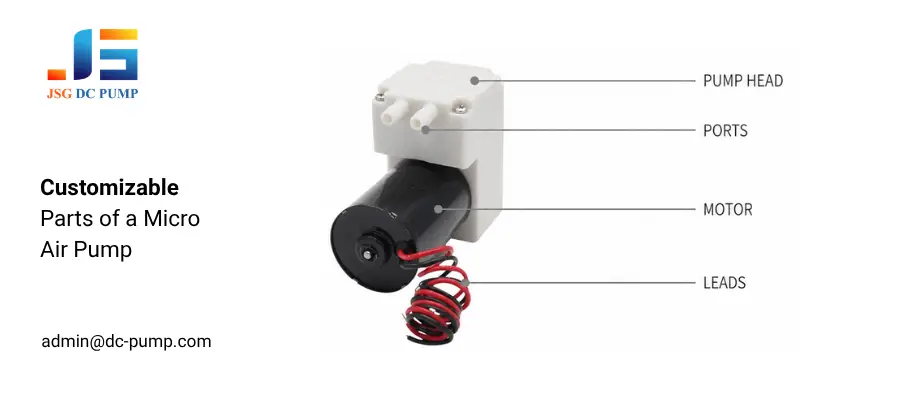
As an engineer at JSG, I’ve seen many projects stall on exactly this problem. A team spends months designing a sleek medical device or a compact analyzer, then finds that no standard pump on the market fits. An off-the-shelf pump is only a starting point. True innovation happens when we build a custom micro air pump purpose-made for your device. Let’s look at what is, and is not, possible.
Which Performance Parameters Can Be Customized?
A standard pump is either too powerful, wasting energy and creating excess noise, or too weak, causing your device to underperform.
You can customize key parameters like maximum pressure, flow rate, and operating voltage. By modifying the motor, eccentric cam, and diaphragm stroke, we can tune the pump’s output to your exact specifications.
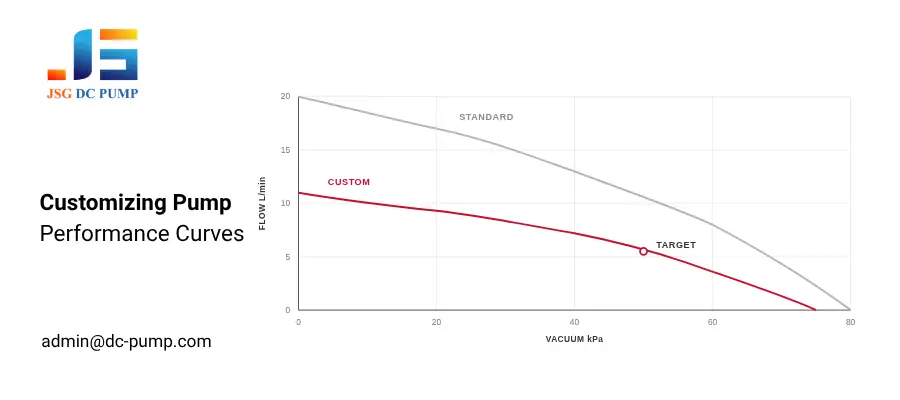
Select a pump around its required operating point—flow at a stated positive pressure or vacuum—not by free-flow or shut-off values alone. For a diaphragm pump, motor and driver selection, cam stroke, diaphragm, and valve design shape the P–Q curve; for a piston pump, the relevant variables differ. A longer stroke generally increases displacement, but its effect on pressure, power, noise, and service life must be verified by testing.
Illustrative JSG-04V Vacuum-Pump Configuration
| Parameter | Standard JSG04 Pump |
Proposed JSG04V Configuration |
Reason for Change |
| Operating Voltage | 12 V/24 V DC | 12 V DC |
Match the device’s 12 V DC power rail. |
| Max Flow Rate | 22 L/min | 11 L/min | Optimize for low-flow gas sampling |
|
Maximum Vacuum (gauge, zero-flow) |
80 kPa | 75 kPa | Reduced to lower power consumption |
| Control | On/Off | PWM Speed Control | Allow for variable sampling rates |
What Structural, Wiring, and Material Options Can Be Changed?
The standard pump’s shape doesn’t fit your enclosure, and its materials aren’t compatible with your media. Redesigning an entire device around a pump is costly and slow.
Depending on the platform, port direction, mounting features, lead exit, wire length, connector, and wetted materials can be configured. Changes to molded pump-head or housing geometry require separate tooling and feasibility review.
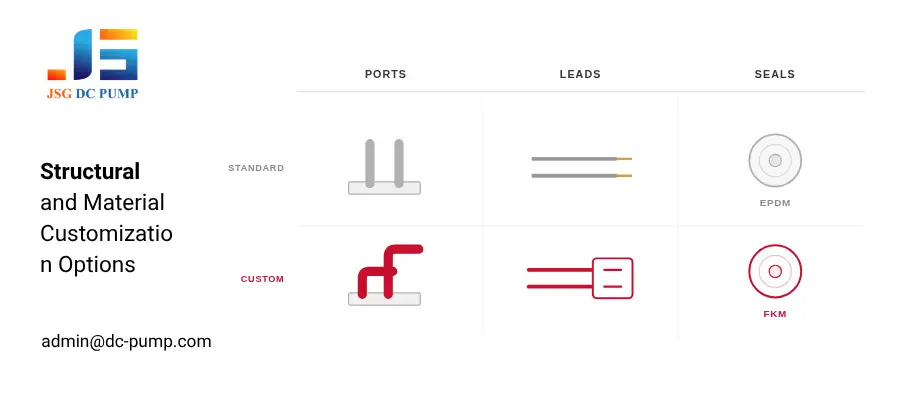
We tailor the pump to your assembly line and end-use environment. Ports can switch from straight to 90-degree elbows for tight tubing runs; custom brackets or housing let the pump mount into your chassis. Electrically, bare leads can be supplied with the specified connector, pinout, wire gauge, and lead length. JSG connectors, saving assembly time. Most critically, wetted parts can change material: one medical client running ozonated-air sterilization saw standard EPDM diaphragms degrade in weeks, so switching to FKM (Viton) secured long-term reliability and regulatory approval.
Common Material Customizations
| Component | Standard Material | Custom Option | Primary Benefit of Customization |
| Pump Head | PPS | Nylon, PSU | Improved chemical resistance, lower cost |
| Diaphragm | EPDM | FKM (Viton), Silicone | Resistance to ozone, oils, or higher temperatures |
| Valves | EPDM | FKM (Viton), Silicone | Matched compatibility with diaphragm and media |
What Cannot Be Customized on a Micro Air Pump?
You have an idea for a custom pump but aren’t sure it’s realistic, and you don’t want to lose weeks pursuing an impossible request.
Even a custom micro air pump has hard limits, and they are set by the pump’s base platform and tooling. Major changes to the fundamental pump head size, motor diameter, or core mechanical principle are not feasible without creating an entirely new product.
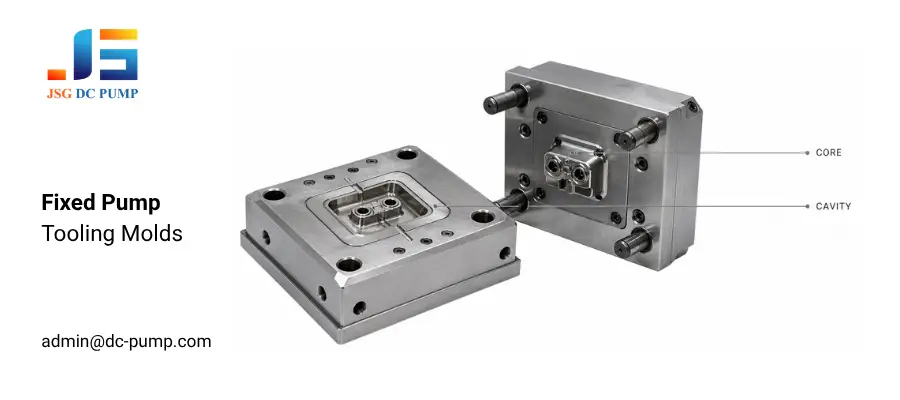
Changes requiring a new pump-head or housing mold, a different motor frame, or a different pumping principle are new-product-development projects rather than routine platform customization. Tooling cost, minimum quantity, development time, and feasibility should be quoted after design review. Increasing a 1 L/min platform to 10 L/min normally requires a higher-displacement platform or a new design.
How Do You Start a Custom Micro Air Pump Project?
You know you need a custom pump, but aren’t sure what information to provide or where to begin.
Start by defining your core requirements: target flow rate, pressure, voltage, and estimated annual quantity. Providing these details, along with any space or material constraints, allows for a productive and efficient first discussion.
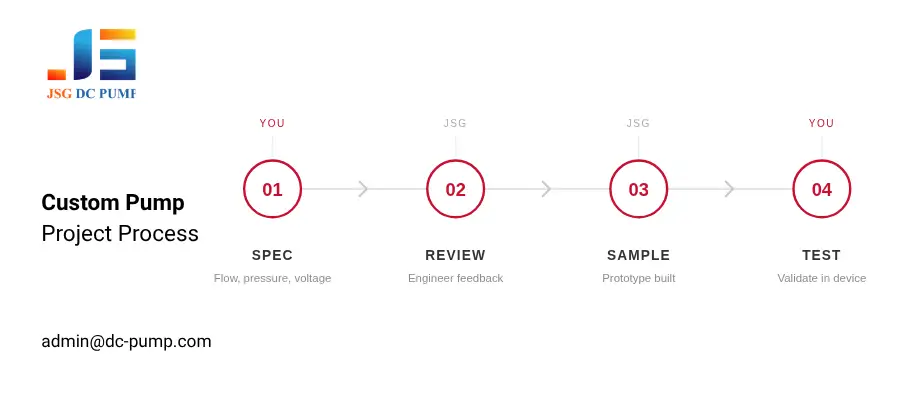
A clear specification is the fastest way to start—with well-defined needs, we can often settle on a solution in one meeting. Here’s my checklist:
1. Required operating point: flow range (L/min) at the specified positive pressure or vacuum (kPa gauge), plus medium, temperature, altitude, duty cycle, and allowable tolerance.
2. Electrical: supply-voltage range, current or power budget, start-up requirements, and PWM or closed-loop control requirements.
3. Mechanical: maximum installed envelope (L × W × H), port direction and size, mounting, connector, and cable length.
4. Environment and reliability: humidity or condensate, dust, temperature, noise or vibration limit, required lifetime, and compliance requirements.
5. Commercial: prototype quantity, estimated annual usage (EAU), target cost, and whether tooling or NRE is acceptable.
With these answers, we can move from concept to prototype sample in a short time.
Which JSG Pump Platforms Support Customization?
You are ready to select a pump, but a catalog of hundreds of models is confusing. You need a simple way to find a starting point.
Every custom micro air pump we build starts from a proven platform, organized by flow rate. They range from the ultra-compact JSG01 (0.3 L/min) to the powerful JSG04series (22 L/min), providing a proven foundation for any project.
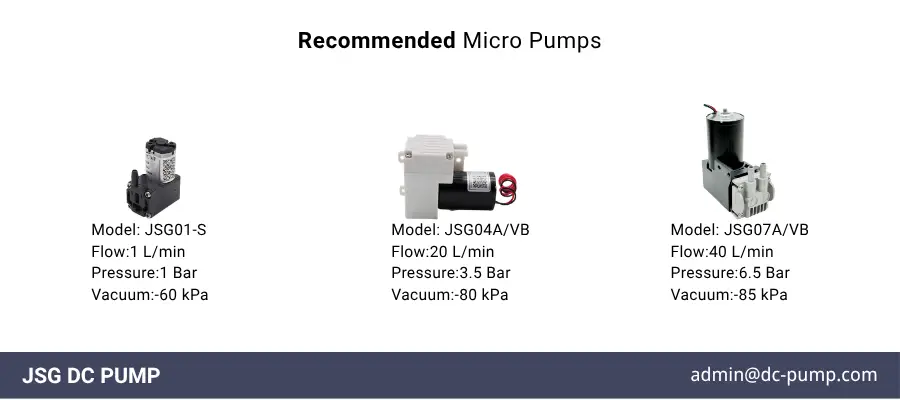
We think in platforms, not individual models—a platform is a family of pumps sharing core motor and mechanical design, a tested foundation we then customize. You just find the platform nearest your target flow rate; we handle the fine-tuning. Around 4 L/min, we start with the JSG03 series; at 40 L/min, the JSG07 series. This approach draws on proven pump architectures built up since 2003.
Conclusion
Customizing a micro air pump’s performance, structure, and materials is key to optimizing your device. Starting with a proven platform and clear requirements makes the process efficient and successful.
Send JSG your required flow at pressure or vacuum, operating voltage, available envelope, gas medium, duty cycle, and annual volume. We will return a platform-feasibility recommendation and sample plan. Contact us at admin@dc-pump.com.
