

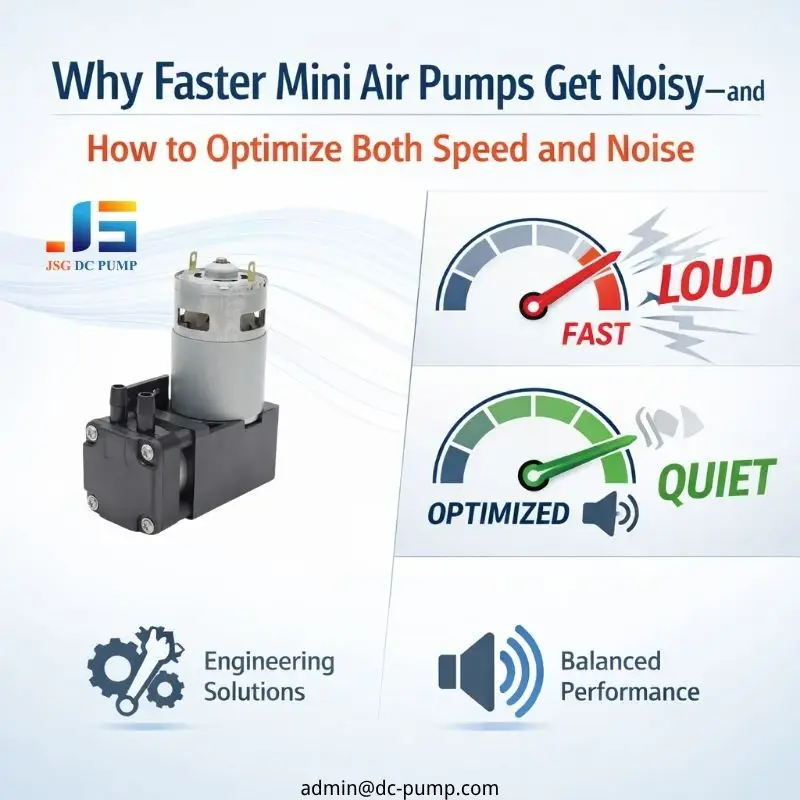
Your inflation system may seem fine in early development, but in integrated testing, the pump may sound sharper and less refined. In compact pneumatic products, faster fill time often comes with higher pump noise.
Faster mini air pumps usually get noisier because higher inflation speed increases motor speed, airflow, internal load, and vibration transfer. But speed and noise can still be optimized together when the pump, air path, mounting, and control strategy are matched to the real working condition.
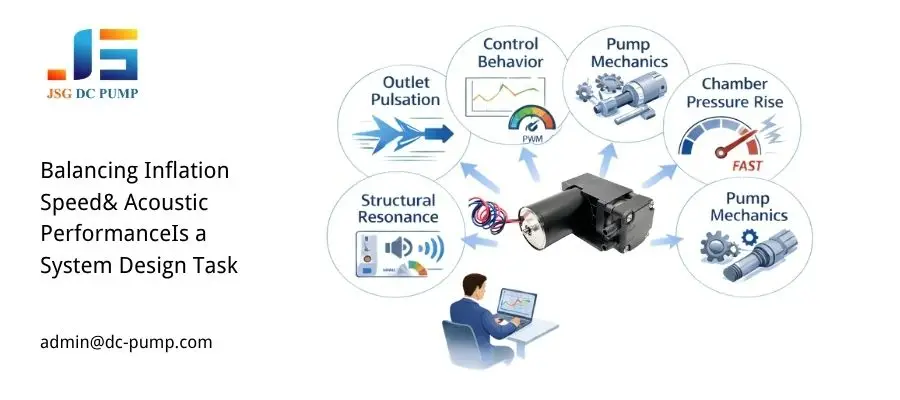
Based on years of experience, this is rarely just a pump problem. What users finally hear is the combined result of pump mechanics, outlet pulsation, chamber pressure rise, structural resonance, and control behavior. That is why balancing inflation speed and acoustic performance is not simply a matter of choosing a faster micro air pump. It is a system design task.
Why Do Faster Mini Air Pumps Usually Become Noisier?
Your pump may seem fine at first, but faster inflation often makes noise rise quickly. In many cases, the whole system is simply being driven harder.
When a mini air pump is pushed to fill faster, the motor runs faster or under heavier load. At the same time, airflow becomes more aggressive and vibration increases across the system.
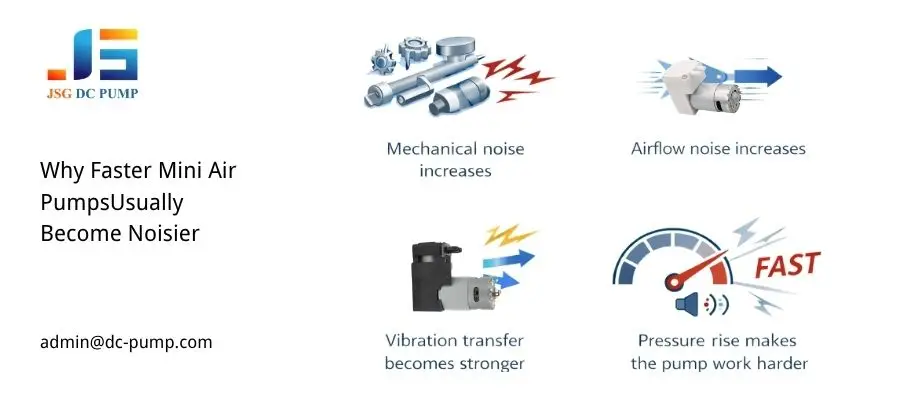
Main Reasons Faster Mini Air Pumps Get Noisier
- Mechanical noise increases
Higher speed puts more stress on bearings, diaphragms, valves, and other moving parts, so the sound often becomes sharper. - Airflow noise increases
Faster airflow through outlets, tubing, valves, and connectors creates stronger hissing and pulsation, especially in restrictive air paths. - Vibration transfer becomes stronger
A faster pump sends more vibration into the bracket, housing, and tubing, which often makes the final product sound louder. - Pressure rise increases load
As chamber pressure builds, the pump works against greater resistance, so noise often becomes more obvious near the end of inflation.
So the problem is not just higher airflow. It is that the whole product is being driven more aggressively.
Which Noise Sources Matter Most in Real Inflation Products?
In real devices, users do not hear one clean pump sound. They hear several noise sources mixed together. That is why a pump that seems acceptable on the bench can sound much worse after integration.
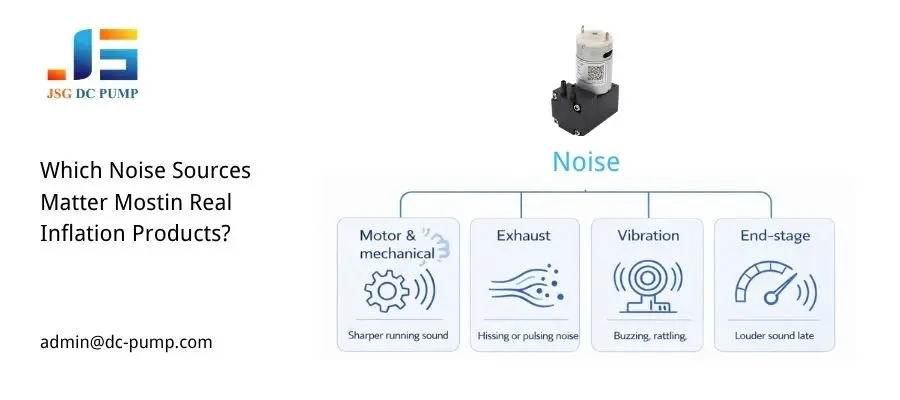
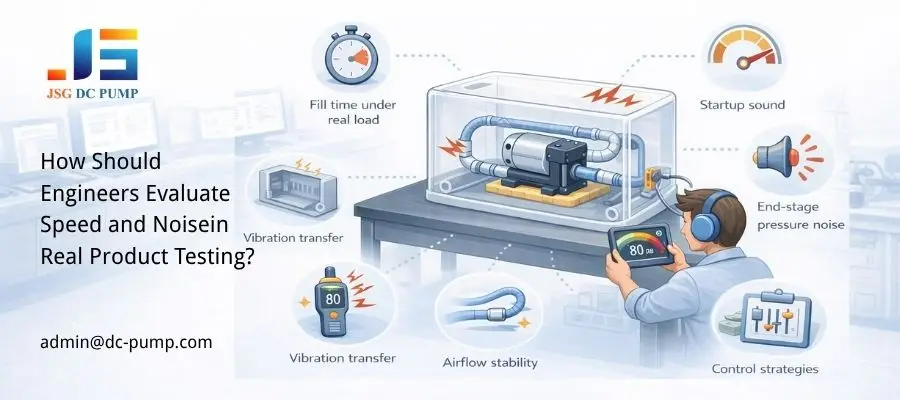
| Noise Source | How It Happens | What Users Usually Hear |
| Motor and internal mechanical noise | Higher speed and heavier load increase moving-part stress | Sharper running sound |
| Exhaust pulsation noise | Air exits more aggressively through the outlet path | Hissing or pulsing noise |
| Vibration transfer | Pump vibration passes into brackets, shell, or tubing | Buzzing, rattling, resonance |
| End-stage pressure noise | Pump works harder as chamber pressure rises near the target | Louder sound late in the fill cycle |
In the final product, these noises often combine. Even moderate exhaust noise or vibration can sound much worse once the housing or structure amplifies it.
Why Is Bench Test Noise Often Different from Final Product Noise?
Your pump may sound acceptable on the bench, but noise often changes after full integration. In many cases, the real cause is the system, not the pump alone.
Bench test noise is often different from final product noise because real product conditions are no longer the same as open-air testing. After integration, load, vibration transfer, air path resistance, and housing structure can all change the sound.
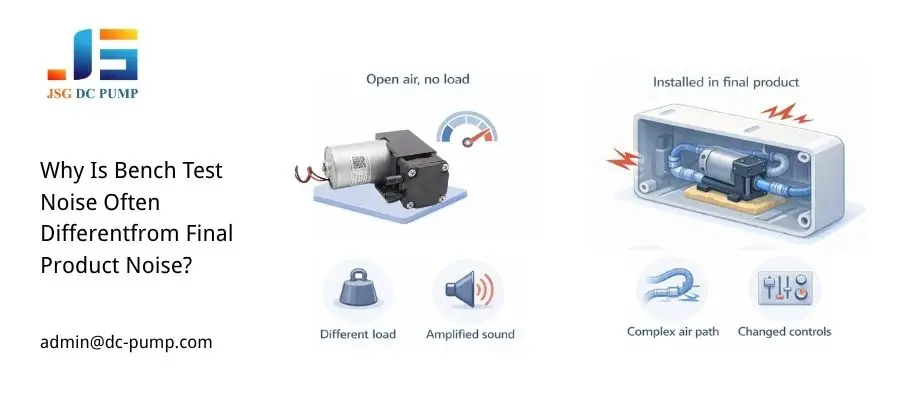
Main Reasons Bench Noise Differs from Final Product Noise
1.The working load is different
In open-air testing, resistance is low. However, in the real product, Mini Air Pumps must work through the actual air path as pressure rises, which significantly increases load and affects noise behavior.
2.The structure changes the sound
After installation, vibration can transfer into the frame or housing and amplify noise.
3.The air path becomes more complex
Tubing, bends, connectors, valves, and outlet geometry all affect discharge noise.
4.The control condition changes
Soft start, PWM, staged control, or pressure feedback can change both noise level and sound character.
5.The product amplifies noise differently
Internal cavities and thin plastic parts can make certain frequencies more obvious than they seem on the bench.
In one portable compression device project, the pump sounded acceptable in open bench testing, but became noticeably sharper after full integration. Once installed with the actual housing, tubing, valve set, and air chamber, rising back pressure increased load, the narrow air path intensified discharge noise, and the housing amplified vibration. The team later improved the acoustic result by adjusting the bracket structure, tubing layout, and control strategy.
For Mini Air Pumps, this clearly shows that real-world integration conditions can significantly change acoustic performance.
What Actually Determines the Right Balance Between Inflation Speed and Noise?
Your pump may look fast on paper, but the final product can still sound too loud. In many cases, the real challenge is finding the right balance between inflation speed and acoustic comfort.
The right balance between inflation speed and noise is determined by real working performance, not by maximum flow or no-load noise alone. What matters is whether the pump can meet the required fill time without making the product too loud.
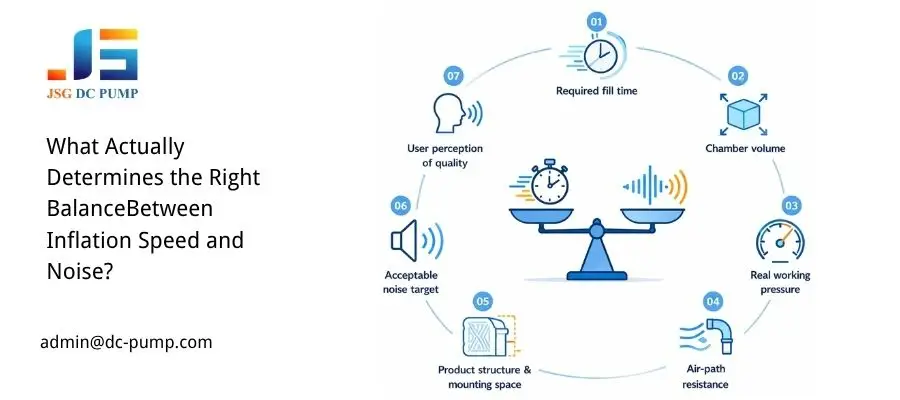
Key Factors That Determine the Speed-Noise Balance
1.Required fill time
The target response speed defines how much effective airflow is needed.
2.Chamber volume
A larger volume requires more air delivery.
3.Real working pressure
What matters is not free-flow alone, but how much usable flow remains as pressure builds.
4.Air-path resistance
Tubing, bends, and restrictive fittings can increase both load and noise.
5.Product structure and mounting space
Compact products often have less room for vibration isolation, so noise amplification becomes more serious.
6.Acceptable noise target
Consumer and close-contact devices usually require better acoustic comfort.
7.User perception of quality
Fast fill time alone is not enough if the sound feels harsh.
From an engineer’s viewpoint, the best pump is not the fastest on paper, but the one that delivers the required inflation result with lower vibration and better sound quality in the real product.
How Can Engineers Improve Inflation Speed Without Causing a Large Noise Increase?
Your pump may fill too slowly, but faster inflation often brings more noise. The real challenge is balancing both.
Engineers can improve inflation speed without a large noise increase by optimizing the whole system, not just increasing pump output. The key is to match the pump, air path, structure, and control strategy to the real working condition.
Main Engineering Methods to Improve Speed Without a Large Noise Increase
1.Match flow and pressure to the real working point
Do not select by free-flow or peak pressure alone. Check whether the pump still delivers useful airflow under real inflation load.
2.Optimize the air path
Reduce unnecessary bends, long tubing, restrictive connectors, and poor outlet transitions to lower resistance.
3.Improve mounting and vibration isolation
Better brackets, damping materials, and structural separation can reduce vibration transfer into the housing.
4.Use smarter control logic
Soft start, staged inflation, PWM tuning, and pressure-based control can reduce harsh startup noise and unnecessary full-speed running.
5.Treat outlet noise when needed
A customized silencer or improved outlet design can reduce exhaust noise without much performance loss.
6.Evaluate the whole pump-system combination
The final result depends on how the pump, chamber, air path, structure, and control strategy work together.
In practical design, the best solution usually comes from combining these methods rather than depending on a single change.
What Happens If You Chase Speed Without Managing Noise Properly?
Your product may fill faster, but still feel worse in actual use. In many cases, the real problem is not speed itself, but chasing speed without controlling the noise and vibration it creates.
If speed is increased without proper noise control, the product may fill faster but feel worse overall. The usual result is more noise, more vibration, and lower perceived quality.
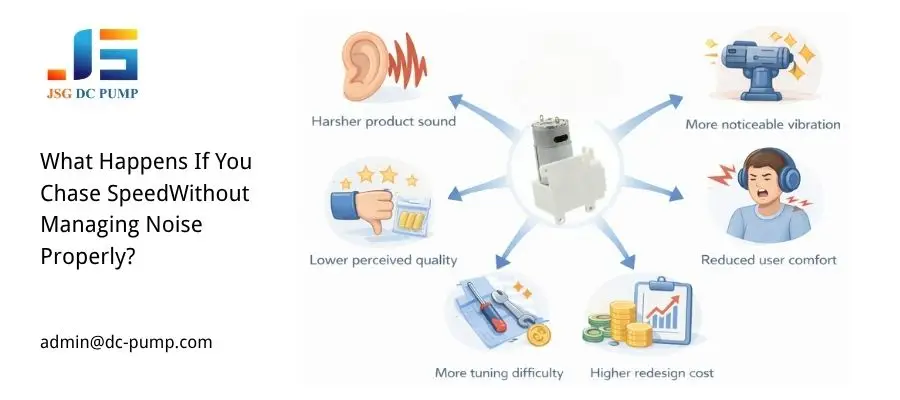
Main Risks of Prioritizing Speed Without Proper Noise Control
- Harsher product sound
The device may technically perform better, but sound much less comfortable to the user. - More noticeable vibration
Stronger pump output often causes more vibration transfer into the shell, bracket, or tubing. - Lower perceived product quality
Even when the product works correctly, excessive noise can make it feel less stable and less premium. - Reduced comfort in close-contact devices
In products used near the body, harsh noise and vibration can negatively affect user experience. - More late-stage tuning difficulty
Once the pump is already integrated, fixing noise may require changes to housing, bracket design, tubing route, or control settings. - Higher redesign cost
Late validation problems usually cost more time and money than correct pump-system matching at the beginning.
This is why speed alone is not a sufficient optimization target. In real products, users experience the total result, not just fill time.
Which Mini Air Pump Configurations Work Best for Quiet and Fast Inflation?
Pump selection should follow the inflation task rather than the desire for the largest performance number. Different configurations suit different priorities.
For lower-noise or portable devices, compact pumps with moderate pressure and controlled flow usually offer a better balance of fill time, size, and noise, while larger chambers or faster-fill systems often need higher-flow, higher-pressure pumps with stronger structural and acoustic control.
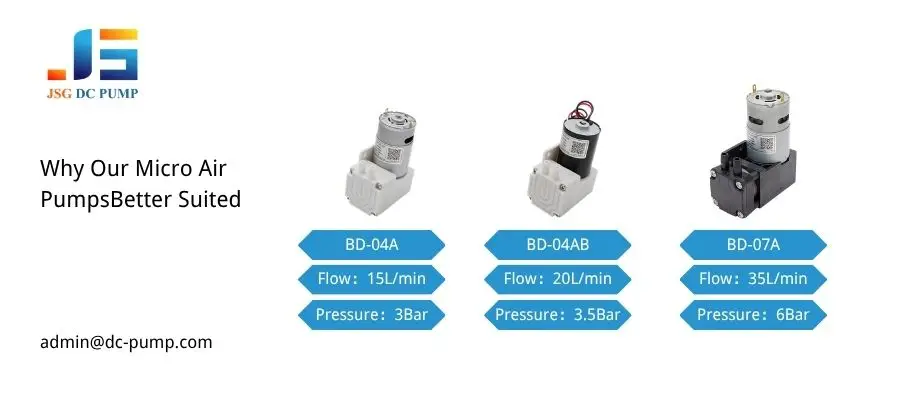
| Series / Configuration | Typical Output | Noise Positioning | Best Fit Application |
| BD-04A | 2.5 bar
11 L/min |
Lower | Portable inflation devices needing quieter operation |
| BD-04A | 3 bar
15 L/min |
Medium | Products needing balanced speed and acoustic control |
| BD-04AB | 3.5 bar
20 L/min |
Medium to higher | Compact systems needing stronger pressure support |
| BD-07A | 6 bar
35 L/min |
Higher | Fast-fill systems and larger chamber inflation |
From an engineering perspective, BD-04 configurations are usually better when the product values compactness, lower perceived noise, and easier integration. BD-07 configurations are more suitable when faster inflation is the primary target and the system can tolerate a higher acoustic and structural burden.
Conclusion
Faster mini air pumps get noisier because higher output increases mechanical load, airflow noise, and vibration transfer. But in real design, speed and noise can still be optimized together by matching the pump to the working point and improving the air path, mounting, control, and outlet design.
A mini air pump affects not only fill speed, but also noise, product feel, and integration difficulty. If you need a better balance between fast inflation and lower noise, JSG can help recommend a more suitable solution. Contact us at admin@dc-pump.com.
