


Your IoT soil sensors are giving inconsistent readings, and you can’t figure out why. You’re questioning the expensive system you built, and the soil data is completely unreliable for any real decision-making.
A small gas vacuum pump is the key enabling component. It actively pulls a controlled, consistent gas sample from the soil and delivers it to your sensors, overcoming the limitations of passive diffusion and ensuring the data your IoT system collects is accurate and repeatable.
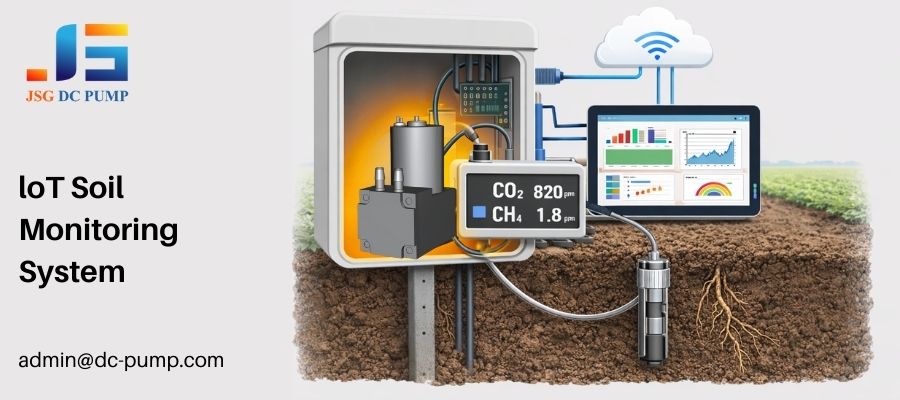
As an engineer at JSG DC PUMP, I’ve had a front-row seat to the evolution of environmental monitoring. Many of our OEM clients are building sophisticated IoT systems for precision agriculture and soil science. They often focus so much on the sensors and the cloud platform that they overlook the most fundamental part of the process: how do you get a trustworthy sample from the ground to the sensor? They soon discover that without a reliable method for active gas extraction, even the most advanced sensor is just guessing. Let’s dig into why a small gas vacuum pump isn’t just a component, but the very heart of a reliable IoT soil monitoring system.
Why Do IoT-Based Soil Monitoring Systems Need Active Gas Sampling?
You’ve placed expensive sensors in the soil, but the data is slow and varies wildly with weather. You can’t trust the readings because passive sensors are inconsistent and easily influenced by soil conditions.
Active gas sampling is necessary because it standardizes the measurement process. A small gas vacuum pump actively extracts a defined volume of gas, bypassing the inconsistencies of passive diffusion and providing reliable data for your IoT system.
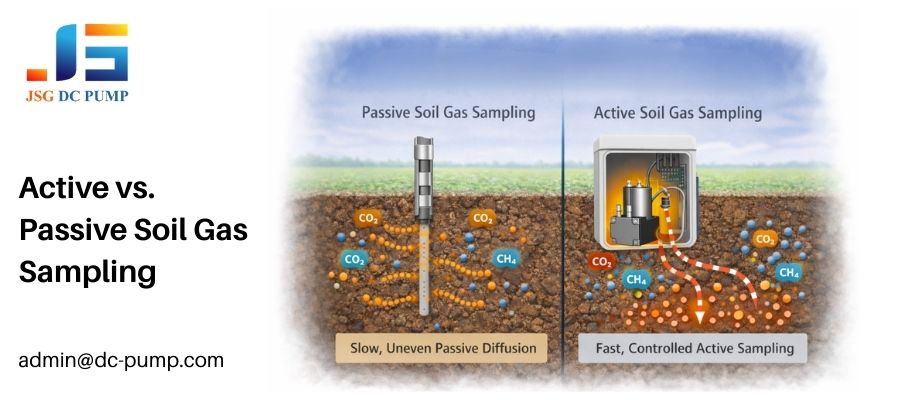
The shift from manual soil testing to automated IoT systems has been revolutionary, but it introduced new challenges. Simply burying a sensor and waiting for soil gases like CO₂ or O₂ to diffuse into it is highly unreliable. The rate of diffusion changes dramatically with soil compaction, moisture levels, and temperature. This means your data is reflecting changes in the soil’s physical state as much as its chemical state. Active sampling, powered by a pump, removes this variable completely. By actively pulling a sample, you create a repeatable scientific measurement, which is the foundation of any trustworthy IoT-based soil monitoring system.
Passive Diffusion vs. Active Pump-Based Sampling
| Feature | Passive Diffusion Sensing | Active Pump-Based Sampling |
|---|---|---|
| Data Reliability | Low. Highly affected by soil moisture and density. | High. Provides a consistent, representative sample. |
| Response Time | Very slow (minutes to hours). | Fast (seconds). |
| Measurement Control | None. Relies on unpredictable environmental conditions. | Precise. Controlled sample volume and flow rate. |
| System Role | A passive data logger. | An active scientific instrument. |
What Is a Small Gas Vacuum Pump and Why Does It Matter in Soil Monitoring?
You hear “vacuum pump” and think of large, oily industrial machines. You’re not sure what kind of pump is suitable for a compact, sensitive environmental monitoring device that needs to run for months.
A small gas vacuum pump is a compact, oil-free device, typically using a diaphragm mechanism. It’s essential for soil monitoring because it moves gas samples cleanly without contamination, making it perfect for sensitive environmental instrumentation.
When we talk about a small gas vacuum pump, we are not talking about a generic air pump. While an air pump is designed to push air at positive pressure, a vacuum pump is optimized to create negative pressure to pull gases. For soil applications, the design must be oil-free, usually diaphragm-based. This is critical because any oil vapor from the pump would contaminate the gas sample and destroy the expensive sensors downstream. Its specific design for creating a stable, clean vacuum is what makes this a unique and necessary component for any serious gas vacuum pump application in environmental science.
Pump Types and Their Suitability
| Pump Type | Working Principle | Suitability for Soil Gas Sampling |
|---|---|---|
| Small Gas Vacuum Pump | Oil-free diaphragm creates a vacuum. | Excellent. Clean, reliable, designed for gas. |
| Standard Air Pump | Pushes air; not optimized for vacuum. | Poor. Inefficient vacuum, may have different sealing. |
| Liquid Pump | Designed for incompressible fluids. | Unsuitable. Will not work for gases. |
Where Does the Vacuum Pump Sit in an IoT Soil Monitoring Architecture?
You’re designing your monitoring station, but you’re unsure how to connect the components. Where does the pump fit in the chain, and how does it interact with the probe and sensors?
The vacuum pump is the active link in the chain, sitting between the soil probe’s filter and the sensor chamber. It pulls gas from the probe, through the tubing, and delivers it to the sensors for analysis before venting it.
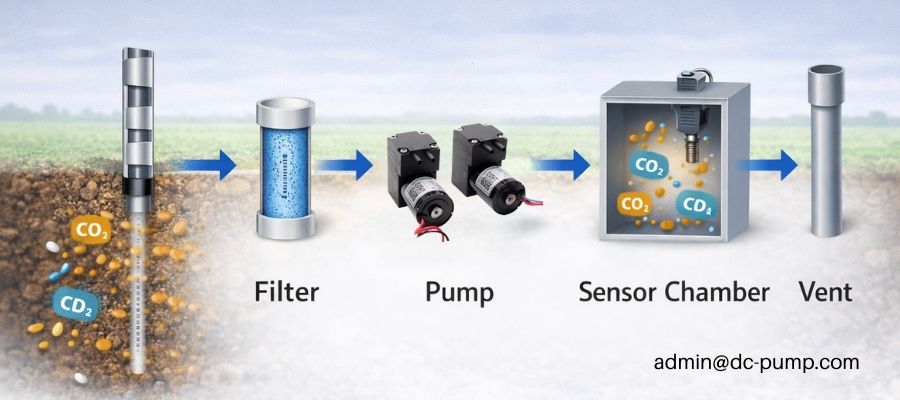
Understanding the system architecture is key to a successful design. The pump acts as the heart, driving the flow of gas through the entire system. Its performance directly dictates the quality of the data your sensors will see. If the pump’s flow is too low, the sensor’s response time will be sluggish. If the flow is unstable, the sensor readings will be noisy and erratic, making it impossible to detect subtle changes in soil gas concentration. A correctly integrated pump ensures a swift, stable, and clean sample delivery, which is the bedrock of a robust soil gas monitoring system design.
System Component Flow and Function:
- Soil Probe & Filter: Sits in the ground to collect gas while blocking entry of water and dirt particles.
- Sampling Tubing: Carries the gas sample from the probe to the instrument enclosure.
- Small Gas Vacuum Pump: Actively pulls the gas sample through the tubing.
- Sensor Chamber: A small manifold containing the gas sensors (e.g., CO₂, O₂, CH₄). The pump pushes the sample past these sensors.
- MCU & Electronics: Controls the pump’s operation, reads the sensor data, and sends it to the cloud.
What Are the Key Performance Requirements for Small Gas Vacuum Pumps in IoT Systems?
You’re looking at datasheets and see “Max Vacuum” numbers. You assume a higher number is better, but this often leads to choosing a pump that is noisy, power-hungry, and ultimately wrong for your battery-powered device.
For IoT systems, the most important requirements are stable flow at the working vacuum level, low power consumption, and a proven lifespan for the intended duty cycle. Maximum vacuum specs are often irrelevant and misleading.
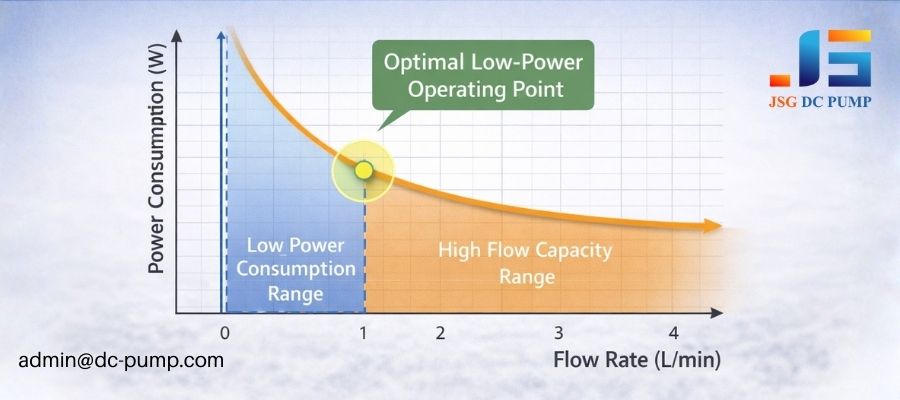
I often advise clients to ignore the “max vacuum” spec initially. In a soil gas sampling application, you are typically pulling gas against very low resistance, creating a vacuum of only -5 to -20 kPa. You are not trying to create a deep vacuum. What you really need is highly stable and repeatable flow in this low-vacuum range. This ensures that every sample is delivered to the sensor in the exact same way. Furthermore, since these devices are often powered by batteries or small solar panels, extremely low power consumption is non-negotiable. This is a classic challenge in vacuum pump selection for IoT devices: finding the perfect balance between just enough performance and maximum efficiency.
Essential Performance Metrics for IoT Pumps
| Metric | Why It’s Critical | Common Mistake |
|---|---|---|
| Flow Stability @ Working Vacuum | Ensures consistent sensor readings and calibration. | Focusing only on max flow at zero vacuum. |
| Low Power Consumption | Maximizes battery life in remote field deployments. | Choosing an oversized, power-hungry pump. |
| Duty Cycle & Lifespan | Must match the system’s sampling frequency (e.g., 1 min every hour). | Assuming a pump rated for intermittent use can run for months. |
| Compact & Lightweight | Enables smaller, easier-to-deploy monitoring stations. | Overlooking the physical size and weight constraints. |
What Environmental Challenges Must a Soil Gas Sampling Pump Overcome?
Your lab prototype works perfectly. But when you deploy it in the field, the pump fails after a few weeks due to moisture, dust, and unexpected corrosion from the soil environment.
A soil gas sampling pump must be robust enough to handle high humidity, dust, and corrosive gases. This requires careful material selection for the pump’s diaphragm and valves, as well as external system-level protection like filters and moisture traps.
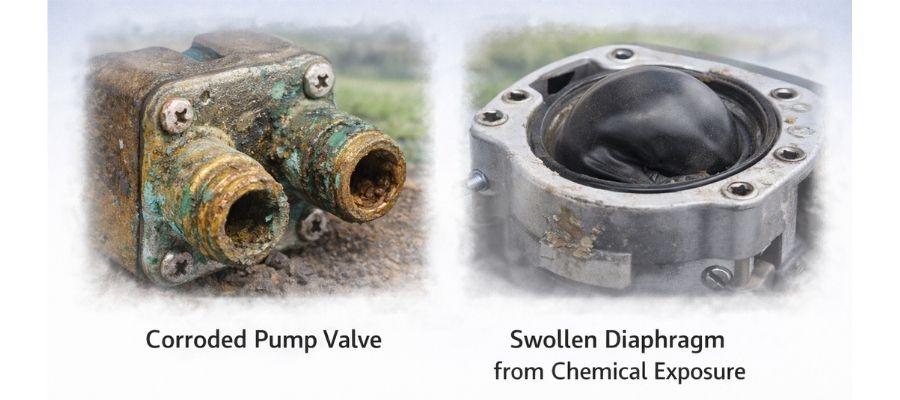
The real world is a harsh place for precision instruments. Soil is not just dirt; it’s a complex and chemically active environment. The number one enemy is humidity. Gas pulled from the soil is often near 100% relative humidity, and as it cools in the tubing, it can condense into liquid water, which can stall the pump or damage sensors. Dust and fine particulates can clog valves if not properly filtered. Furthermore, agricultural soils often contain residues from fertilizers, like ammonia or sulfates, which can become corrosive when mixed with water. A reliable environmental monitoring pump must be built from materials like EPDM or even FKM to resist these chemical attacks.
Key Environmental Threats and Solutions
| Threat | Risk to the Pump and System | System-Level Solution |
|---|---|---|
| High Humidity & Condensation | Can cause pump to stall, corrode motor, and damage sensors. | Implement a water trap or coalescing filter before the pump inlet. |
| Dust and Particulates | Can clog pump valves, causing performance degradation and failure. | Use a multi-stage filtration system, starting with a coarse filter at the probe. |
| Corrosive Gases (Ammonia, H₂S) | Can degrade rubber diaphragm and valves, leading to leaks and failure. | Select a pump with chemically resistant materials (e.g., EPDM, FKM). |
How Do Small Gas Vacuum Pumps Integrate with IoT Control Systems?
You have the pump, but how do you control it precisely? You need it to turn on, run for a specific duration, and then turn off, all while using minimal power.
Pumps are integrated via the system’s microcontroller (MCU), which controls the pump using a simple on/off signal through a transistor or a variable speed command using PWM. This allows for perfect synchronization between the sampling cycle and sensor measurement.
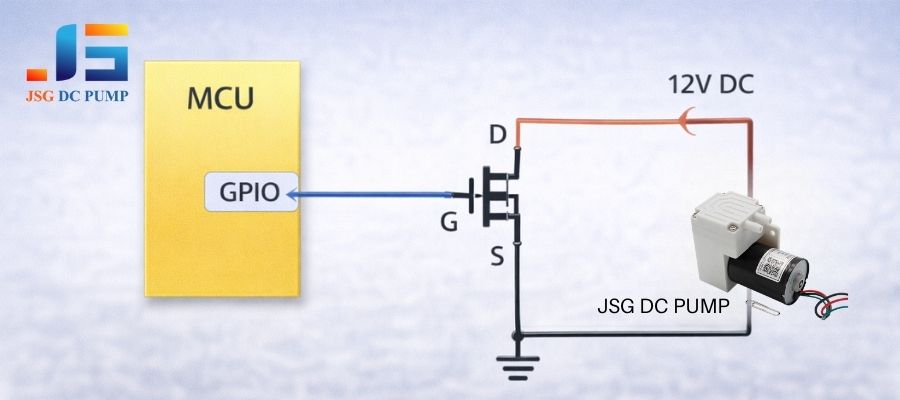
The beauty of modern DC pumps is their ease of integration. For a typical soil monitoring duty cycle—for example, “run for 60 seconds to purge the lines and take a sample, then sleep for an hour”—a simple on/off control is all that’s needed. The MCU sends a high signal to the gate of a MOSFET, which turns the pump on. After the sampling period, the MCU sends a low signal, turning it off. For more advanced systems that may require variable flow rates, a PWM signal from the MCU can be used to precisely regulate the pump’s speed. This IoT vacuum pump integration ensures that the pump only runs when needed, drastically saving power and extending both battery and pump lifetime.
Common Control Methods:
- Simple On/Off Control: An MCU’s digital output pin controls a MOSFET or relay to switch the pump on and off. This is the most common and power-efficient method for fixed-duration sampling.
- PWM Speed Regulation: The MCU generates a PWM signal to control pump speed, allowing for variable flow rates. This is useful for systems with different phases, like a fast initial purge followed by a slow, gentle sampling phase.
What Are Some Typical Applications of Small Gas Vacuum Pumps in Soil Monitoring?
You understand the technology, but you’re wondering where it’s being applied. What are the real-world use cases where this technology is making a significant impact?
These pumps are critical components in smart greenhouses for root-zone analysis, in precision agriculture for optimizing fertilizer use, and in environmental science for long-term soil respiration studies.
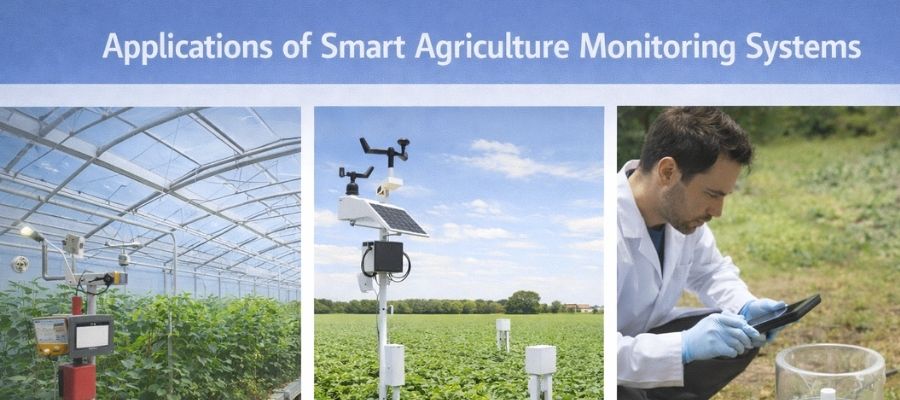
The applications for active soil gas sampling are expanding rapidly. It’s a cornerstone technology for any smart agriculture monitoring system. In high-tech greenhouses, these systems constantly monitor the oxygen levels in the root zone to prevent hypoxia and optimize plant growth. In large-scale precision agriculture, monitoring soil gas can help farmers understand nutrient cycles and microbial activity, allowing them to apply fertilizer more efficiently and reduce environmental runoff. Climate scientists also deploy these systems in remote locations for years at a time to conduct long-term soil respiration studies, measuring CO₂ flux to better understand the global carbon cycle. In all these cases, the humble gas vacuum pump is the key to getting reliable data.
What Are Common Design Mistakes When Using Small Gas Vacuum Pumps?
You’re eager to build your prototype, but you want to avoid the common pitfalls that delay projects and cause field failures. What are the mistakes that other engineers frequently make?
The most common mistakes are choosing a pump based only on its max vacuum spec, failing to implement proper moisture and dust filtering, overlooking flow stability, and underestimating the lifetime required for long-term deployment.
I’ve seen these same vacuum pump integration mistakes derail many promising projects. An engineer will select a powerful pump from a datasheet because the “max vacuum” number looks impressive, not realizing it’s inefficient and loud at the low vacuum level their system actually needs. The most critical oversight I see is inadequate moisture management. A prototype that works for days in a dry lab will fail within a week in a humid field without a water trap. Another issue is calibrating expensive gas sensors with an unstable pump flow, which leads to incorrect calibration curves and bad data. Finally, they choose a pump rated for 500 hours of continuous use, not realizing that even at a 5% duty cycle, this is less than a year of field operation.
How Does JSG DC PUMP Support OEM IoT-Based Soil Monitoring Projects?
You need more than just a pump; you need an engineering partner. You need a supplier who understands the application and can help you select and integrate a pump that will be reliable in the field for years.
JSG DC PUMP partners with OEMs by providing highly reliable, oil-free diaphragm vacuum pumps designed specifically for gas sampling. We offer engineering support to help you select the right materials and specifications to ensure your system’s long-term accuracy and reliability.
At JSG DC PUMP, our approach is to be more than just a component vendor; we are an engineering partner in your success. We have extensive experience supplying small gas vacuum pumps for demanding environmental monitoring projects. We understand that our oil-free DC diaphragm pumps are core to your system’s reliability. That’s why we focus on providing pumps with stable vacuum performance and low pulsation to support sensitive gas sensors. We offer flexible options for voltage, materials, and connectors to match your design. Our goal is to work with your team from the initial prototype all the way through mass production, ensuring the pump you integrate is the right one for the job.
The JSG DC PUMP Advantage:
| Our Commitment | How It Benefits Your IoT Project |
|---|---|
| Application-Specific Experience | We understand the challenges of environmental gas sampling. |
| Reliable, Oil-Free Pumps | Our pumps are designed for clean, continuous gas sampling. |
| Stable Performance | Low pulsation and stable flow ensure accurate sensor data. |
| OEM Customization | We offer flexible voltage, material, and interface options. |
| Full Engineering Support | We partner with you from prototpye to production to de-risk your design. |
Conclusion
Reliable IoT-based soil monitoring is impossible without controlled gas sampling. While sensors and cloud platforms are important, they cannot fix bad data. A properly selected small gas vacuum pump is the backbone that ensures data accuracy and system longevity.
