

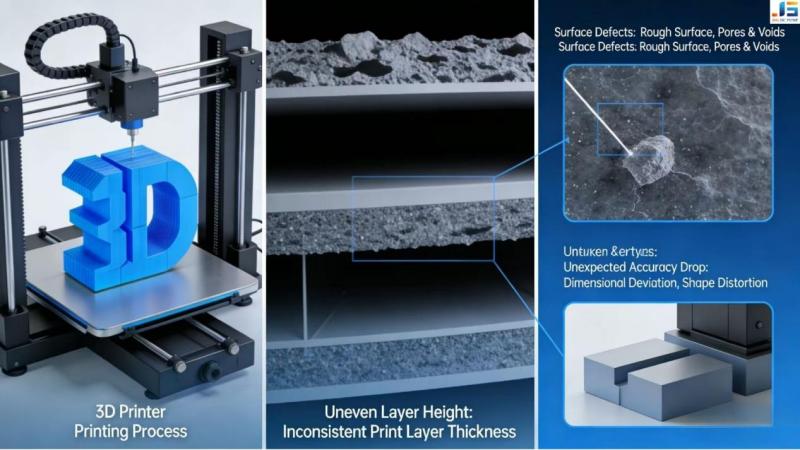
Your 3D printing system delivers inconsistent results—layers become uneven, surfaces show defects, and precision drops unexpectedly. This instability directly impacts product quality and makes process control difficult.
Stable flow micro pumps are critical in precision 3D printing because inconsistent airflow or liquid delivery leads to over-extrusion, under-extrusion, and poor repeatability. These issues typically occur when the pump cannot maintain stable output under changing load conditions, material viscosity, or system resistance.
In my experience working with micro pump systems in industrial and precision applications, I’ve seen that flow instability is one of the most underestimated causes of printing failure. On a test bench, the pump may appear stable, running under ideal voltage and minimal resistance. However, once integrated into a real 3D printing system—with nozzle backpressure, temperature variation, and dynamic material behavior—the operating conditions change significantly. The pump itself is rarely the problem; instead, the issue lies in how the pump interacts with the system. Understanding this interaction is the key to achieving stable, high-precision printing performance.
What Problems Are Caused by Unstable Micro Pump Flow?
Unstable flow is often misdiagnosed as a printer or material issue. In reality, it is a fluid control failure.
Common Defects in 3D Printing
- Over-extrusion
→ Excess material causes bulging or blobs - Under-extrusion
→ Gaps between layers - Layer inconsistency
→ Uneven thickness across prints - Surface artifacts
→ Ripple patterns or rough finishes - Dimensional deviation
→ Parts fail tolerance requirements
Hidden Consequences
- Increased material waste
- Higher rejection rates
- Reduced production efficiency
- Difficulty in process optimization
What Causes Flow Instability in Micro Pump Systems?
Flow instability is rarely caused by a single factor. It is typically a system-level issue involving pump design, control, and integration.
1. Pump Design Factors
- Single-head diaphragm pumps
→ Higher pulsation - Brushed motors
→ Speed fluctuation due to wear - Valve design limitations
→ Inconsistent flow regulation
2. System Load Variation
- Nozzle resistance changes
- Material viscosity variation
- Temperature-induced property changes
These factors shift the operating point away from the ideal condition.
3. Control and Power Issu
- No PWM control
→ Fixed speed cannot adapt - Voltage instability
→ Directly affects motor speed - Lack of feedback (FG signal)
→ No closed-loop control
4. Integration Problems
- Long or narrow tubing
- Leakage in connectors
- No buffer tank
- Filter clogging
These issues introduce additional resistance and fluctuation.
How Do Stable Flow Micro Pumps Improve 3D Printing Quality?
Stable flow pumps directly address the root causes of printing defects.
Key Improvements
- Consistent material delivery
→ Eliminates over/under extrusion - Stable pressure output
→ Ensures uniform deposition - Reduced pulsation
→ Improves surface finish - Accurate flow control
→ Enables precise process tuning
Performance Comparison
| Feature | Unstable Pump | Stable Flow Pump |
| Flow Consistency | Poor | High |
| Print Surface | Rough | Smooth |
| Accuracy | Variable | Precise |
| Repeatability | Low | High |
Which Types of Micro Pumps Are Used in 3D Printing Systems?
Different 3D printing technologies require different pump types, depending on how the material is delivered, controlled, or stabilized during the printing process. Selecting the appropriate pump category is essential for ensuring consistent flow, reliable system performance, and high printing precision.
| Pump Type | Applications | Advantages | Recommended JSG DC PUMP Models |
| Micro Air Pumps | Pneumatic extrusion systems; Pressure-assisted material feeding; Air-driven paste or viscous material control in industrial 3D printers | Fast response time enables real-time pressure adjustment; Simple system integration with low complexity; Suitable for intermittent or dynamic pressure control scenarios | 1.JSG-08AB-D (Brushless) 24V- 4.5A, 7 bar, 80 L/min |
| Mini Vacuum Pumps | Print bed adsorption for part fixation; Material handling and positioning; Vacuum-assisted stabilization in precision printing systems | Provides stable holding force for consistent positioning; Enables precise control of suction levels; Improves repeatability in automated printing processes | 2.JSG-07VB-M (Brushless) 24V-2A, -85 kPa, 35 L/min |
| Micro Liquid Pumps | Resin-based 3D printing (SLA/DLP); Inkjet and material jetting systems; Bio-printing and microfluidic applications | Delivers accurate liquid dosing for high-resolution printing; Ensures smooth and continuous flow; Supports precise control of small-volume materials in sensitive applications | 3.JSG-03WB (Brushless) 24V- 0.2A, 500 ml/min |
This classification helps engineers match pump types to specific 3D printing requirements, improving both system stability and final output quality.
From an engineering perspective, selecting a pump is not just about matching flow or pressure specifications. It is about ensuring stable performance under real working conditions, including varying back pressure, material viscosity, and continuous operation cycles. The recommended JSG DC PUMP models above are designed with brushless motor architecture, which provides higher speed stability, longer service life, and better compatibility with PWM or closed-loop control systems—making them particularly suitable for precision 3D printing applications.
How to Choose the Right Micro Pump for 3D Printing?
Selecting the correct micro pump is critical for achieving stable material delivery, consistent pressure, and overall system reliability in 3D printing applications. The right choice depends not only on flow and pressure requirements, but also on control capability, lifespan expectations, and the specific demands of the printing process.
Key Selection Logic
need high precision
→ Choose brushless micro pumps
- Stable speed output under varying load conditions
- Long lifespan suitable for continuous operation
- Supports feedback control (FG signal) for closed-loop systems
If you need low pulsation
→ Choose dual-head diaphragm pumps
- Smoother output compared to single-head structures
- Reduced flow ripple improves surface quality
- More consistent material delivery for fine-layer printing
If your system requires control
→ Choose PWM-compatible pumps
- Adjustable flow rate for different printing stages
- Adaptive to process changes such as viscosity or pressure variation
- Enables integration with advanced control systems
By aligning pump selection with real application requirements, engineers can significantly improve printing accuracy and system stability.
What Engineering Practices Ensure Stable Flow in Real Systems?
Even the best micro pump will fail to deliver stable performance if the system integration is not properly designed. In precision 3D printing, flow stability depends on the interaction between the pump, control system, fluid path, and operating conditions. Engineers must consider real-world variables such as back pressure, thermal effects, and dynamic load changes.
Recommended Engineering Practices
Maintain 15–25% flow margin
→ Avoid operating at limits
- Ensures the pump does not run at maximum capacity continuously
- Provides tolerance for pressure fluctuations and viscosity changes
Avoid startup under load
→ Prevent stalling
- High back pressure at startup can cause motor stall or delayed response
- Especially critical for diaphragm and piston pump structures
Use buffer tanks
→ Reduce pulsation
- Acts as a damping element to smooth pressure and flow fluctuations
- Improves consistency in material deposition
Optimize tubing design
→ Minimize resistance
- Shorter tubing and proper diameter reduce pressure loss
- Avoid sharp bends and leakage points
Install proper filtration
→ Prevent clogging
- Protects internal valves and diaphragms from particles
- Maintains long-term flow stability
Use stable power supply
→ Ensure consistent motor performance
- Voltage fluctuation directly affects pump speed and output
- Essential for maintaining repeatable flow in precision systems
These practices collectively ensure that the pump operates within its optimal performance window under real working conditions.
Conclusion
Stable flow is the foundation of precision 3D printing. Without it, print quality, accuracy, and repeatability cannot be guaranteed.
Key takeaways:
- Flow stability directly determines print performance
- Most defects originate from unstable fluid delivery
- Correct pump selection and integration are essential
For engineers and manufacturers, choosing a stable flow micro pump is a system-level decision, not just a component upgrade.
Looking for a reliable solution?
JSG DC PUMP offers brushless micro air, vacuum, and liquid pumps designed for stable output and precision control.
📩 Contact: admin@dc-pump.com
