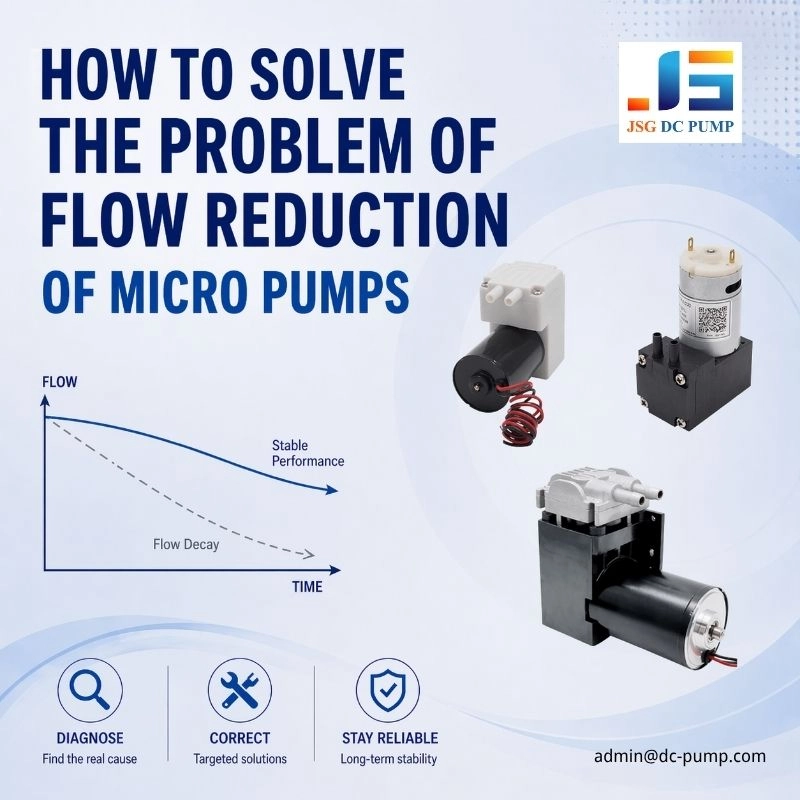
Your device may start with acceptable output, then gradually lose suction, transfer speed, dosing consistency, or evacuation performance after repeated use. Once cycle time increases or final performance weakens, this micro pump flow decay becomes a reliability issue, not a small fluctuation.
Micro pump flow decay should be handled through diagnosis first, not blind replacement. The right fix depends on whether the decline comes from internal wear, valve fatigue, contamination, leakage, media change, or an operating condition that is pushing the pump out of its stable range.
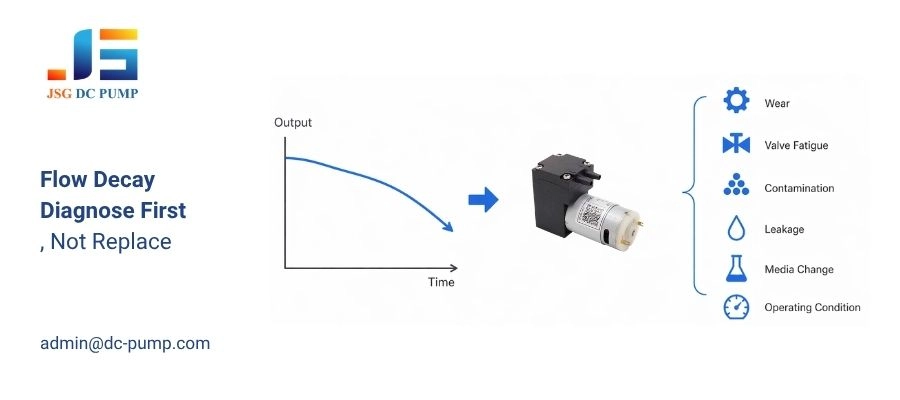
Micro Pump Flow Decay Diagnosis
Based on JSG DC PUMP’s application and manufacturing experience dating back to 2003, flow decay is rarely caused by a single factor. It usually occurs when the pump structure, medium, duty cycle, and actual system load no longer match over time. Therefore, the issue should be evaluated from several angles rather than simply concluding that the pump has become weak.
What Does Flow Decay Actually Mean in a Micro Pump?
Your pump may still run and still produce some output. That is exactly why early decay is often missed.
Flow decay means the pump is delivering less useful output than before under the intended application condition. It is not just a temporary fluctuation or a one-time test error. It is a sustained reduction in real working performance.
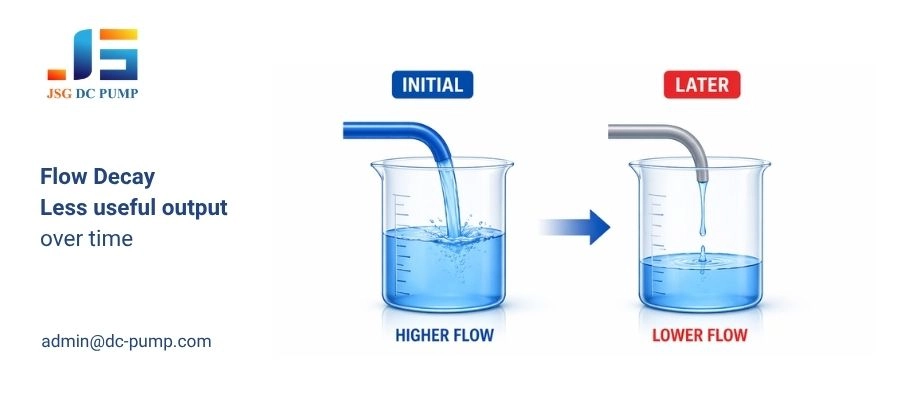
Micro Pump Flow Decay Output Reduction
In practice, that decline may appear as slower filling, weaker suction, reduced transfer volume, poorer dosing repeatability, or longer time to reach the target pressure or vacuum. The key point is that flow decay should be judged by functional result, not by whether the motor is still turning. A pump can remain mechanically active while already losing effective displacement, sealing efficiency, or one-way transfer quality.
Why Is Early Flow Decay So Hard to Notice in Micro Pumps?
Your device may still pass a basic function check while output looks acceptable. Early performance decay is easy to miss at this stage.
Early flow decay is hard to notice because it usually does not begin as an obvious failure. It often appears as a slight loss of efficiency, a small increase in cycle time, or a mild drop in output consistency while the pump still seems to run normally.
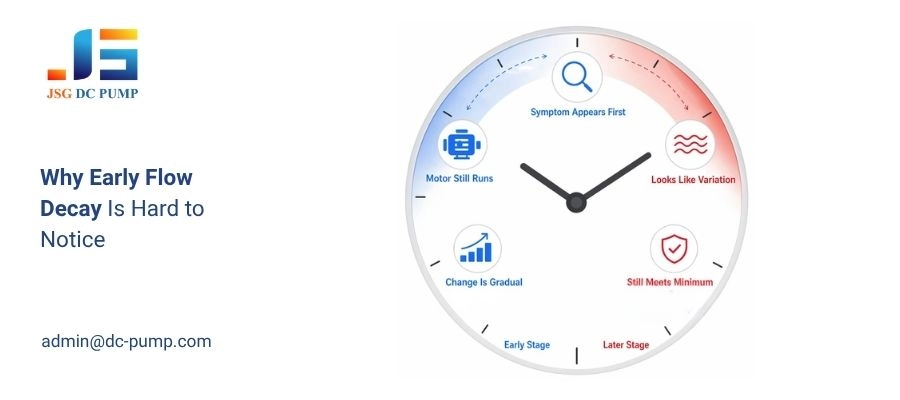
Early Micro Pump Flow Decay Warning Signs
Why the early stage gets overlooked
- The motor still runs
Users often judge pump condition by whether it starts, sounds normal, or keeps cycling. That can hide a meaningful decline in useful output. - The change is gradual
A 5% or 10% loss may not be obvious in one short check, but it becomes serious after repeated cycles or longer operating periods. - The symptom appears in the device first
Teams may notice weaker suction, slower refill, or poorer spray result before they notice anything abnormal at the pump itself. - Early decay looks like normal variation
Small differences are often blamed on temperature, testing inconsistency, or medium variation, so the real trend is missed. - The system may still meet the minimum requirement
The pump can remain “good enough” for a while, even though its stability margin is already shrinking.
These mechanisms reduce flow in different ways. Some lower displacement efficiency, some increase reverse loss, and some add resistance. That is why “flow dropped” is not one generic failure mode.
What Usually Causes Flow Decay to Start?
Your pump may still lose output, but the real cause may not be inside the pump. The label “pump problem” is often too broad to support effective correction.
Flow decay usually starts from valve fatigue, diaphragm or elastomer aging, internal leakage growth, contamination buildup, media-related material change, or long-term operation under excessive stress. These mechanisms reduce useful output in different ways, so they should never be treated as one generic failure mode.
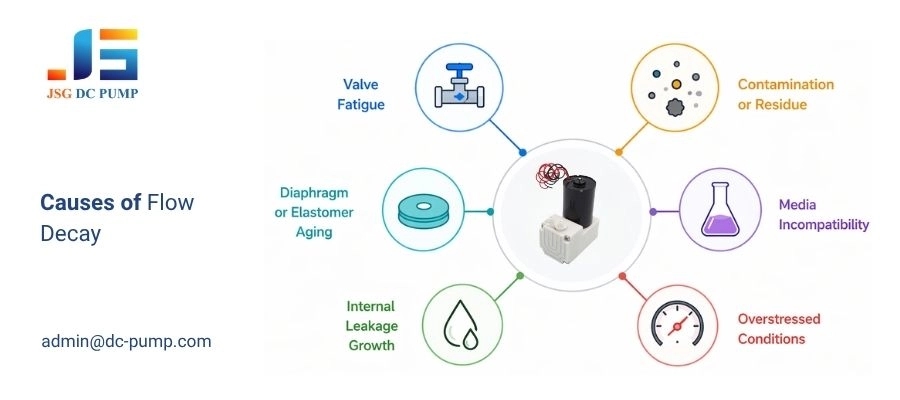
Causes of Micro Pump Flow Decay
Common root-cause categories
- Valve fatigue
The valve may still move, but its one-way transfer efficiency becomes weaker. - Diaphragm or elastomer aging
Repeated deformation can reduce rebound quality and displacement consistency. - Internal leakage growth
Worn sealing surfaces can allow part of the moved volume to slip back. - Contamination or residue
Fine particles, condensate, oil mist, or process residue can increase resistance or disturb sealing. - Media incompatibility
Poor material matching can lead to swelling, hardening, or chemical degradation. - Overstressed working conditions
High back pressure, deep vacuum demand, long-duty operation, or repeated thermal loading can accelerate decline.
In one portable sampling device project, longer evacuation time was first blamed on pump aging. But the replacement pump only brought short-term improvement. The real cause was condensate buildup and higher upstream filter resistance. Once the filter and drainage design were corrected, stable performance returned.
How Can You Tell Real Pump Decay from False Flow Loss?
Your system may show weaker performance even when the pump itself has not truly degraded. False diagnosis often leads teams to replace the wrong part.
Real pump decay must be separated from blockage, leakage, power instability, and changing process conditions before any replacement decision is made. If that step is skipped, the same performance problem often returns even after a new pump is installed.
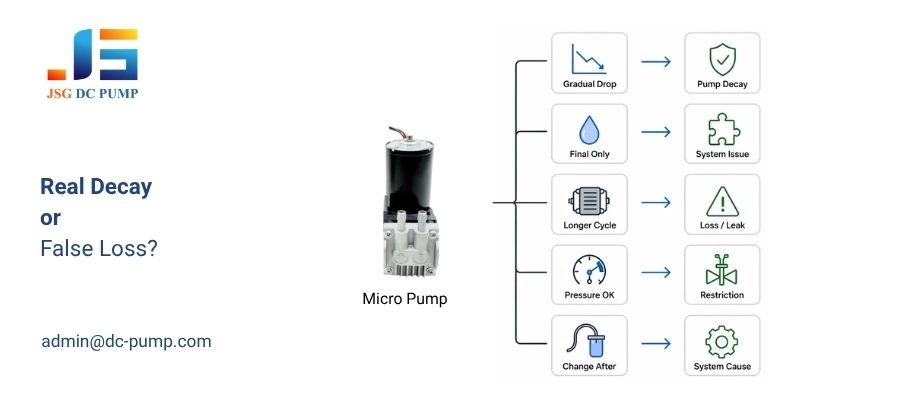
Real Micro Pump Flow Decay or False Flow Loss
| Observed sign | More likely meaning |
| Output drops gradually in all conditions | Real pump-side decay is possible |
| Output drops only in the final device | System resistance or integration issue is more likely |
| Motor runs normally but cycle time gets longer | Efficiency loss, restriction, or leakage may be present |
| Pressure or vacuum still forms, but flow weakens | Restriction or valve-efficiency loss is possible |
| Performance changes after tubing, filter, or medium changes | System-side cause is highly likely |
How Should Engineers Correct Flow Decay Without Guesswork?
Your pump may seem like the easiest part to replace first. Path, medium, and control-side problems can be missed when replacement becomes the first reaction.
Engineers should correct flow decay in sequence: confirm the symptom under the real task, isolate system-side resistance from pump-side loss, inspect leakage and power condition, and only then decide whether cleaning, redesign, material correction, or pump replacement is necessary. A structured process is what turns troubleshooting into a durable fix.
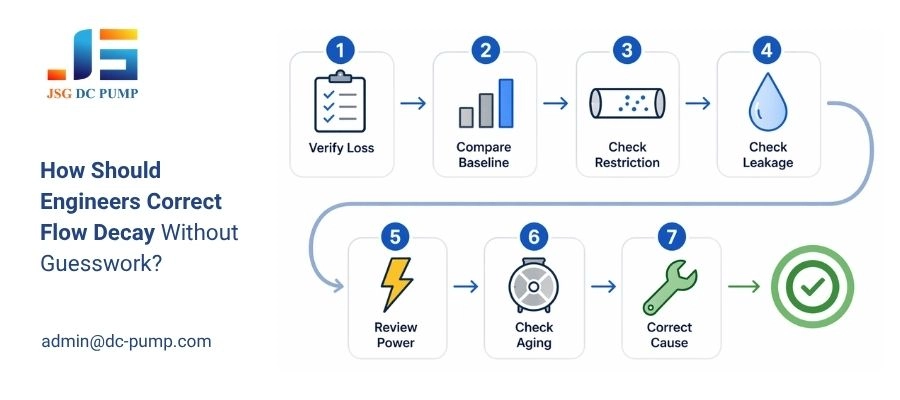
Micro Pump Flow Decay Correction Process
A practical correction sequence
- Verify the real output loss
Check whether transfer time, suction result, dosing result, or evacuation time has truly worsened in the actual application. - Compare against the original validated condition
Use the same medium, tubing, load, voltage, and target condition that were present when the system performed correctly. Use the micro pump sample validation checklist to record the setup before comparing results. - Inspect restriction first
Review filters, tubing bends, connectors, residue, narrowed passages, and outlet geometry before assuming pump wear. - Inspect leakage next
Check joints, chambers, seals, and interfaces where useful transfer may be lost. - Review power and control behavior
Low voltage, unstable drive, or poor PWM strategy can reduce effective output without internal pump damage. - Check internal aging last
Valve fatigue, diaphragm aging, and seal deterioration become credible causes only after external factors are ruled out. - Correct the cause, not only the symptom
The answer may be cleaning, path redesign, material upgrade, control adjustment, or pump replacement depending on what the diagnosis shows.
Which Design Choices Most Strongly Influence Long-Term Flow Stability?
Your pump may start strong in early testing, but lose usable output too soon in real service. Early design choices often decide whether long-term flow stability can hold.
Long-term flow stability is strongly influenced by operating margin, media compatibility, contamination control, thermal exposure, and whether the pump platform is matched to the actual duty cycle. A pump that only meets the target on day one is not always the pump that stays stable across the service life of the product.
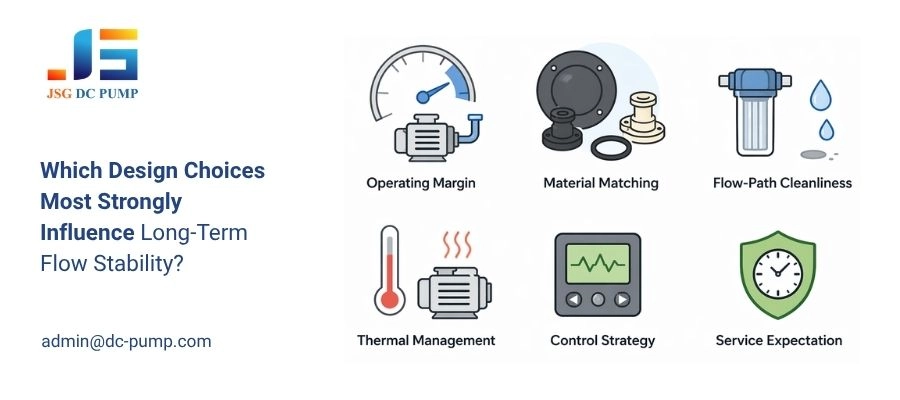
Micro Pump Flow Stability Design Choices
The design choices that matter most
- Operating margin
A pump selected too close to its practical limit tends to drift faster under real load. - Material matching
Diaphragm, valve, and seal materials must match the medium, humidity, vapor exposure, and chemical environment. - Flow-path cleanliness
Upstream filtration, condensate management, and residue control are often just as important as pump selection. - Thermal management
Repeated heat buildup can change material response and accelerate long-term output decline. - Control strategy
Aggressive cycling, harsh restarting, or unstable drive conditions can make flow stability worse over time. - Service expectation
If the application demands long, consistent output over high usage hours, the pump platform should be chosen for endurance, not only initial performance.
Which Micro Pump Configurations Better Resist Long-Term Flow Decay?
Your application may not need the strongest pump on paper. It needs a pump that can hold stable output under the real medium, duty cycle, and service condition.
The configurations that resist flow decay best are the ones whose motor type, material system, and operating range match the real application instead of only meeting an initial flow target. Better long-term stability usually comes from the right pump platform choice, not from choosing the highest headline spec.
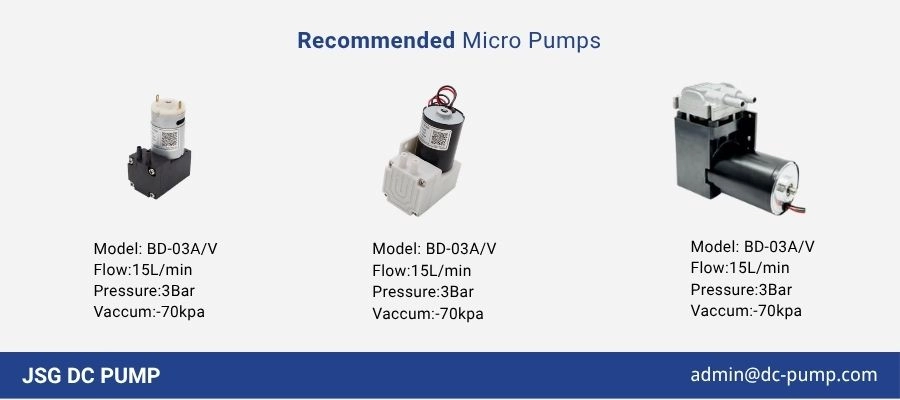
Recommended Micro Pumps for Flow Stability
| Application condition | What JSG DC Offers | Main benefit |
| Intermittent use, moderate load, cost-sensitive design | BD-03A/V
Flow:3-6L/min Vacuum: –60 to –70 kPa Pressure:2-3bar Lifespan:1000hours |
Practical choice when duty is limited and service expectations are moderate |
| Longer-duty operation, tighter consistency target | BD-04A/VB
Flow:11-20L/min Vacuum: –75 to –80 kPa Pressure:2.5-3.5bar Lifespan:5000hours |
Better endurance and more stable long-term behavior |
| Higher-load working target | BD-07A/VB-M
Flow:17-40L/min Vaccun:-80~-85kpa Pressure:4.5-6.5bar Lifespan:3000hours |
Lower overstress and slower performance drift |
Brushed pumps can still work well in moderate-duty applications. For higher long-term consistency, brushless designs are usually safer.
Conclusion
Micro pump flow decay is a serious reliability issue, but it is usually manageable when the real cause is identified correctly. The key is to diagnose the source clearly, then solve it through targeted correction and better pump matching.
If you are developing a compact device and need support with pump selection, long-term flow stability evaluation, or brushed versus brushless design matching, JSG can help. Contact us at admin@dc-pump.com.