Solution

Why Is My Vacuum Diaphragm Pump Losing Suction? Causes and Fixes

Vacuum diaphragm pump with red and black wires on a blue industrial background, article title “Why Is My Vacuum Diaphragm Pump Losing Suction?”

A vacuum diaphragm pump that no longer reaches its expected vacuum is not necessarily defective. The most common causes are a leak in the external circuit, a restricted filter or tube, insufficient voltage at the pump terminals, operation outside the rated duty cycle, moisture or particles in the air path, or wear in the diaphragm and valves.

Start with measurements that do not require opening the pump. Record the vacuum directly at the pump inlet, then reconnect the filter, tubing, fittings, and chamber one section at a time. This separates a pump problem from a system problem quickly and safely.

Quick Diagnostic Table

Symptom Likely area First check
Vacuum is normal at the pump inlet but weak at the device External leak or restriction Isolate the filter, tubing, fittings, and chamber one section at a time.
Vacuum is weak directly at the inlet and motor speed sounds low Power supply or wiring Measure voltage at the pump terminals while the pump is running.
Vacuum starts normally and falls as the pump warms Thermal load or duty-cycle mismatch Check the actual working point, ambient temperature, ventilation, and rated duty cycle.
Performance dropped after moisture or particles entered the line Wet filter, contaminated valve, or damaged elastomer Disconnect the pump, replace or dry external components, and contact the manufacturer before internal service.
Motor runs with abnormal clicking, vibration, or unstable speed Mechanical wear, contamination, or unstable supply Stop the pump and compare voltage, current, sound, and vacuum with the model specification.

JSG DC PUMP has manufactured miniature pumps since 2003. The troubleshooting sequence below is designed for OEM engineers and service teams: verify the external pneumatic circuit first, then the electrical supply and operating conditions, and only then consider internal wear.

How Can External Leaks Cause a Major Loss of Suction?

You can hear the pump running hard, but the vacuum gauge won’t budge. It feels like you’re trying to empty a pool with a leaky hose. The problem might not be the pump at all.

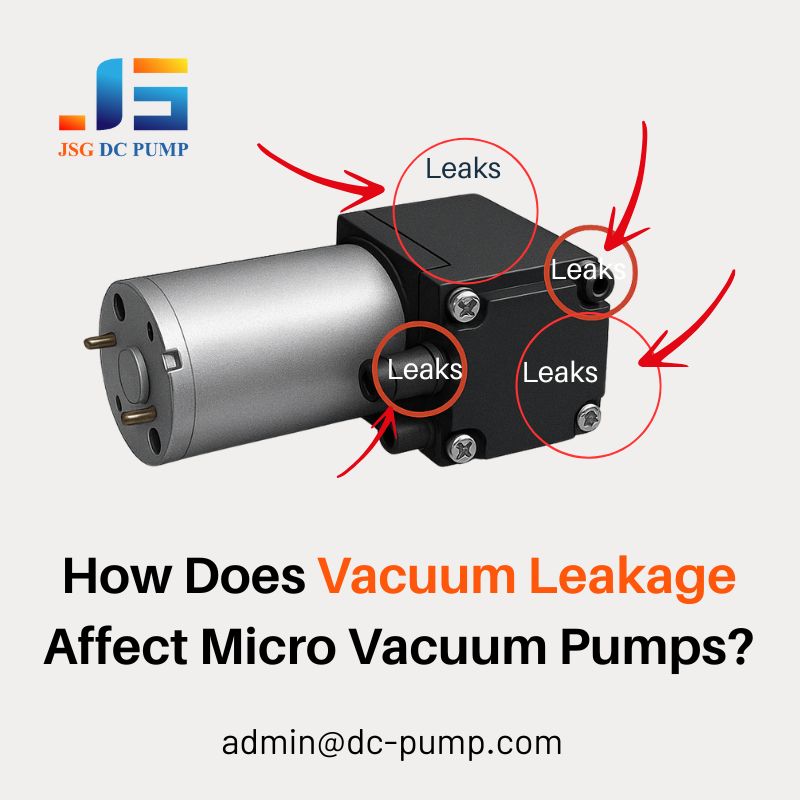
Even a tiny, invisible pinhole leak in a tube or fitting can destroy your vacuum. Instead of removing air from your system, the pump just pulls in an endless supply of outside air. The first step in any diagnosis is to meticulously inspect every external connection.

A Systematic Leak-Finding Method

Start at the pump inlet and move toward the application. Change only one connection at a time so that each measurement has a clear meaning.

  • Inspect the line: Look for cracked tubing, distorted tube ends, loose clamps, damaged O-rings, and fittings that are not fully seated.
  • Measure at the pump: Connect a suitable vacuum gauge directly to the inlet and compare the result with the model’s test data at the same voltage and operating conditions.
  • Isolate sections: Reconnect the filter, tubing, valves, and chamber one section at a time. The section that causes the vacuum to fall is the first place to investigate.
  • Use a dry leak test where possible: A vacuum-decay or rate-of-rise test is more informative than judging suction by touch. Avoid drawing soap solution or other liquid into the pump inlet; it can contaminate the valves and diaphragm. Use liquid leak detection only when the pump is isolated and the approved service procedure permits it.
Inspecting vacuum tubing and fittings for an air leak
Inspect the external vacuum circuit before opening the pump.

Common Leak Points and Their Solutions

Leak Location Common Cause How to Fix
Tube Connections Loose fitting or cracked tube Re-seat the tube, tighten the clamp, or trim the end of the tube and re-insert.
Filter Housings Improperly sealed threads or O-ring Unscrew the housing, check the O-ring for damage, and re-tighten securely.
Vacuum chamber or device Worn gasket or seal Inspect the gasket for cracks or compression; replace if it looks damaged.

Could a Simple Clog Be Suffocating Your Vacuum Diaphragm Pump’s Performance?

Your pump motor sounds perfectly healthy, but almost no air is moving through the system. You’ve checked for leaks and found nothing. The pump may be trying to breathe through a blocked straw.

A blockage in the air pathway will prevent the pump from creating a vacuum, even if it’s in perfect working order. Debris, dust, or moisture can easily clog inlet filters, tubing, or the pump’s own valve system, effectively suffocating its performance.

Diagnosing a Blockage

A restriction is found by removing external components one at a time and repeating the same vacuum or flow measurement.

  • Check the inlet filter: Replace a disposable filter that is wet, discolored, or loaded with particles. Clean a reusable filter only according to its manufacturer’s instructions.
  • Inspect disconnected tubing: Look for kinks, collapsed walls, condensed liquid, or debris. Clean or replace the tube away from the pump. Do not blow contamination toward the pump inlet.
  • Test the pump directly: With external tubing removed, measure vacuum at the inlet using a suitable gauge. A finger test is not quantitative and cannot confirm whether the pump meets its specification.
Comparison of a clean and blocked vacuum pump inlet filter
A saturated or blocked inlet filter can reduce flow and slow vacuum generation.

Internal vs. External Restrictions

Observation Likely location Next step
Normal vacuum at the pump inlet but weak performance at the end of the line External filter, tube, fitting, valve, or chamber Continue section-by-section isolation.
Weak vacuum directly at the pump inlet after voltage and operating conditions are verified Possible internal contamination, valve leakage, diaphragm wear, or motor-speed issue Stop the pump and contact the manufacturer or an authorized technician.

Do not open the pump head unless the model is designed to be serviced and you have the correct procedure and replacement parts. Opening a factory-assembled pump can affect valve alignment, sealing, calibration, and warranty coverage.

Are the Diaphragm or Valves Worn or Contaminated?

After external leaks, restrictions, supply voltage, and operating conditions have been ruled out, weak vacuum at the pump inlet may point to an internal issue. Particles can prevent a valve from sealing; moisture or incompatible vapor can change elastomer properties; fatigue can eventually reduce diaphragm stroke or sealing performance.

Internal service is model-specific. Some pumps have approved service kits, while others are intended to be replaced as an assembly. Contact JSG with the model number, serial or batch information, operating medium, working vacuum, supply voltage, accumulated hours, and a description of the failure before disassembly.

Repair or Replace?

Observation Possible cause Recommended action
Vacuum declined gradually while voltage and external circuit remain normal Valve contamination, elastomer fatigue, bearing wear, or reduced motor speed Request model-specific inspection guidance.
Vacuum dropped suddenly after liquid or particles entered the inlet Contaminated or damaged valves/diaphragm Stop operation and report the incident before restarting.
Abnormal clicking, knocking, or vibration Loose, worn, or damaged moving component Disconnect power and have the pump inspected.
Critical equipment with uncertain service history Multiple possible wear mechanisms Compare the risk and downtime of repair with replacement and revalidation.

Is the Pump Receiving the Correct Voltage and Current?

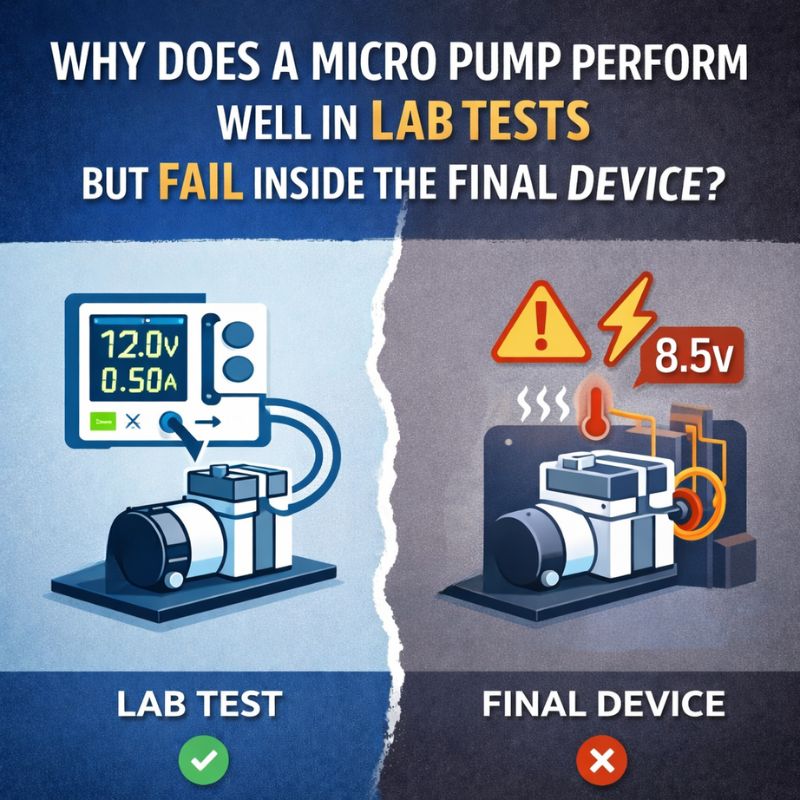
Pump performance depends on motor speed, and motor speed depends on the voltage available at the pump while it is running. A supply that reads correctly with no load can still sag during startup or at the actual working point.

Measuring voltage at a DC vacuum pump while it is running
Measure voltage at the pump terminals under load, not only at the power supply output.

Electrical Checklist

Parameter What to verify Why it matters
Operating voltage Voltage at the pump terminals must remain within the model’s specified range while running. Voltage drop reduces motor speed and can reduce vacuum and flow.
Peak and running current The supply and protection circuit must accommodate the model’s measured or specified startup and working current. A fixed multiplier is not reliable for every motor and controller.
Wiring and connectors Check wire gauge, length, connector resistance, loose terminals, and ground return. Resistance in the supply path creates voltage drop under load.
Polarity and control input Follow the wiring diagram for the exact brushed or BLDC model, including PWM/enable leads where applicable. A brushed motor may reverse with reversed polarity; a BLDC controller may not start or may enter protection.

Record voltage and current at the same time as vacuum. Those three measurements make it much easier to distinguish an electrical problem from a pneumatic or mechanical one.

Does Vacuum Fall as the Pump Warms Up?

If the pump reaches the expected vacuum when cold but performance falls after the temperature stabilizes, check the real operating point and thermal environment. Continuous operation near maximum pressure or vacuum, high ambient temperature, restricted ventilation, or an unsuitable duty cycle can raise the temperature of the motor and pump head.

Thermal Checks

Check What to record Recommended action
Working point Vacuum or pressure and flow during normal operation Compare the working point with the model’s curve and approved operating range.
Duty cycle On/off time and cycle frequency Use the duty cycle stated for the exact model; do not assume that every brushless pump is continuous-duty.
Ambient and enclosure Ambient temperature, nearby heat sources, and available airflow Improve ventilation or reduce thermal load if the application exceeds the validated conditions.
Temperature trend Pump temperature and vacuum after a repeatable warm-up period Share the trend with the manufacturer for model-specific evaluation.

Stop the test if temperature, current, sound, or vibration becomes abnormal. A pump intended for continuous operation still needs to be validated at the actual load, voltage, ambient temperature, mounting orientation, and enclosure conditions.

Is the Pump Correctly Sized for the Application?

A healthy pump may appear weak when it was selected only by maximum open flow or maximum vacuum. Those endpoint values are not the same as the flow available at the required working vacuum.

  • Working vacuum and flow: Locate the target operating point on the model’s vacuum-flow curve. If the required point lies outside the tested curve, select another model or reduce system resistance.
  • Evacuation time and system volume: A pump can eventually reach the target vacuum but still be too slow for the application’s cycle time.
  • Leak rate: The pump must remove air faster than it enters through seals, valves, porous materials, and process leakage.
  • Gas and moisture: State whether the medium is dry air, humid air, vapor, or another gas. Condensation can block filters and affect valves.
  • Material compatibility: EPDM, FKM, PTFE, and other materials have different strengths and limitations. There is no universally best elastomer; confirm compatibility for the exact gas, concentration, temperature, and exposure time.

For a new design, send the pump manufacturer the target vacuum, required flow or evacuation time, chamber volume, leak rate, voltage, ambient temperature, duty cycle, noise limit, medium, tubing size, and space constraints. This is more reliable than selecting by one maximum specification.

Conclusion

Diagnosing suction loss in a vacuum diaphragm pump is a process of elimination. Measure vacuum directly at the pump, then add the external components one at a time. Verify voltage at the pump terminals under load, check the real duty cycle and temperature, and avoid opening the pump unless the model has an approved service procedure.

After correcting a suspected fault, use the sample validation checklist to record the setup and compare results under consistent conditions.

For model-specific support, send JSG DC PUMP:

  • pump model and rated voltage;
  • measured terminal voltage and current while running;
  • vacuum directly at the inlet and vacuum at the application;
  • required flow or evacuation time;
  • ambient temperature, duty cycle, and enclosure details;
  • gas, humidity, or possible liquid/particle exposure;
  • photos of the tubing, filter, fittings, and test setup.

Contact our engineering team at admin@dc-pump.com for troubleshooting and pump selection support.

Related Posts