

Engineering Guide for OEM Equipment
Miniature Vacuum Pump Selection Guide
Select a miniature vacuum pump from the required working vacuum and flow under load—not only free flow or maximum vacuum. Chamber volume, tubing resistance, filters, valves, leakage, altitude and duty cycle all change the real evacuation time.
Start With the Actual Vacuum Working Point
A suitable pump must deliver enough flow at the normal operating vacuum while meeting the equipment’s size, power, noise and duty requirements.
Working vacuum
Specify the normal vacuum level and whether it must be held, cycled or reached only once.
Flow under load
Use the flow required at the working vacuum, rather than relying only on the free-flow value.
Evacuation time
Provide chamber volume, initial condition, target vacuum and the maximum permitted time.
Duty cycle
Define continuous or intermittent operation, cycle duration, ambient temperature and cooling conditions.
Choose the Vacuum Pump Mechanism
The mechanism and motor should be selected together with the pneumatic circuit and operating profile.
Before choosing a pump mechanism, compare vacuum pumps and Venturi generators to decide which vacuum source fits the available utilities and operating cycle.
Diaphragm vacuum pumps
Suitable for compact, oil-free gas handling where size, controllability and isolation of the gas path are important.
Piston vacuum pumps
Consider a piston platform when the system needs higher flow, stronger pneumatic output or a different pressure-vacuum balance.
Brushed or brushless motor
BLDC options can support electronic speed control and defined operating profiles. Final noise, life and thermal behavior must be verified for the selected duty.
Vacuum Pump Selection Data
Send the information below before a model is recommended or a sample plan is prepared.
| Selection item | What to provide | Why it matters |
|---|---|---|
| Working vacuum | Normal operating vacuum, tolerance and whether the system must maintain or cycle the vacuum. | Maximum vacuum alone does not define the usable operating point. |
| Flow or response time | Required flow at vacuum, or chamber volume and permitted evacuation time. | Determines the usable pump size and system response. |
| Gas condition | Gas composition, humidity, condensate, particles and temperature. | Affects wetted materials, filtration and contamination controls. |
| Pneumatic circuit | Tube length and diameter, valves, filters, silencers, restrictions and expected leakage. | System resistance can reduce effective flow and slow evacuation. |
| Electrical interface | Voltage, allowable current or power, startup limit, PWM and required feedback signal. | Confirms motor and driver compatibility. |
| Duty and environment | Continuous or intermittent duty, cycle time, ambient temperature, altitude and noise target. | Required for thermal, acoustic and reliability validation. |
| Mechanical integration | Available space, mounting points, port direction, tube size, connector and wire length. | Prevents redesign after the pneumatic performance is approved. |
System Factors That Change Vacuum Performance
The same pump can produce different results in different equipment because the complete pneumatic path defines the system load.
Tubing and fittings
Long, narrow or sharply bent tubing increases restriction and reduces effective flow.
Filters and valves
Pressure drop, opening behavior and contamination over time can change the working point.
Leakage and seals
Small leaks may prevent the target vacuum from being reached or increase pump operating time.
Altitude and temperature
Ambient pressure, air density and heat dissipation should be considered in the validation condition.
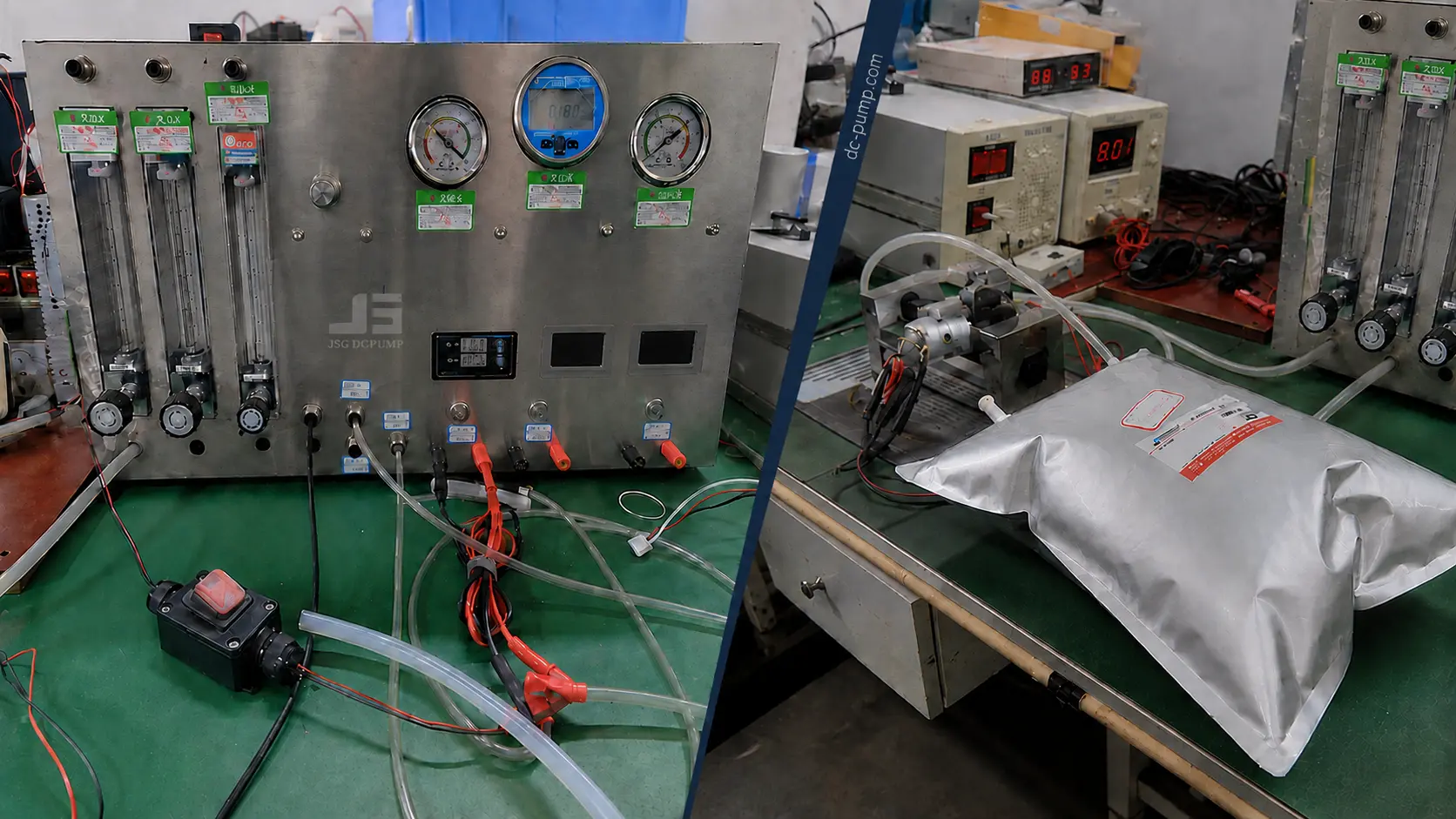
Validate the Pump in the Actual Pneumatic Circuit
Before final approval, sample testing should reproduce the chamber, tubing, filters, valves, power supply and operating cycle used by the equipment.

From Requirement to Approved Pump Configuration
A controlled selection process reduces the risk of choosing a pump from endpoint specifications alone.
Define the load
Confirm working vacuum, required flow or evacuation time, gas condition and system resistance.
Match platforms
Compare suitable diaphragm or piston pump platforms and motor options.
Review integration
Check voltage, control, space, ports, tubing, mounting, noise and environment.
Test samples
Validate the proposed configuration in a representative circuit and duty cycle.
Freeze the version
Confirm model, materials, wiring, connector, performance criteria and required documentation.
Frequently Asked Questions
Can maximum vacuum be used to select the pump?
No. Maximum vacuum is an endpoint. Selection should be based on the flow available at the normal working vacuum.
Why is the evacuation time slower in the equipment?
Tubing, filters, valves, chamber volume, leakage and the power supply can reduce effective system performance.
When should a BLDC vacuum pump be considered?
Consider BLDC when the application needs electronic speed control, defined operating profiles or a different motor-life strategy. The complete duty still requires validation.
Can one pump handle moisture or particles?
Exposure must be defined first. The system may require filtration, separation, drainage, a different orientation or different wetted materials.
What should be sent for a pump recommendation?
Send the working vacuum, required flow or evacuation time, gas condition, voltage, duty, space, control method and estimated quantity.
Does a pump certificate cover the complete equipment?
No. Pump documentation does not replace the regulatory assessment required for the customer’s complete device.
Related Micro Pump Resources
Request a Vacuum Pump Working-Point Review
Send the target vacuum, required flow or evacuation time, gas condition, voltage, duty cycle, installation space, control method and estimated quantity. We will identify suitable pump platforms and the tests needed for confirmation.
Send Your Pump Selection Requirements
Provide the real working point and application conditions. JSG engineers can use these details to shortlist suitable pump platforms and define the tests needed before approval.
