

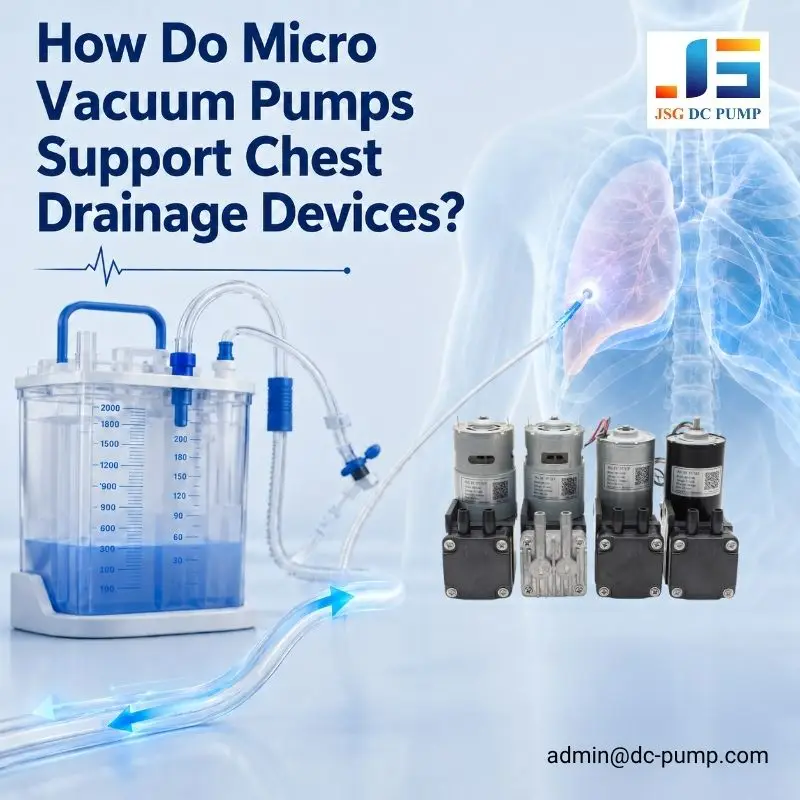
Your chest drainage device may look like a simple negative pressure system, but its real performance depends on how steadily the vacuum source works during operation.
A micro vacuum pump supports chest drainage devices by creating controlled negative pressure and helping the system maintain a stable suction environment. Instead of working as a simple on/off suction part, it becomes the active pressure source behind drainage consistency, vacuum recovery, and system reliability.
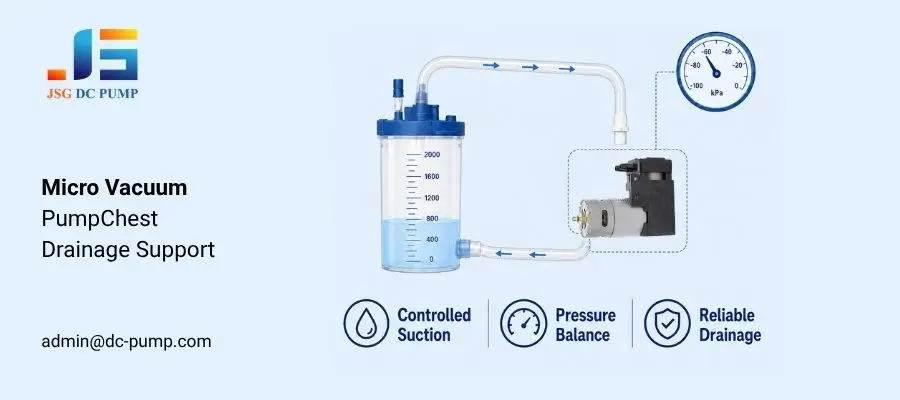
As a JSG engineer with more than 20 years of micro pump application experience, I often see development teams focus first on the drainage bottle, tube layout, or outer device structure.These parts are important, but the vacuum pump’s performance ultimately determines if the complete system can maintain stable negative pressure when facing real-world challenges like leakage, resistance, chamber volume, and extended working times.
Why Do Chest Drainage Devices Need Stable Negative Pressure?
Your chest drainage device may drain air or fluid, but the process must happen in a controlled and predictable way.
Chest drainage devices need stable negative pressure because the system must support continuous air or fluid removal without sudden suction changes. A weak vacuum may reduce drainage efficiency, while excessive or unstable suction can make system control more difficult.
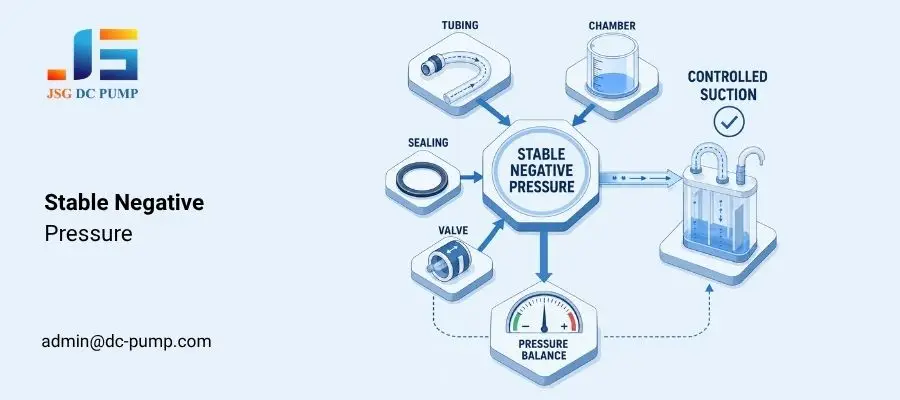
From an engineering perspective, the key issue is pressure balance. The pump must help the device maintain a suitable working pressure after tubing resistance, chamber volume, sealing condition, and valve structure are included. This is why stable operating performance is more important than only chasing a high maximum vacuum value.
What Role Does a Micro Vacuum Pump Play in Chest Drainage?
Your pump may be listed as one component in the device, but its function affects the whole negative pressure path.
The micro vacuum pump works as a dynamic negative pressure management unit. It creates the initial suction, helps recover vacuum after pressure loss, and supports more consistent pressure control during drainage.
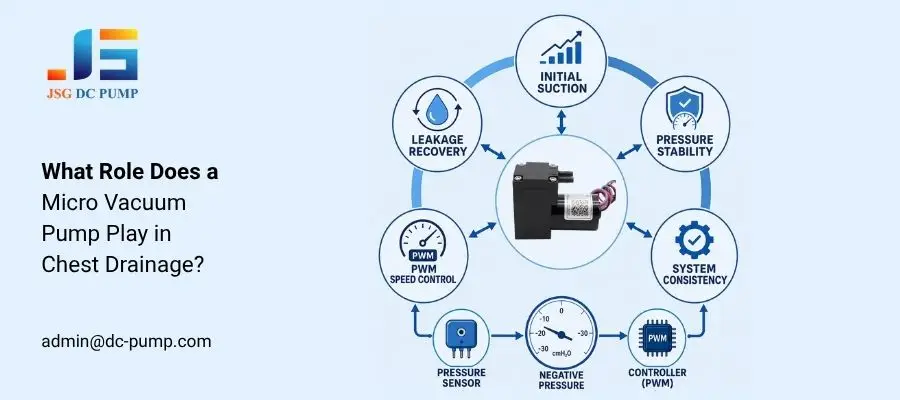
The pump mainly supports:
1.Initial negative pressure generation
2.Vacuum recovery after small leakage
3.Pressure stabilization during drainage
4.Speed adjustment through PWM control
5.System-level suction consistency
With a pressure sensor and controller, the pump can support closed-loop pressure control. The controller reads pressure changes and adjusts pump speed, reducing reliance on simple start-stop operation.
How Does a Chest Drainage System Work With a Micro Vacuum Pump?
Your chest drainage system may include several passive parts, but the airflow path only works effectively when the vacuum source is properly controlled.
The micro vacuum pump creates negative pressure inside the collection chamber. This pressure is transferred through the tubing and helps guide air or fluid from the pleural space into the drainage system.
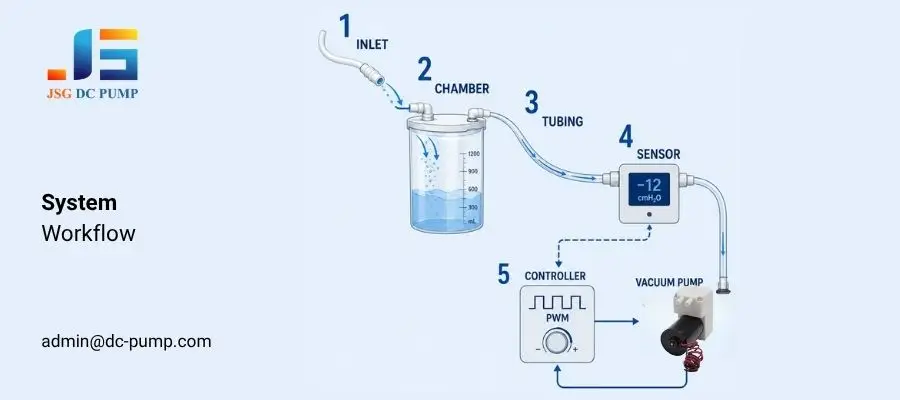
Basic working process:
1.The micro vacuum pump creates negative pressure in the collection chamber.
2.The pressure is transferred through the connected tubing.
3.Air or fluid moves from the pleural space into the chamber.
4.The pressure sensor monitors system changes.
5.The controller adjusts pump speed when pressure correction is needed.
This section is mainly about system workflow, not only pump output. The pump, chamber, tubing, sensor, and controller must work together, so pump response speed and controllability directly affect the complete drainage path.
What Medical Applications Can Micro Vacuum Pumps Support in Chest Drainage?
Your chest drainage device may be used in different clinical scenarios, and each scenario may place different demands on vacuum stability and flow control.
Micro vacuum pumps can support chest drainage equipment used for pneumothorax management, pleural fluid drainage, hemothorax drainage, and post-thoracic surgery recovery support.
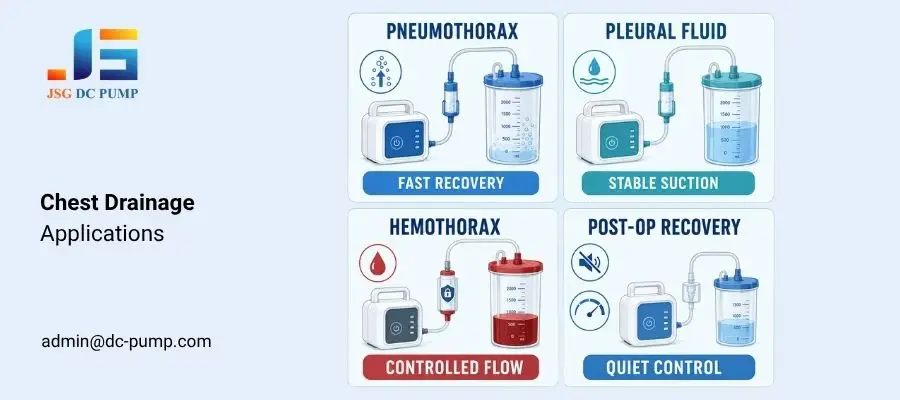
For pump selection, these applications should not be treated as one identical load condition. Air removal usually requires responsive vacuum recovery, while fluid drainage may place more attention on continuous suction stability and system protection. Post-operative drainage may also require quieter operation, longer working time, and smoother pressure regulation.
Which Pump Parameters Matter Most for Chest Drainage Equipment?
Your pump may show strong performance on a datasheet, but the final device may create a very different working condition.
For chest drainage equipment, engineers should evaluate the pump according to working vacuum, flow stability, motor type, noise, control method, material compatibility, and installation structure.
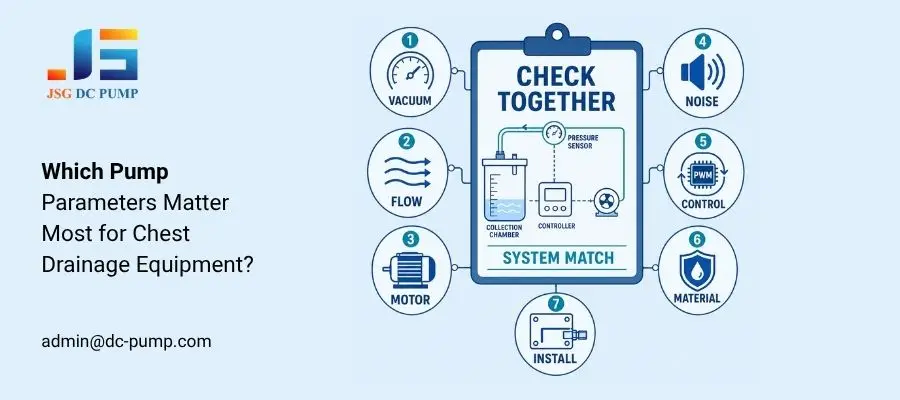
| Parameter | Why It Matters | Engineering Notes |
| Working Vacuum Range | Affects suction control | Match the required working pressure, not only the peak vacuum value |
| Flow Stability | Affects drainage consistency | Verify output after the pump is connected to the real air path |
| Motor Type | Affects lifetime and reliability | Brushless motor is often preferred for longer operating cycles |
| Noise and Vibration | Affects bedside or portable use | Lower noise and softer mounting help improve device experience |
| Control Method | Affects pressure regulation | PWM or closed-loop control may be required |
| Material Compatibility | Affects long-term reliability | Check moisture, gas contact, and sealing material requirements |
These parameters should be checked together instead of separately. For example, a pump with enough vacuum may still be unsuitable if noise is too high, motor life is too short, or control response is not stable enough for the final device.
How Should Engineers Select a Micro Vacuum Pump for Chest Drainage Devices?
Your project may face redesign later if the pump is chosen only from catalog values.
Engineers should build the selection process around real device behavior. The pump should be tested with the actual tubing, chamber, sensor, valve, filter, and control logic before final confirmation.
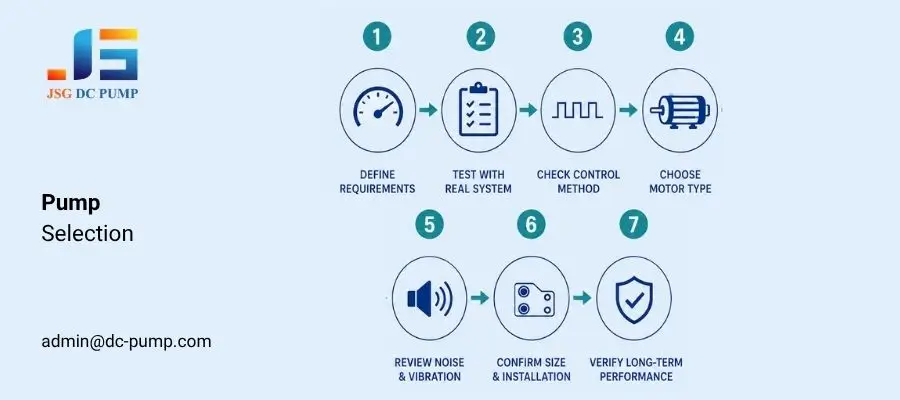
When selecting a micro vacuum pump for chest drainage equipment, engineers should focus on these key steps:
1.Define the required working vacuum and recovery speed.
2.The pump with the real drainage structure.
3.Check whether PWM control or closed-loop pressure control is needed.
4.Choose the motor type according to duty cycle and reliability target.
5.Review noise and vibration under actual installation conditions.
6.Confirm pump size, connector direction, and mounting position.
7.Verify long-duration performance before moving to final design.
Sample testing is especially important for medical drainage equipment. During validation, engineers should monitor pressure stability, temperature rise, vibration, noise, power consumption, and long-term output consistency.
Which DC-PUMP Micro Vacuum Pump Solutions Can Support Chest Drainage Equipment?
Your chest drainage project may need a compact vacuum source.The correct model depends on pressure range, flow demand, working time, and device structure.
For chest drainage equipment, DC-PUMP offers different micro vacuum pump platforms.Selection can match device size, vacuum demand, duty cycle, control method, and OEM integration needs.
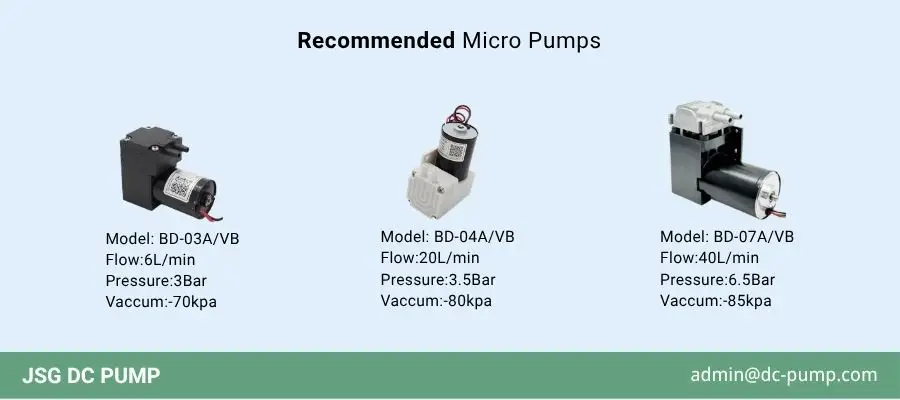
| DC-PUMP Solution | Recommended Models | Suitable Requirement | Engineering Support |
|---|---|---|---|
| Compact Micro Vacuum Pump | BD-03V / BD-04V | Compact suction, moderate vacuum, limited space | Suitable for small suction modules, portable drainage devices, and compact negative pressure systems |
| Brushless Micro Vacuum Pump | BD-03VB / BD-04VB | Longer working time and stable repeated operation | Brushless motor supports longer service life, lower maintenance risk, and more consistent vacuum output |
| Higher Output Vacuum Pump | BD-07V / BD-07VB | Stronger suction, faster vacuum recovery, higher load demand | Suitable for systems with tubing resistance, filters, valves, chamber volume, or higher recovery requirements |
| Customized OEM Solution | Customized DC-PUMP | Special voltage, connector, mounting, material, or control needs | Voltage, flow, vacuum level, motor type, sealing material, connector, and PWM control can be customized |
For this type of application, the recommended model should be confirmed through real system testing. DC-PUMP can support pump selection, sample evaluation, material matching, and customized integration for OEM medical negative pressure equipment.
Conclusion
A micro vacuum pump is not just a small suction component inside a chest drainage device. It is the active pressure source that helps the complete system maintain stable and controllable negative pressure.
For engineers, pump selection should match real load, pressure stability, motor life, noise, materials, and space. JSG DC-PUMP can help evaluate suitable micro vacuum pump options for chest drainage equipment. Contact admin@dc-pump.com.
