

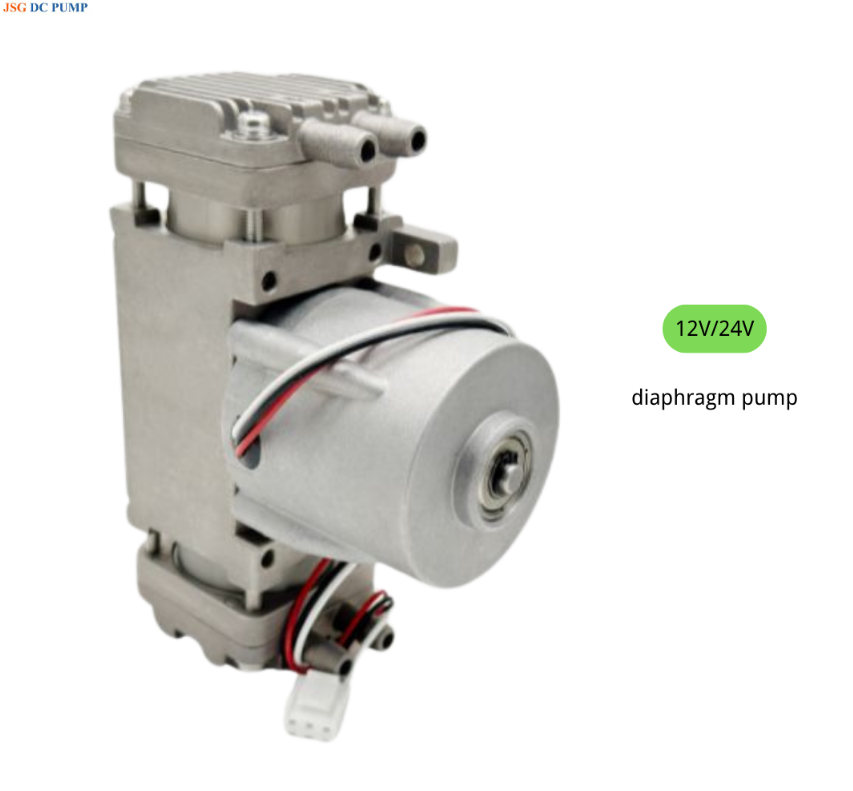
In modern medical devices, laboratory instruments, and industrial automation systems, airflow stability directly affects equipment reliability. When a vacuum pump generates excessive noise, unstable pressure, or frequent overheating, the entire system can suffer from performance fluctuations, maintenance interruptions, and shortened service life.
For OEM manufacturers, selecting the right quiet vacuum pump is no longer just a component decision. It is part of a larger strategy focused on product reliability, user comfort, and long-term operational efficiency.
Many conventional pumps still rely on brushed motor structures that create high vibration, unstable airflow, and excessive heat during continuous operation. These limitations become especially problematic in medical environments, portable instruments, and precision analytical systems where quiet performance and pressure consistency are essential.
To solve these challenges, JSG developed a brushless low-noise vacuum pump platform engineered specifically for continuous-duty OEM applications. By combining brushless DC motor technology, oil-free airflow architecture, and customizable pressure control, the system provides stable pneumatic performance while maintaining exceptionally low operating noise.
Why Traditional Vacuum Pumps Create System Problems
Many OEM devices fail to achieve stable long-term operation because the pump itself becomes the weakest point in the system.
Traditional brushed vacuum pumps often introduce several operational risks:
Excessive Noise During Continuous Use
Carbon brush friction and unstable motor balancing increase vibration over time. In medical equipment, laboratory analyzers, and rehabilitation devices, high noise levels negatively affect both operators and patients.
Unstable Pressure Output
Standard pumps frequently experience airflow fluctuations during long operating cycles, especially under changing resistance conditions. This instability affects calibration accuracy and pneumatic consistency.
Frequent Maintenance Requirements
Brushed motors gradually wear down during operation. Carbon brush replacement, lubrication, and bearing degradation increase maintenance costs and reduce equipment uptime.
Heat Accumulation in Compact Devices
Poor thermal efficiency causes internal temperature rise, which can damage surrounding electronic components inside compact OEM systems.
These issues explain why more manufacturers are replacing traditional pumps with a low noise brushless vacuum pump designed for continuous-duty performance.
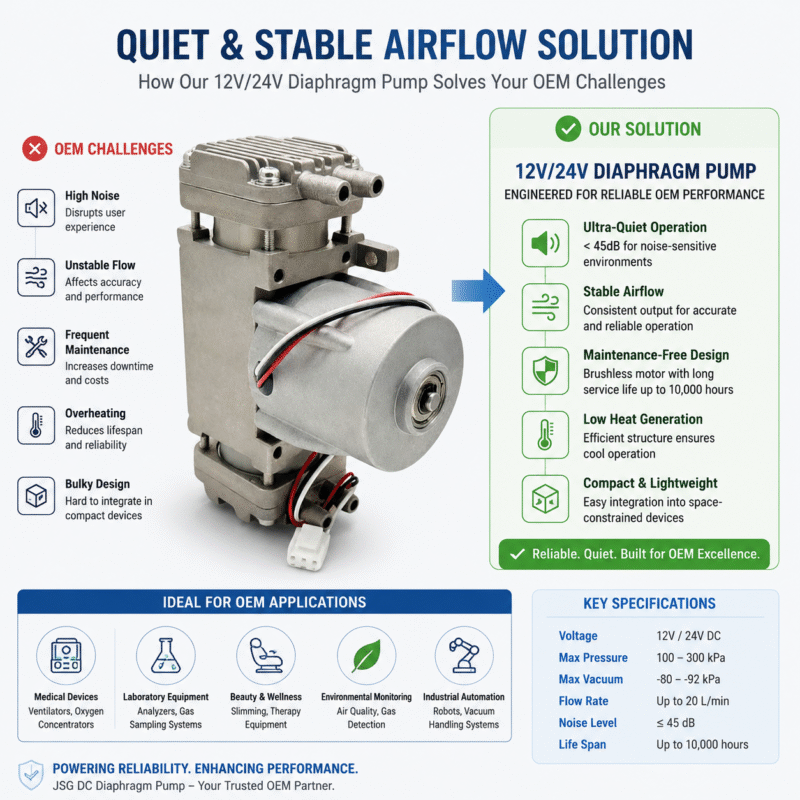
How JSG Quiet Vacuum Pump Technology Solves These Challenges
JSG’s engineering approach focuses on four core performance areas: acoustic control, airflow stability, thermal management, and long-term durability.
Brushless DC Motor Architecture Reduces Noise
Unlike conventional brushed systems, the JSG platform uses a high-efficiency brushless DC motor with dual-bearing stabilization.
This design significantly reduces:
- Mechanical friction
- Rotor vibration
- Electromagnetic noise
- Heat generation
As a result, the pump maintains operating noise levels below 45dB, making it ideal for:
- Portable medical equipment
- Laboratory sampling systems
- Beauty and rehabilitation devices
- Quiet environmental monitoring systems
For OEM manufacturers seeking a quiet vacuum pump for medical equipment, low acoustic output becomes a major competitive advantage.
Stable Vacuum and Airflow Control for Precision Devices
Many compact systems require highly controlled airflow rather than raw pressure output.
JSG’s PWM controlled vacuum air pump platform allows engineers to precisely regulate:
- Airflow speed
- Vacuum level
- Positive pressure output
- Operating frequency
This enables stable operation across varying system resistance conditions.
Typical operating capabilities include:
| Performance Factor | JSG Brushless Vacuum Pump |
|---|---|
| Operating Noise | ≤45dB |
| Continuous Lifespan | 5,000–10,000 hours |
| Flow Range | Up to 20L/min |
| Vacuum Range | -80kPa to -92kPa |
| Positive Pressure | 100–300kPa |
| Duty Cycle | Continuous operation |
These specifications are far more aligned with actual compact OEM vacuum pump system requirements, especially in portable and embedded applications.
Oil-Free Design Improves Reliability
Contamination control is critical in medical, laboratory, and gas analysis equipment.
JSG’s oil-free diaphragm structure eliminates the risk of lubricant vapor entering the airflow path. This helps maintain clean pneumatic transfer while reducing maintenance requirements.
The pump also supports chemically resistant materials such as:
- FKM
- EPDM
- PTFE
This improves compatibility with:
- Humid gas sampling
- Mild chemical vapor transfer
- Laboratory analysis systems
- Environmental monitoring equipment
For systems requiring a continuous duty vacuum pump, material stability directly affects long-term reliability.
Real OEM Applications Across Multiple Industries
The flexibility of the JSG platform allows integration into various high-precision devices.
Medical and Healthcare Equipment
Quiet airflow and low vibration are essential in respiratory and rehabilitation systems.
Common applications include:
- Oxygen concentrators
- Portable therapy devices
- Compression therapy systems
- Diagnostic instruments
Laboratory and Environmental Monitoring
Stable vacuum pressure supports accurate gas transfer and air sampling.
Typical systems include:
- Gas analyzers
- VOC detection equipment
- Air quality monitors
- Laboratory filtration systems
Industrial Automation Equipment
Compact brushless pumps support continuous pneumatic control in automated machinery.
Common uses include:
- Pick-and-place systems
- Vacuum adsorption equipment
- Packaging automation
- Precision dispensing systems
Because of its low heat generation and compact structure, the pump integrates easily into space-constrained OEM devices.
Why OEM Manufacturers Compare Brushless vs Brushed Vacuum Pumps
When engineers compare pump technologies before procurement, several performance differences become immediately clear.
| Comparison Area | Brushed Pump | JSG Brushless Vacuum Pump |
|---|---|---|
| Noise Stability | Increases over time | Remains consistently low |
| Motor Lifespan | 2,000–3,000 hrs | Up to 10,000 hrs |
| Maintenance | Brush replacement required | Maintenance-free |
| Heat Generation | Higher | Lower |
| Airflow Stability | Moderate fluctuation | Stable PWM regulation |
| Continuous Operation | Limited | Designed for continuous duty |
This is why many OEM manufacturers are upgrading to a compact OEM vacuum pump system with brushless architecture instead of traditional brushed solutions.
OEM Customization for Specialized Equipment
JSG supports extensive OEM and ODM customization for global equipment manufacturers.
Customization options include:
- 12V / 24V DC configurations
- Custom airflow and pressure calibration
- Integrated silencers
- Specialized mounting brackets
- Chemical-resistant diaphragm materials
- Customized pneumatic connectors
Established in 2003 and supported by more than 400 pump prototypes and parameter configurations, JSG DC PUMP helps manufacturers accelerate pump selection, sample validation, customization, and OEM system integration.
What is considered a quiet vacuum pump?
Most OEM medical and laboratory systems require pump noise below 50dB. Pumps operating below 45dB are generally considered suitable for low-noise professional equipment.
Why are brushless vacuum pumps quieter?
Brushless motors eliminate carbon brush friction, reducing vibration, heat, and mechanical wear during operation.
Can a quiet vacuum pump run continuously?
Yes. A properly engineered continuous duty vacuum pump with brushless architecture can operate for thousands of hours without interruption.
Which industries commonly use low noise vacuum pumps?
Medical devices, laboratory instruments, environmental monitoring systems, rehabilitation equipment, and automation machinery all commonly use low-noise pneumatic systems.
Conclusion
As OEM devices become smaller, quieter, and more performance-sensitive, traditional brushed pumps are increasingly unable to meet modern engineering requirements. Excessive vibration, unstable airflow, and high maintenance costs create long-term operational risks for manufacturers.
A professionally engineered quiet vacuum pump provides the stable airflow, low acoustic output, and maintenance-free operation required in today’s medical, laboratory, and industrial systems.
By combining brushless DC technology, oil-free airflow architecture, and flexible OEM customization, JSG helps manufacturers build quieter, more reliable equipment with stronger long-term performance and lower operational costs
