

Inconsistent shockwave treatments can reduce treatment reliability and damage your brand’s credibility. In many cases, this variability originates in the pneumatic system. Selecting the right micro pump for shockwave therapy is essential for delivering stable, accurate, and repeatable therapeutic energy.
A high-performance micro pump improves shockwave therapy by enabling rapid and consistent pressure recovery between pulses. It reduces pressure ripple and maintains stable pneumatic pressure and airflow, resulting in more accurate energy delivery, more consistent treatment performance, and a more reliable medical device.This article focuses on pneumatic radial shockwave devices, also known as radial pressure wave equipment. These systems use compressed air to accelerate a projectile inside the handpiece. Focused electrohydraulic, electromagnetic, and piezoelectric shockwave systems are outside the scope of this discussion.
As an engineer at JSG, I have spent more than two decades helping medical device manufacturers develop better products. I have seen shockwave therapy devices fail validation not because of a major component defect, but because of small inconsistencies within the pneumatic system. The first pulse may be strong, while the fifth or tenth pulse delivers less energy. This variation compromises the consistency of the entire treatment protocol. In many cases, the root cause is that the pump cannot recover pressure quickly enough.
Can the Pump Recover Pressure Before the Next Shockwave Pulse Arrives?
Your device delivers a strong first pulse, but the following pulses become weaker. This inconsistency undermines treatment performance. The likely cause is a pump that cannot recharge the pneumatic system quickly enough.
A high-performance micro pump with sufficient flow at the required working pressure can restore system pressure between pulses. This recharge capability ensures that the air chamber reaches the target pressure before every shot, supporting consistent energy delivery even at high operating frequencies.
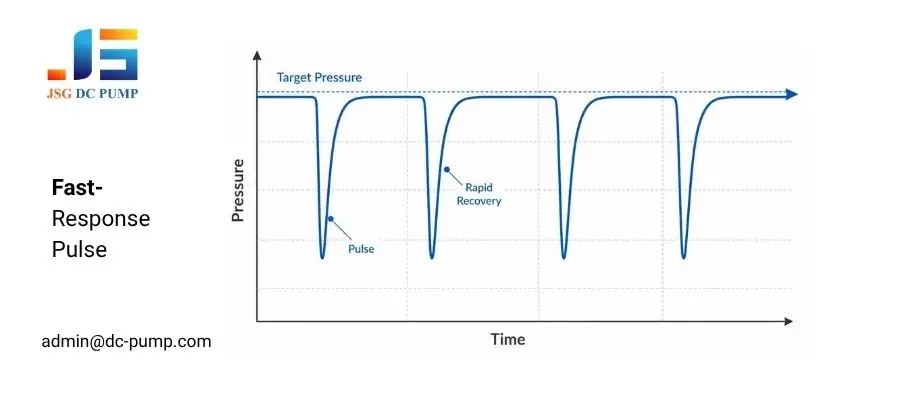
Think of a shockwave therapy device like a camera with a flash. After each flash, the capacitor must recharge before it can fire again at full power. A pneumatic shockwave system operates in a similar way. The pump pressurizes an air chamber, and a valve rapidly releases the compressed air to generate the shockwave. At a treatment frequency of 15 Hz, the system fires 15 times per second, leaving approximately 67 milliseconds between pulses. In practice, the pump has even less time to restore pressure because valve switching, projectile movement, sensing, and control processes also take place during each cycle. If the pump cannot deliver enough airflow at the target pressure, the second pulse may be weaker than the first, and the following pulses may continue to lose energy.
Is Pump Pressure Ripple Distorting the Energy of Each Therapeutic Impact?
Your device’s pressure gauge may display a steady 4 bar, while the actual impact energy still fluctuates. This hidden variation is often caused by pressure ripple, making a precision medical device less accurate than expected.
Pressure ripple generated by the pump’s compression strokes can cause the energy of each pulse to vary, even when the average pressure appears stable. A dual-head “boxer” pump or a properly sized buffer tank can smooth these fluctuations and provide more stable instantaneous pressure.
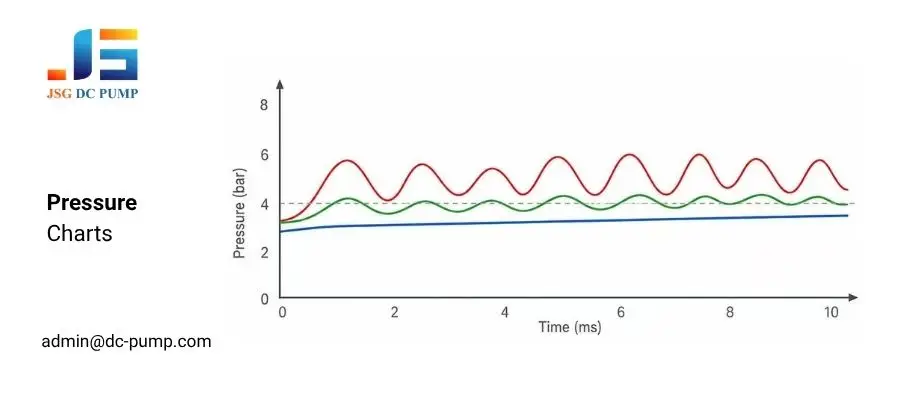
A standard diaphragm or piston pump generates pressure through repeated mechanical strokes. Each stroke creates a small pressure rise and fall around the average operating pressure. These rapid fluctuations are known as pressure ripple. Imagine the surface of a lake on a windy day. The overall water level remains relatively constant, but small waves move across the surface. If the shockwave valve opens at the peak of a pressure wave, the delivered energy may be higher. If it opens at the lowest point, the resulting impact may be weaker.
Smoothing Pressure for Better Accuracy
| Pump Type | Pressure Ripple | Pulse Energy Stability | System Complexity |
| Single-Head Pump | High | Low | Simple |
| Single-Head Pump + Buffer Tank | Low | High | More complex, larger footprint |
| Dual-Head Pump | Very Low | Very High | Integrated, compact solution |
How Do Micro Pump, Valve, and Air Chamber Dynamics Shape the Final Shockwave?
You may select a powerful shockwave therapy air compressor but still experience a weak or slow final shockwave. In this situation, the pump itself may not be the problem. The pneumatic system may be poorly matched, causing the components to work against one another.
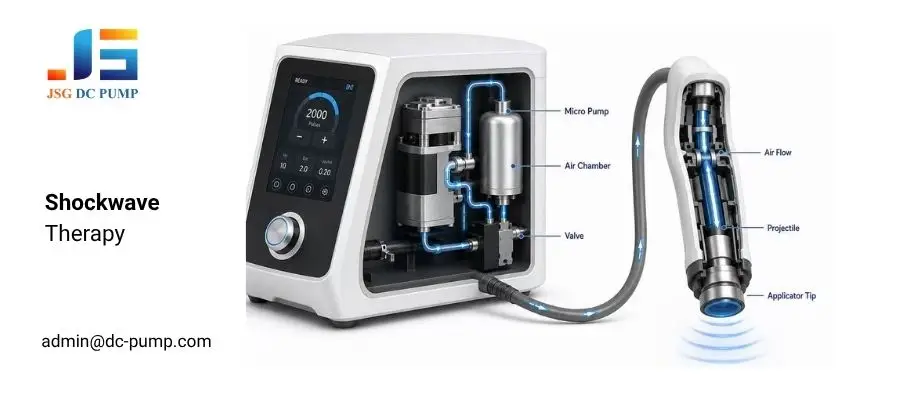
The compact piston air pump, valve, and air chamber operate as a tuned pneumatic system. The pump’s airflow must match the chamber volume to achieve fast pressure recovery, while the valve’s response speed and flow capacity determine how sharply the stored air is released. These three components must be optimized together to achieve stable and powerful shockwave output.
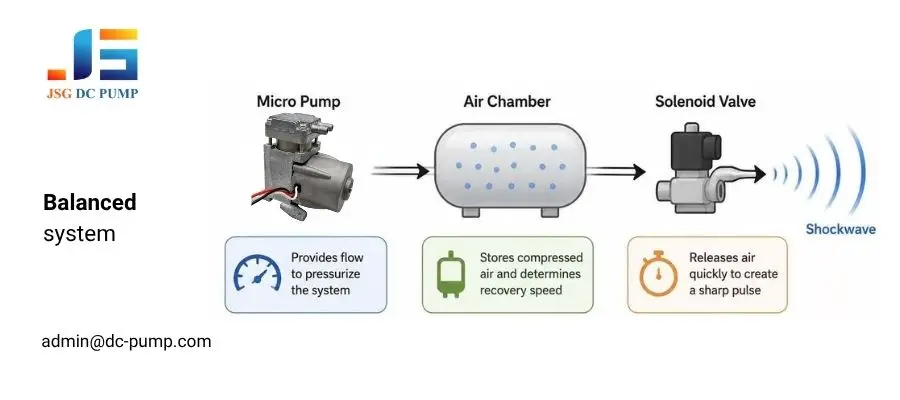
In my experience, many design teams evaluate each component separately. They select the most powerful pump and the fastest valve, then install both within the available space. However, strong individual components do not automatically create an efficient pneumatic system.
1. If the air chamber is too large for the pump’s available flow at the working pressure, the system will take too long to recharge. This limits the maximum treatment frequency and may cause pulse-to-pulse energy variation.
2. If the valve opens too slowly or has an insufficient internal flow path, compressed air will be released too gradually. The result is a weak, extended, or “mushy” pulse instead of a sharp and powerful shockwave.
As a pump supplier, our role often extends beyond providing an individual component. We work with our customers’ engineering teams to evaluate and test the complete pneumatic system and identify the right balance between pump performance, chamber volume, valve characteristics, and operating frequency.
When Does Heat Buildup Begin to Change Pump Output During Continuous Treatment?
Your device may perform well during the first five minutes, but its output gradually fades during a longer treatment session. This performance decline is often caused by heat buildup, which can make the device unreliable in continuous professional use.
Motor heat may begin to affect pump performance after 10 to 15 minutes of continuous operation, depending on the load, ventilation, motor design, and installation conditions. A pump using a high-efficiency brushless motor and effective thermal management can maintain more stable pressure and airflow throughout the treatment session.
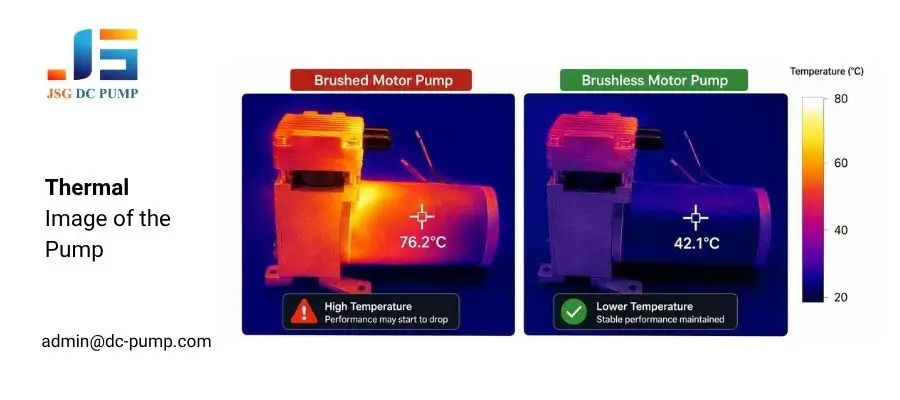
As the motor’s internal temperature rises, electrical resistance also increases. This reduces motor efficiency and may cause the pump to draw more current to maintain the same output. The increased current then generates additional heat, creating a cycle that can further reduce performance. For a shockwave therapy device used in a busy clinic, this is a critical consideration. A treatment session may last 20 minutes or longer, so the pump must deliver stable performance from the first minute to the final pulse.
This is why motor selection is so important.
1. A brushed motor is generally less efficient and produces more frictional heat. During extended operation, it may be more susceptible to temperature rise, brush wear, speed variation, and performance fading.
2. A high-quality brushless DC motor is typically more efficient, operates at a lower temperature, and provides better speed and thermal stability for continuous professional use.
How Do You Select a Micro Pump for Pneumatic Radial Shockwave Therapy?
Your pneumatic system requires fast pressure recovery, stable airflow, and reliable performance throughout the complete treatment session. Selecting a medical device compressor based only on its maximum pressure may leave the system without sufficient airflow, recovery speed, or operating margin.
For this application, JSG’s 8-series piston pump platform can be considered a practical engineering starting point. The final model should be selected according to the actual working pressure, airflow requirement, air chamber volume, treatment frequency, installation space, duty cycle, and acceptable noise level.
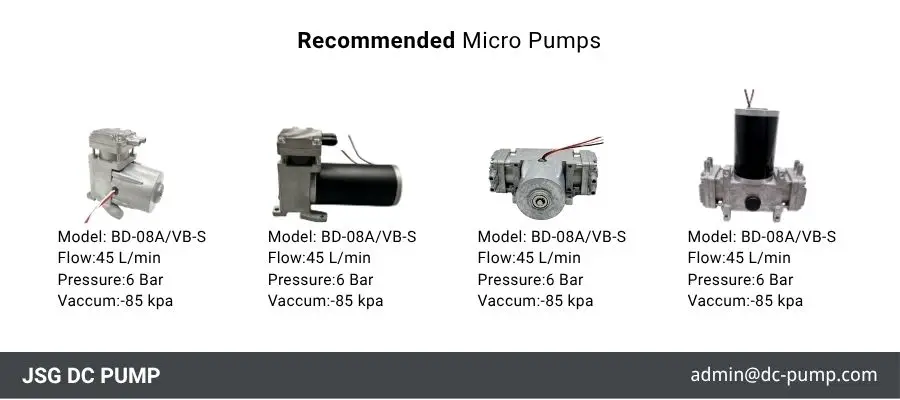
JSG 8-Series Pump Selection Direction
| Pump Model | Key Feature | Suitable System Direction |
| BD-08A-S | Up to 45L/min; up to 6bar | Compact shockwave therapy devices |
| BD-08AB-S | Up to 45L/min; up to 6bar | Systems requiring faster pressure recovery |
| BD-08A-D | Up to 80L/min; up to 7bar | Systems requiring lower pressure ripple |
| BD-08AB-D | Up to 80L/min; up to 7bar | Larger air chambers or high-frequency systems |
Conclusion
A micro pump for shockwave therapy should be selected as part of the complete pneumatic system rather than as an isolated component. Flow at the actual working pressure, pressure recovery time, pressure ripple, valve response, chamber volume, temperature rise, and vibration all affect pulse-to-pulse pneumatic repeatability.
At JSG, we work closely with medical device manufacturers to select and customize suitable micro pump solutions for shockwave therapy based on working pressure, airflow, chamber volume, treatment frequency, noise, installation space, and operating requirements. Contact us to discuss your shockwave therapy project and identify the most suitable JSG 8-series pump configuration for your system.
Email: admin@dc-pump.com
