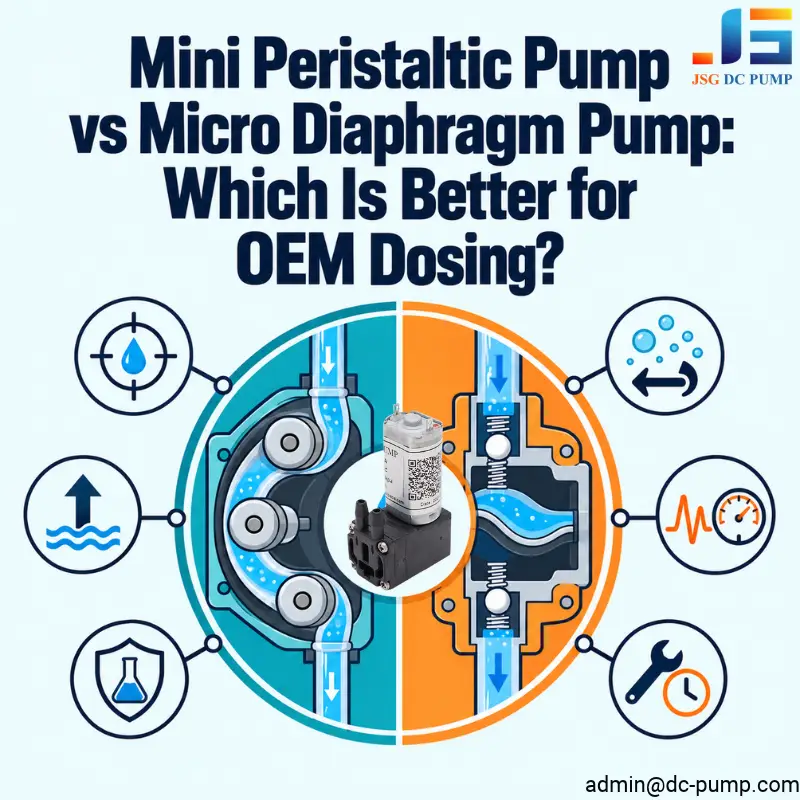
The decision between a mini peristaltic pump and micro diaphragm pump is all about flow rates? It might look that way on paper, but in actual equipment you can end up with a wrong choice and thus, inaccurate dosing, unsteady operation, and re-design costs.
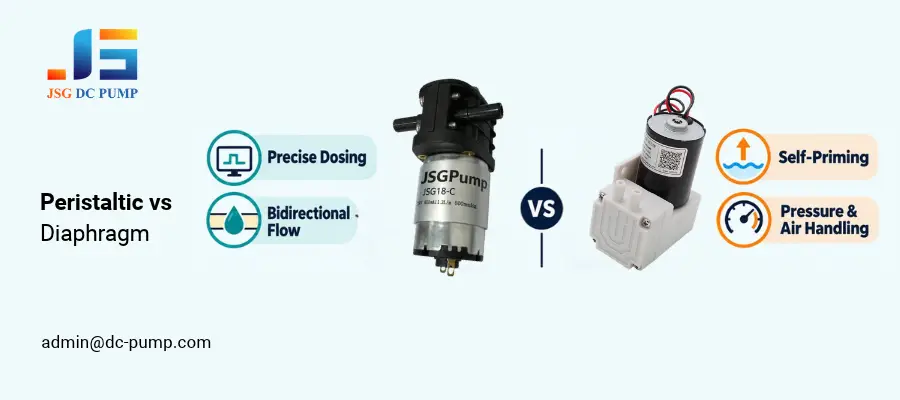
A peristaltic pump works best for programmable dosing, bidirectional flow and a defined liquid path. When self-priming, pressure capability, compact transfer, and intermittent air-liquid handling are the main priorities, the micro diaphragm pump is usually favored. The final decision is always based on the actual working conditions will govern the decision in terms of free flow performance.
I am an JSG engineer for many years in OEM pump development, I start the decision with experience I have acquired looking at the liquid, dose required under load, suction conditions, control setup, duty cycle, and maintenance plan. This article illustrates how these engineering parameters drive which pump technology should be employed today for optimal OEM dosing system.
Mini Peristaltic Pump vs Micro Diaphragm Pump: What Is the Engineering Difference?
You may assume pumps with similar flow rates are interchangeable, but their different mechanisms affect dosing, pressure, pulsation, and service life.
A peristaltic pump pushes liquid by progressively compressing an elastic flow path. A diaphragm pump changes the volume of a chamber while inlet and outlet valves direct the liquid.
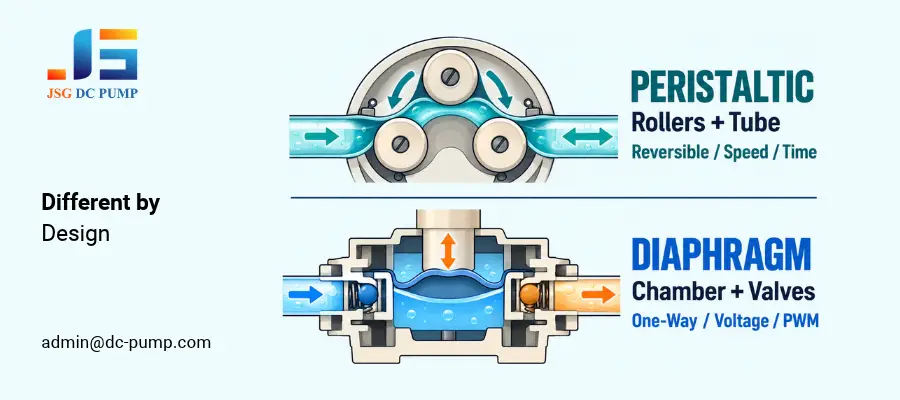
1. Peristaltic action: Rollers or compression elements push liquid through an elastic path.
2. Diaphragm action: A motor-driven diaphragm alternately fills and empties a pump chamber.
3. Flow direction: A peristaltic pump can normally reverse; diaphragm-pump valves establish one direction.
4. Output control: Peristaltic flow is adjusted through speed, steps, and time. Diaphragm flow is commonly regulated through voltage or PWM.
5. Engineering impact: Their different mechanisms respond differently to backpressure, bubbles, viscosity, and wear.
Peristaltic Pump vs Diaphragm Pump: Which Gives More Reliable Dosing Accuracy?
Many dosing problems begin when catalog flow is treated as guaranteed system output. Actual dose volume changes with liquid properties, suction height, tubing resistance, backpressure, temperature, and trapped air.
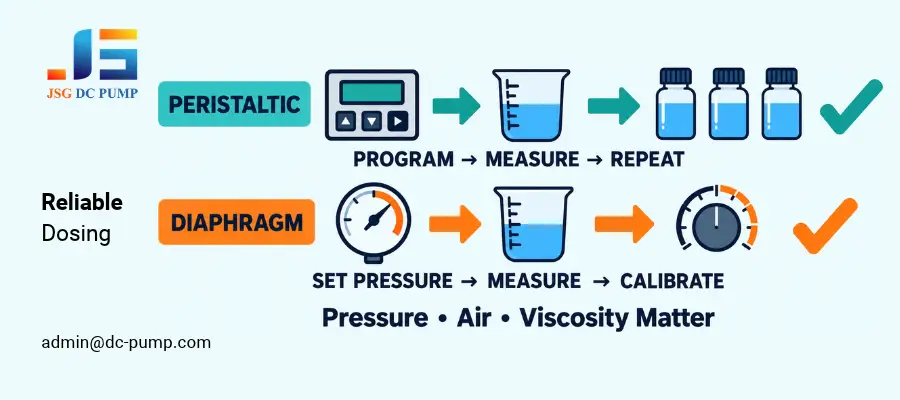
A stepper-driven peristaltic pump is generally easier to program and calibrate for repeated doses. A diaphragm pump can also provide stable dosing, but its valves and chamber-filling behavior require careful validation under the real system load.
| Selection factor | Mini peristaltic pump | Micro diaphragm pump |
| Output adjustment | Speed, steps, direction, and run time | Voltage, PWM, and run time |
| Backpressure effect | May change elastic-element compression and flow | May change valve action and diaphragm displacement |
| Air bubbles | Reduce the actual liquid volume per cycle | Disrupt chamber filling and valve sealing |
| Viscosity effect | Changes suction and elastic-element recovery | Changes chamber filling and valve response |
| Calibration | Usually direct after measuring actual output | Must be completed at the required working pressure |
| Typical advantage | Programmable low-volume dosing | Liquid transfer with useful pressure reserve |
Which Pump Is Safer for Sensitive or Aggressive Liquids?
A pump may meet the required flow but still damage the liquid or fail because its wetted materials are incompatible. Residual liquid, cleaning chemicals, and long exposure times must also be considered.
A peristaltic pump is often preferable when the application needs an isolated or serviceable liquid path. A diaphragm pump remains suitable when its pump head, diaphragm, and valves are compatible with the medium and cleaning process.
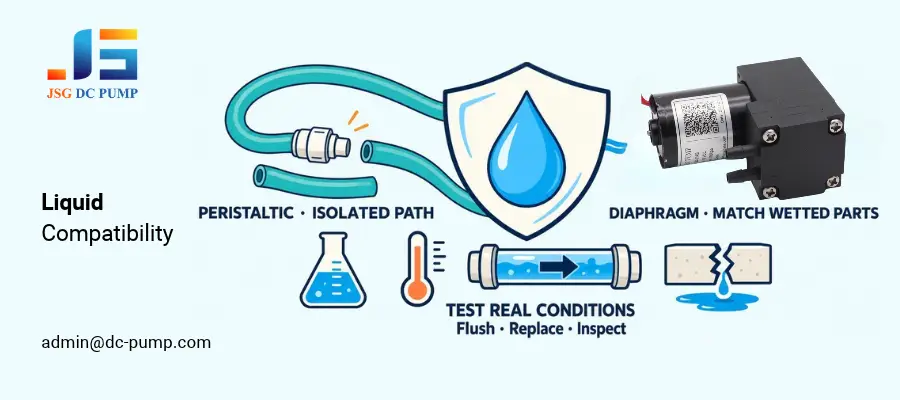
1. Identify every material that contacts the liquid.
2. Check compatibility using the real concentration and temperature.
3. Evaluate carryover after flushing or changing liquids.
4. Confirm whether the liquid path can be cleaned or replaced.
5. Test for swelling, hardening, cracking, leakage, and flow drift.
6. Verify application requirements instead of relying only on terms such as “chemical resistant” or “medical grade.”
Which Pump Handles Priming, Bubbles, and Reverse Flow Better?
An OEM dosing system may need to lift liquid from a lower container, restart with a dry inlet line, or return unused liquid after each cycle. Poor priming can make an otherwise accurate pump unreliable.
Both technologies can self-prime, but a peristaltic pump has a clear advantage when reverse purging or liquid recovery is required. A diaphragm pump can work well through repeated air-liquid transitions when its valves and suction conditions are suitable.
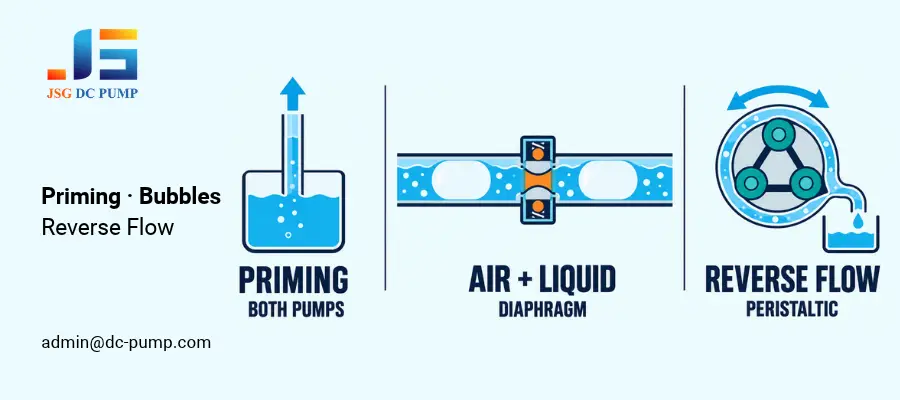
1. Test priming with the actual suction lift and tube diameter.
2. Use reversible peristaltic flow for purging or liquid recovery.
3. Measure whether trapped air changes the delivered dose.
4. Eliminate inlet leaks that allow air into the system.
5. Avoid excessive suction resistance from narrow tubing or blocked filters.
6. Add a suitable valve or adjust the reservoir position if siphoning occurs after shutdown.
How Do Pulsation and System Resistance Change the Choice?
Both pump types move liquid through repeated mechanical actions, so neither produces perfectly continuous flow. Ignoring pulsation can cause unstable sensor readings, uneven droplets, tubing movement, and additional equipment noise.
The better choice depends on how the complete fluid system responds, not simply on which pump sounds quieter during an open-flow test. Peristaltic pulsation is influenced by roller geometry, speed, compression volume, and elastic recovery. Diaphragm pulsation is affected by diaphragm displacement, valve timing, motor speed, and outlet resistance.
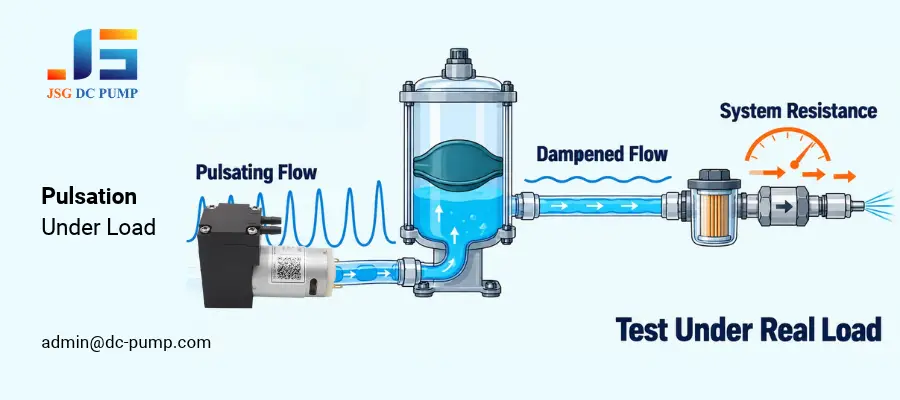
A buffer chamber, pulsation dampener, compliant tubing, or slower tube transitions can reduce flow variation. Long or narrow tubing, loaded filters, restrictive nozzles, and check valves can increase system resistance and change both flow and noise. I therefore compare candidate pumps using the same liquid, tubing, pressure, mounting method, and enclosure before selecting one for an OEM project.
Peristaltic Pump vs Diaphragm Pump: Which Has the Lower Lifetime Cost?
The pump with the lowest purchase price may require more replacements, recalibration, or service work. These costs can exceed the original component price over the equipment’s operating life.
Peristaltic-pump maintenance is usually concentrated in its elastic pumping element. Diaphragm pumps may offer longer service intervals, but their diaphragms and valves eventually experience fatigue, chemical attack, or sealing loss.
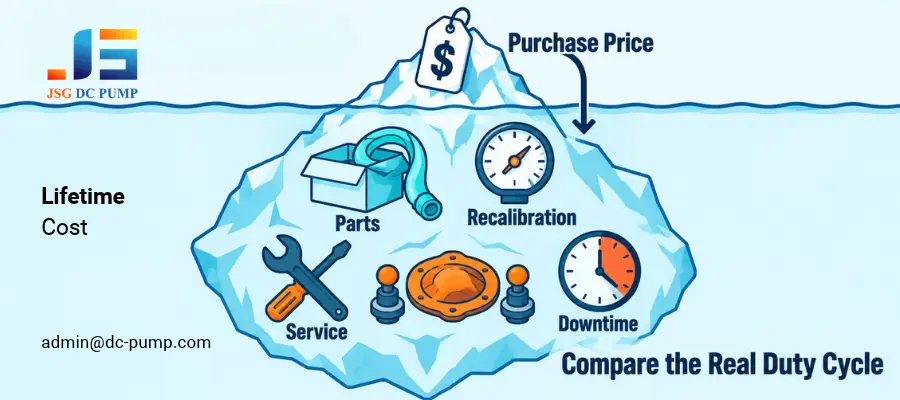
1. Compare replacement intervals under the real duty cycle.
2. Include recalibration after changing the pump or liquid path.
3. Check whether maintenance can be completed inside the equipment.
4. Calculate downtime and field-service labor.
5. Include drivers, valves, dampeners, tubing, and spare parts.
6. Define an acceptable flow-drift limit before complete pump failure occurs.
Conclusion
A mini peristaltic pump is generally the better choice for reversible, programmable dosing and a serviceable liquid path. A micro diaphragm pump is usually more suitable for self-priming transfer, pressure-demanding circuits, and repeated air-liquid handling. Whichever technology is selected, it should be tested with the actual liquid, suction lift, backpressure, tubing, and duty cycle.
JSG can help you evaluate the right pump for your OEM dosing system. Send your medium, target flow or dose, pressure conditions, voltage, control method, and expected quantity to admin@dc-pump.com.