

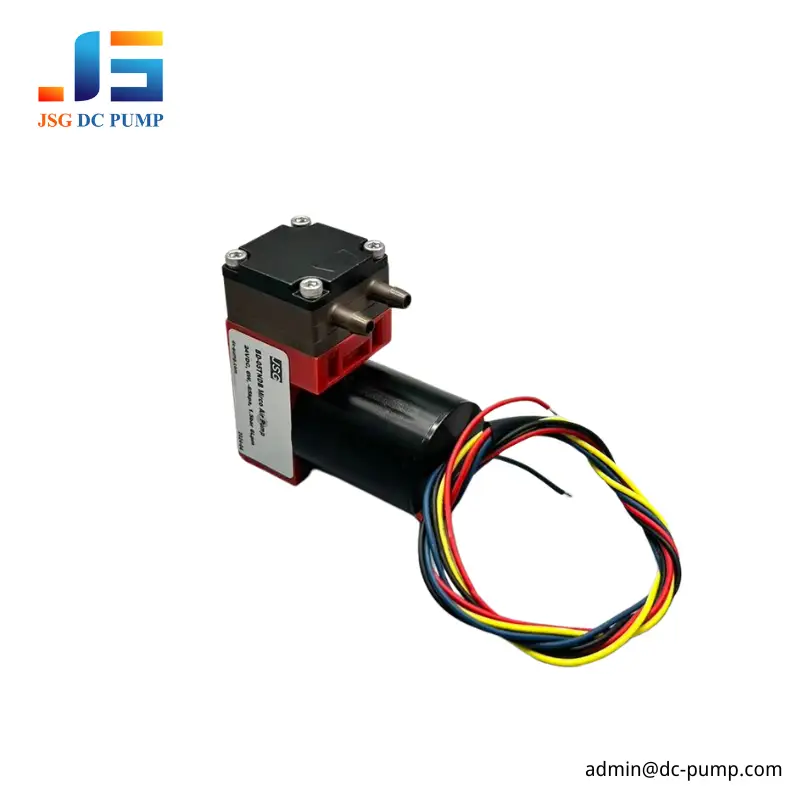
A diaphragm gas pump must deliver stable sample flow despite resistance from filters, tubing, valves, and sensors. If your gas analysis equipment uses a pump selected only by its maximum free-flow rating, the actual sampling rate may fall below your target. This can affect measurement consistency, extend sampling cycles, and complicate system validation.
The JSG05TVB-S brushless diaphragm pump from Shenzhen Jingsuguang Technology Co., Ltd. addresses these integration challenges with a maximum rated flow of 4.6 L/min, vacuum capability down to –70 kPa, and 12V/24V DC options. Its PWM speed control and FG feedback also support electronic flow adjustment and motor monitoring. For OEM engineers, these features provide a practical starting point for evaluating a compact gas sampling pump against real operating conditions.
What Makes This Diaphragm Gas Pump Suitable for Gas Analysis?
The JSG05TVB-S combines a compact diaphragm mechanism with a brushless DC motor. Measuring approximately 60.4 × 32 × 55 mm and weighing 148 g, it fits portable analyzers, environmental monitoring instruments, and desktop laboratory equipment.
Key specifications include:
- Maximum flow: 4.6 L/min, measured using a float flowmeter
- Reference flow: Approximately 3.0 L/min, measured using an electronic flowmeter
- Maximum pressure: Up to 1.5 bar
- Maximum vacuum: –70 kPa
- Rated power: 5 W
- Supply voltage: 12V or 24V DC
- Control interface: PWM speed control and FG feedback
- Published motor-life reference: Up to 10,000 hours, subject to test conditions and configuration
These values describe different operating points and measurement methods. Therefore, you should verify the flow available at your required pressure or vacuum instead of treating the maximum free-flow figure as guaranteed system performance.
How Does a Brushless Diaphragm Gas Pump Improve Control?
Unlike a pump selected solely for fixed-speed operation, the JSG05TVB-S supports PWM-based speed adjustment. Your equipment controller can vary the motor command to suit different sampling stages, while FG feedback provides motor-speed pulses for operational monitoring.
This arrangement can help engineers integrate the pump into automated gas analysis systems. However, FG feedback does not directly measure gas flow; a suitable flow sensor is needed when your application requires actual flow measurement.
The pump uses a PPS pump head, a nylon body, and standard EPDM diaphragm and valves. An FKM configuration is available for selected applications requiring different chemical resistance, subject to compatibility verification.
Diaphragm Gas Pump Specifications Compared
The following table compares the JSG05TVB-S’s pressure and vacuum configurations with typical selection considerations for gas analysis equipment.
| Parameter | Pressure configuration | Vacuum configuration |
|---|---|---|
| Main function | Low-pressure gas delivery | Gas sampling and suction |
| Maximum rated performance | Up to 1.5 bar pressure | Up to –70 kPa vacuum |
| Maximum free flow | 4.6 L/min under the stated measurement method | Confirm the relevant model curve and operating point |
| Motor | Brushless DC | Brushless DC |
| Power options | 12V / 24V | 12V / 24V |
| Control | PWM and FG feedback | PWM and FG feedback |
| Typical applications | Gas transfer and pneumatic functions | Sampling, chamber evacuation, and leakage testing |
Actual performance depends on the selected configuration and system resistance. Confirm the applicable pressure-flow or vacuum-flow curve before finalizing your design.
How to Select the Right Gas Sampling Pump
Follow these steps to evaluate the JSG05TVB-S for your equipment:
- Define the operating point. Specify the required flow at the target pressure or vacuum, rather than relying on maximum free flow alone.
- Check system resistance. Include tubing length, filter loading, valves, connectors, sensors, and chamber volume in your assessment.
- Choose voltage and control. Select 12V for compatible portable systems or 24V for equipment using that supply. Confirm PWM signal requirements and FG feedback compatibility.
- Verify gas compatibility. Use EPDM for suitable clean-air applications. Evaluate FKM for selected chemical or hydrocarbon vapors after checking gas composition, concentration, temperature, and exposure duration.
- Test a sample. Record flow, pressure or vacuum, current, noise, temperature, and duty cycle under representative conditions before approving production.
Shenzhen Jingsuguang Technology Co., Ltd. supports OEM/ODM projects through pump selection, customization, sample evaluation, and production. Its ISO 9001:2015 certification provides a relevant quality-management credential; project-specific performance must still be validated against agreed acceptance criteria.
Real Applications of a Miniature Diaphragm Gas Pump
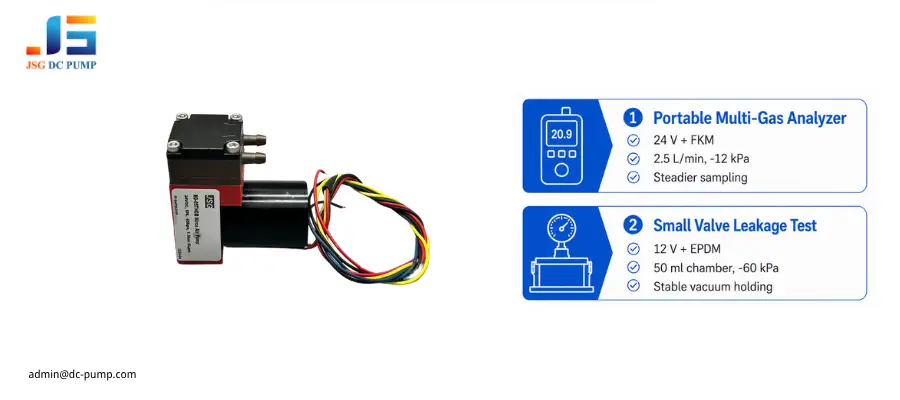
Portable multi-gas analyzer: In one described application, a 24V JSG05TVB-S with FKM diaphragm and valves operated at approximately 2.5 L/min and –12 kPa while drawing samples through a dust filter, moisture separator, tubing, and sensor chamber. This illustrates why working-point performance matters more than the headline flow rating.
Automated valve leakage testing: Another described application used a 12V configuration with EPDM components, a check valve, a digital vacuum sensor, and a buffer tank. The system evacuated a 50 mL test chamber to approximately –60 kPa, helping stabilize the vacuum conditions used for repeated tests.
These examples are application references, not universal performance guarantees. Your results will depend on the equipment layout, operating cycle, gas medium, and test conditions.
Frequently Asked Questions
1. Is the JSG05TVB-S suitable for continuous operation?
Its operating mode depends on the load point and configuration. Confirm the duty cycle, temperature rise, and aging-test conditions with JSG DC PUMP before specifying continuous operation.
2. Can this diaphragm gas pump handle corrosive gases?
An FKM option is available for selected gases, but FKM is not universally compatible with every chemical. Provide the gas composition, concentration, temperature, and operating duration for a material review.
3. Does 4.6 L/min represent the flow in my analyzer?
Not necessarily. The 4.6 L/min figure is a maximum-flow value measured using a float flowmeter. Filters, tubing, valves, and sensors create resistance, so you should confirm the expected flow at your actual operating point.
Conclusion
Choosing a diaphragm gas pump requires more than matching a flow rating to an equipment specification. The JSG05TVB-S combines a compact 60.4 × 32 × 55 mm structure, 12V/24V brushless operation, PWM control, FG feedback, and pressure-vacuum capability for gas analysis and sampling projects. By validating the working point, materials, and control interface, you can make a more reliable OEM selection with Shenzhen Jingsuguang Technology Co., Ltd.
CTA
Send your target flow, operating pressure or vacuum, gas composition, supply voltage, duty cycle, and installation dimensions to admin@dc-pump.com. The JSG DC PUMP team can review the requirements, recommend a suitable configuration, and help define sample-testing conditions before production.

