

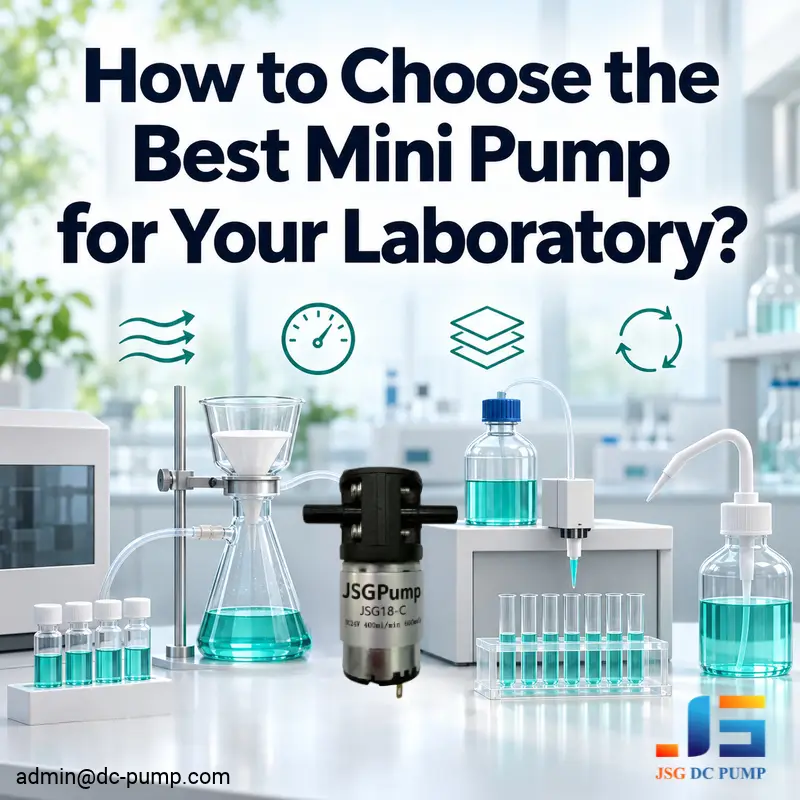
Laboratory mini pumps move samples, reagents, rinse water, waste, and gases through compact instruments. When these movements become inconsistent, preparation time, delivered volume, and sample quality can vary.
Mini pumps support sample preparation by creating pressure or vacuum and transferring fluids between stages. Their role depends on the task: gas sampling needs airflow, dosing needs repeatable delivery, and rinsing needs sufficient water through the cleaning path.
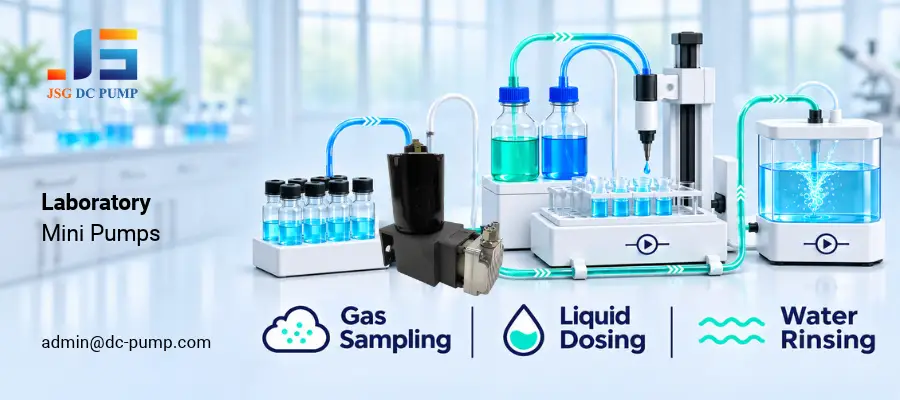
As a JSG engineer, I review the complete workflow before recommending a pump. The starting point is what must move, where it must go, and under which conditions.
How Do Laboratory Mini Pumps Support Sample Preparation?
Manual transfer and shared vacuum lines can be difficult to integrate into enclosed instruments. Repeated preparation steps also require coordination with valves, sensors, and containers.
Laboratory mini pumps provide local fluid movement that the instrument can control within its programmed sequence. They prepare and move material for analysis rather than perform the analysis themselves.
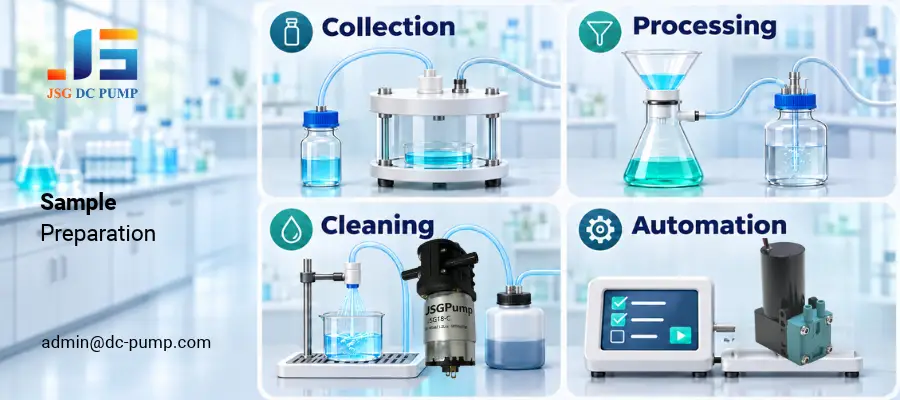
- Collection:Draw gas or liquid into a sampling path.
- Processing:Support filtration, aspiration, and reagent transfer.
- Cleaning:Supply rinse water and remove compatible waste.
- Automation:Repeat validated movements with less manual handling.
Which Laboratory Mini Pumps Fit Each Preparation Task?
A gas pump, vacuum pump, and liquid pump perform different jobs. Choosing the correct function starts with understanding whether the sample enters the pump.
Match the pump mechanism to the medium and movement required. The following applications show how that connection determines product selection.
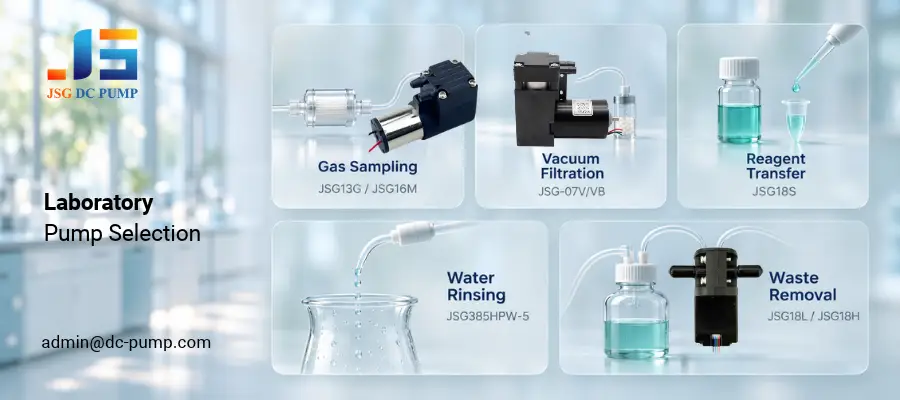
Air and Gas Sampling
A pump draws sample gas through tubing, filters, and a sensor chamber, helping replace the previous gas with a fresh sample. Flow through this complete path affects how quickly the chamber receives it.
- Candidate:JSG13G for compact 3 V, low-flow paths; JSG16M for 5 V brushless sampling.
- Key check:Airflow at the actual inlet vacuum.
- System detail:Filters add resistance; condensation control protects the gas pump.
Vacuum Filtration and Aspiration
A vacuum pump lowers pressure downstream of a filter or collection vessel. The pressure difference moves liquid through the filter or draws it into a waste bottle, while the pump handles the gas side.
- Candidate:JSG-07V/VB when higher airflow is required.
- Key check:Flow at working vacuum and acceptable suction.
- System detail:Use a collection vessel, liquid trap, and appropriate overflow protection to prevent liquid ingress.
Sample and Reagent Transfer
A liquid pump moves material between reservoirs, reaction vessels, and processing stages. For dosing, the useful result is the volume delivered per cycle, including variation between cycles.
- Candidate:JSG18 for evaluation within its 0.5–50 mL/min reference range.
- Key check:Calibrated delivery with the actual liquid and backpressure.
- System detail:Confirm wetted materials, retained volume, cleaning, and carryover; adjustable speed alone does not establish dosing accuracy.
Water Rinsing
A water pump feeds rinse liquid through tubing, valves, and nozzles to remove residues from reusable surfaces. Cleaning performance depends on water reaching the intended location with sufficient flow and duration.
- Candidate:JSG385HPW-5 for self-priming water supply.
- Key check:Delivered volume through the installed nozzle.
- System detail:Test priming at the lowest reservoir level and review any cleaning-solution additives for compatibility.
Waste-Liquid Removal
A liquid pump transfers collected waste into a disposal container, helping maintain available capacity for subsequent preparation cycles. Waste composition may differ substantially from the original sample.
- Candidate:JSG18L or JSG18H for compatible, filtered waste within the required flow range.
- Key check:Mixed-liquid compatibility, transfer rate, and discharge resistance.
- System detail:Filter damaging particles and confirm the cleaning procedure; suitability for clean water does not establish suitability for laboratory waste.
How Do Laboratory Mini Pumps Affect Sample Consistency?
Automating transfer does not automatically eliminate variation. Bubbles, changing liquid levels, filter loading, and residues can affect preparation even when the motor runs for the same time.
Consistency depends on the pump and complete fluid path working together under defined conditions. Distinguish repeatable timing from repeatable delivered output.
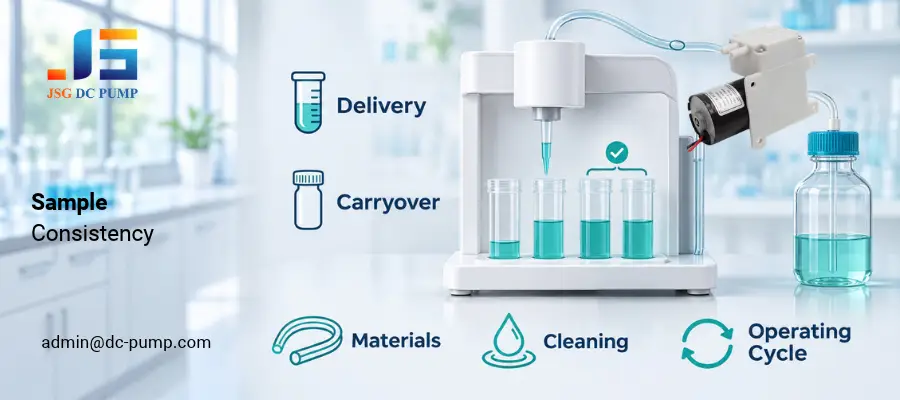
- Delivery:Measure actual volume or airflow across representative cycles.
- Carryover:Test blanks after samples with high concentrations.
- Materials:Check adsorption, swelling, and compatibility.
- Cleaning:Validate flushing or replacement procedures.
- Operating cycle:Confirm output after repeated starts and representative use.
What Do Practical Application Examples Show?
A published JSG16M gas-sampling case specified at least 0.55 L/min at −20 kPa through tubing, a filter, and a sensor chamber. The product page reports approximately 0.60 L/min and current below 160 mA in the integrated prototype. This illustrates selection against an installed working point.
For a reagent-dosing calculation example, delivering 5 mL in 30 seconds requires an average 10 mL/min. JSG18S can be evaluated, but the final speed and time require calibration with the intended reagent. This calculation does not establish measured dosing accuracy.
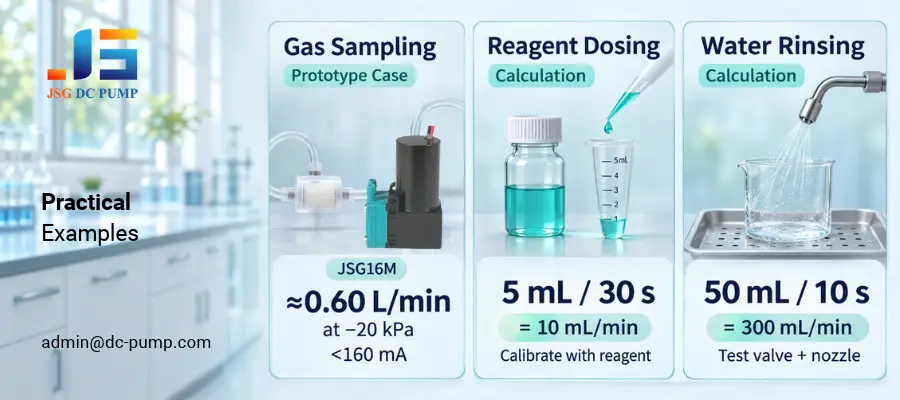
For a water-rinsing calculation example, delivering 50 mL in 10 seconds requires 300 mL/min. Evaluate JSG385HPW-5 through the actual valve and nozzle, including priming time where applicable. Adequate volume must also produce adequate cleaning.
How Should Laboratory Mini Pumps Be Tested?
Open-bench results can change once filters, tubing, valves, and reservoirs are installed. Approval should therefore represent the instrument’s actual preparation sequence.
Test laboratory mini pumps against written output and sample-quality limits. For occupational air sampling specifically, OSHA guidance calls for representative media or equivalent backpressure during pump calibration.
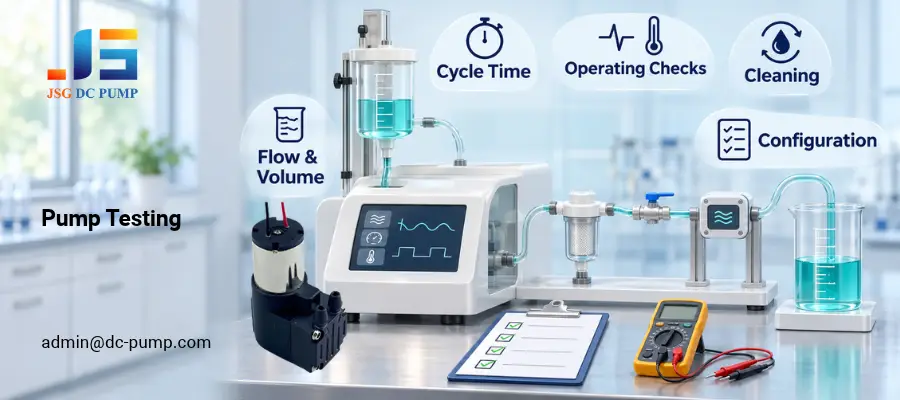
- Measure working flow, delivered volume, and cycle time.
- Include representative liquids, reservoir levels, and filter conditions.
- Check startup, current, temperature rise, leakage, and noise.
- Repeat cleaning and inspect carryover.
- Confirm the approved configuration before production.
How Do You Choose Suitable Laboratory Mini Pumps?
A pump may meet the advertised flow rating but deliver too little once tubing, filters, or nozzles add resistance.
Select by flow at the actual working pressure or vacuum, then check compatibility and operating conditions. Compare these requirements before choosing a model.
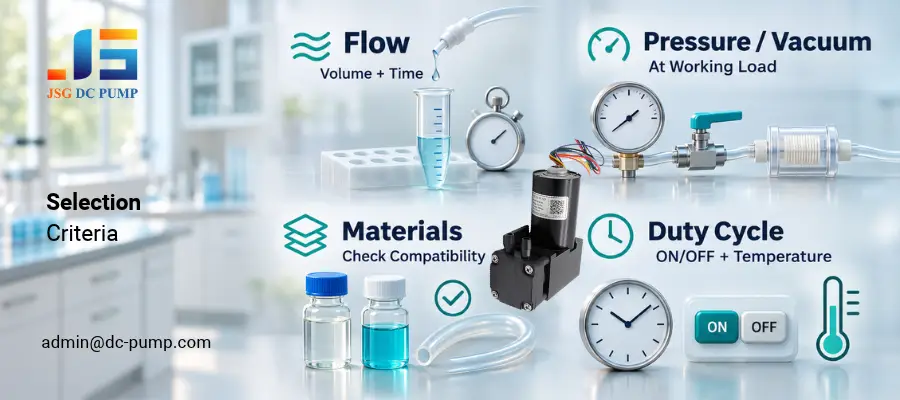
Select flow at the working load, then confirm materials and duty cycle.
- Flow:Define the required volume and time; 5 mL in 30 seconds requires an average 10 mL/min.
- Pressure or vacuum:Check available flow at the target load; maximum flow and maximum pressure are separate endpoints.
- Materials:Confirm compatibility with the sample, reagent, and cleaning solution.
- Duty cycle:Check ON/OFF times, startup load, temperature rise, and expected life.
Conclusion
Laboratory mini pumps support gas sampling, filtration, liquid transfer, rinsing, and waste removal. Their value comes from delivering the required movement consistently while preserving sample integrity. Match each task to a suitable pump, then validate the complete fluid path.
Send your medium, working flow or dose, pressure or vacuum, operating cycle, cleaning method, and installation limits to admin@dc-pump.com for application review and sample selection.
