

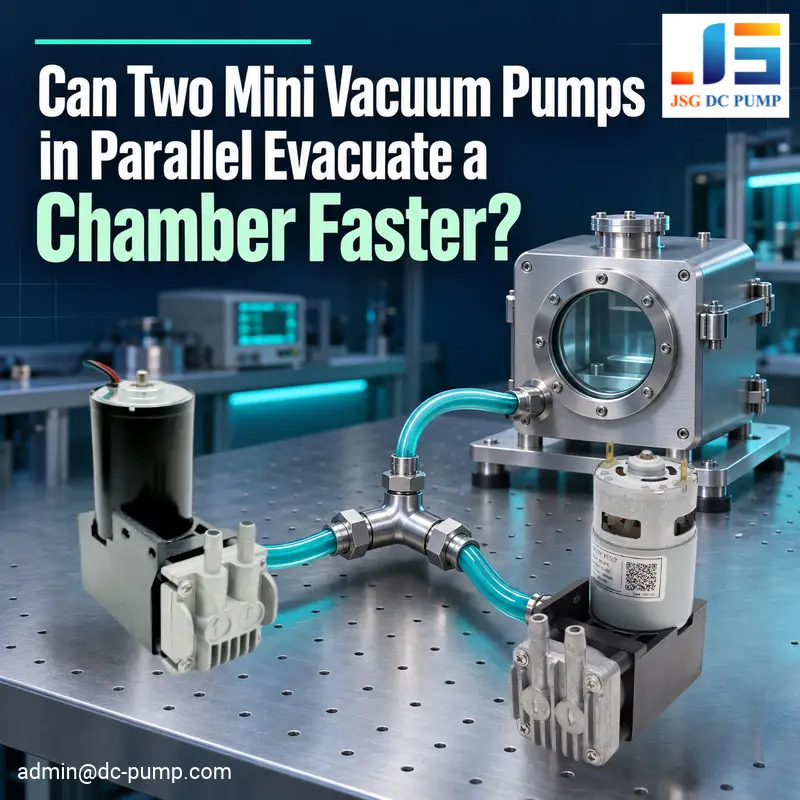
Your prototype reaches the required vacuum in 28 seconds, but the production cycle allows only 18. You try parallel mini vacuum pumps, connecting both to the existing manifold. Both pumps run, yet the chamber still misses the time limit. Before changing the design again, you need to find out why the second pump saves so little time.
Yes, two mini vacuum pumps in parallel can evacuate a chamber faster if they increase the effective pumping speed at the chamber. If that speed nearly doubles across the required pressure range, pump-down time can approach half the original time. The actual gain depends on pump performance under vacuum and the resistance of the installed suction path.
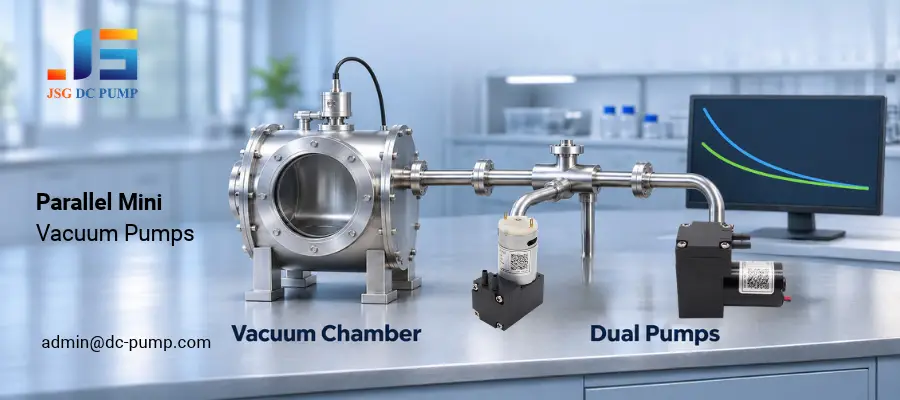
In my years working with miniature pumps at JSG, I’ve learned to compare the full chamber pressure traces. A second pump can save time early in the cycle and contribute very little near the target. Looking at where the pressure falls more slowly helps me decide whether to check the pump curve, the plumbing, or the power supply.
How Do Parallel Mini Vacuum Pumps Work?
Two pumps may each deliver enough flow on the bench, yet make little difference once installed. If both draw through the same undersized chamber port, that port can limit how quickly gas leaves the chamber.
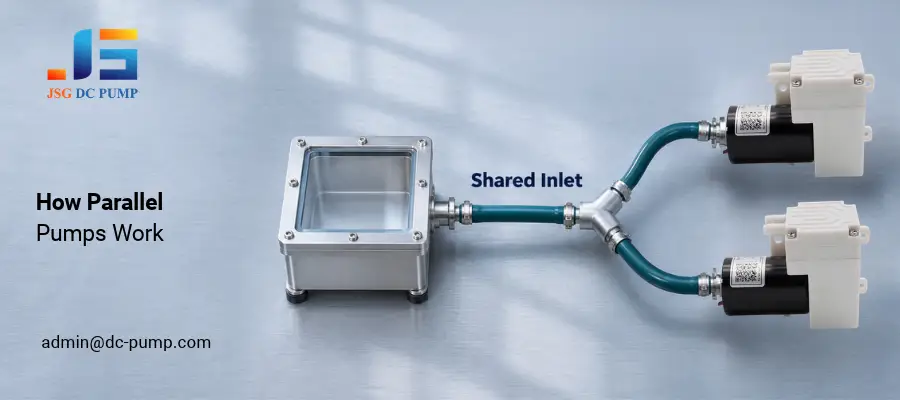
In a parallel layout, each pump inlet has its own branch connected to the same chamber or manifold. At the same inlet pressure, the pumps’ gas removal capacities can add together. With two identical pumps, the main gain is higher pumping speed at a given pressure. The pump design’s intrinsic ultimate pressure stays essentially the same.
- Compare flow at the pressures you need. Use the same flow reference conditions for both pumps. For a model-specific example, see the JSG-07V compact DC piston vacuum pump curve.
- Check the common suction path. The chamber port, shared filter, and valve upstream of the split carry the combined flow.
How Much Time Can a Second Mini Vacuum Pump Save?
Using the free-air flow rating for the entire evacuation cycle can make a design look faster on paper than it is in the machine. The estimate needs to reflect the effective pumping speed at the chamber as pressure falls.
For a first estimate, use t ≈ (V ÷ S_eff) × ln(P_start ÷ P_target). V is the evacuated volume, S_eff is the effective pumping speed at the chamber, and both pressures are absolute. Use liters and liters per minute to get the time in minutes. This approximation assumes nearly constant effective speed, negligible leakage and gas release, and a target well above the pump’s ultimate absolute pressure. See Leybold’s guide to sizing a vacuum pump.
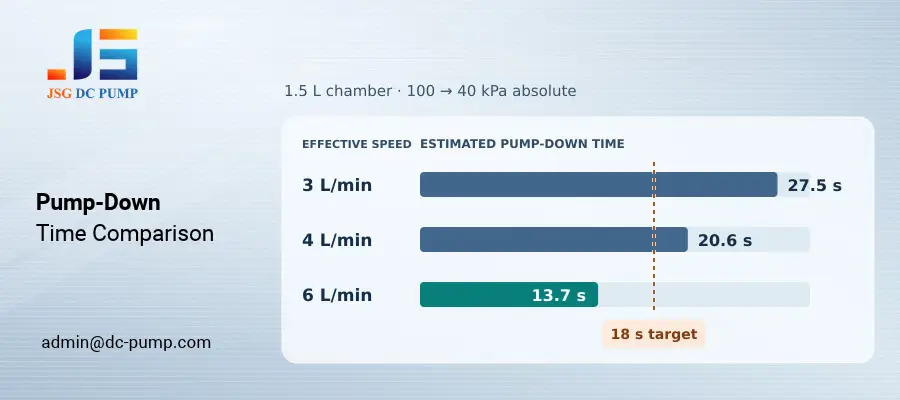
Consider a 1.5 L chamber evacuated from 100 to 40 kPa absolute. At 3 L/min effective pumping speed, the estimated time is 27.5 seconds. At 6 L/min, it falls to 13.7 seconds. If the installed dual-pump system delivers only 4 L/min, the estimate is 20.6 seconds, which still misses the 18-second target.
What Limits the Gain From Parallel Mini Vacuum Pumps?
The pressure may fall quickly when both pumps start, then level off near the target. If you judge the setup from the first few seconds, you can miss the part of the cycle that determines throughput.
Compare chamber pressure with pump inlet pressure while gas is flowing, and measure voltage at the pump terminals during startup. Use the pressure trace to decide which part of the system to check first.
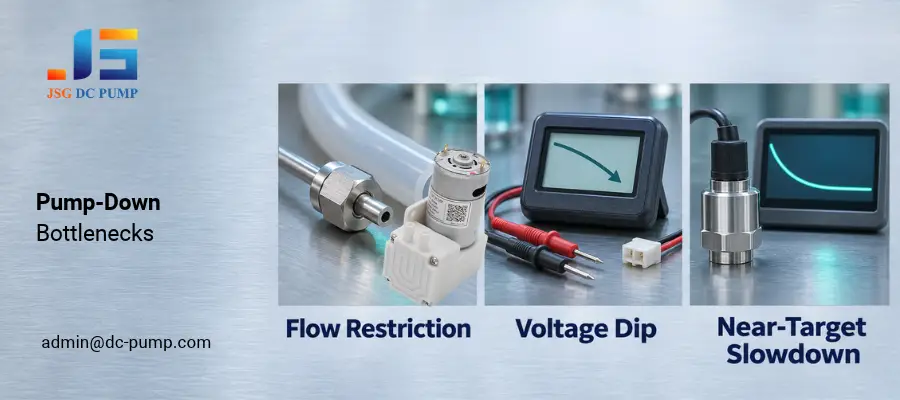
| What you observe | What to check next |
|---|---|
| Chamber pressure is much higher than pump inlet pressure | Measure pressure drop across the shared port, filter, and valve. |
| Terminal voltage dips when both pumps start | Check the power supply, wiring, and connectors under simultaneous startup. |
| Evacuation slows mainly near the target | Check the pump flow curve in that range and run an isolated chamber pressure-rise test. |
What Happens When One Pump Switches Off?
A machine may start with both pumps and then switch one off. If chamber pressure rises after that switch, the remaining pump may have to remove gas returning through the idle branch.
Test the changeover with the intended valve sequence. Isolate the idle branch and repeat the run. If the pressure rise decreases, investigate leakage or backflow through that branch.
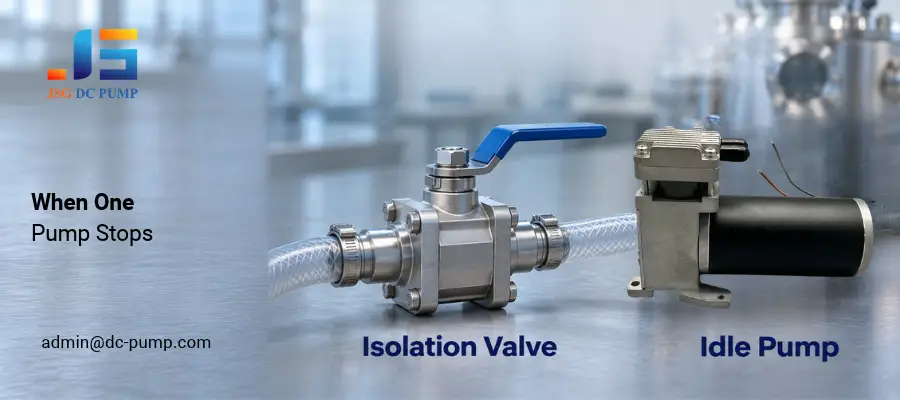
- Check valve sealing. Confirm that the isolation valve seals at the operating pressure difference.
- Recheck pump-down time after adding a valve. The valve can add a restriction when both pumps are drawing through their branches.
How Should You Test Parallel Mini Vacuum Pumps?
A dual-pump run can appear faster simply because the chamber retained some vacuum from the previous test. That advantage disappears when each production cycle starts at atmospheric pressure.
Test each pump alone, then both together on the same chamber. Keep the starting pressure, target pressure, sensor location, and chamber contents consistent. Isolate the unused branch during each single-pump run.
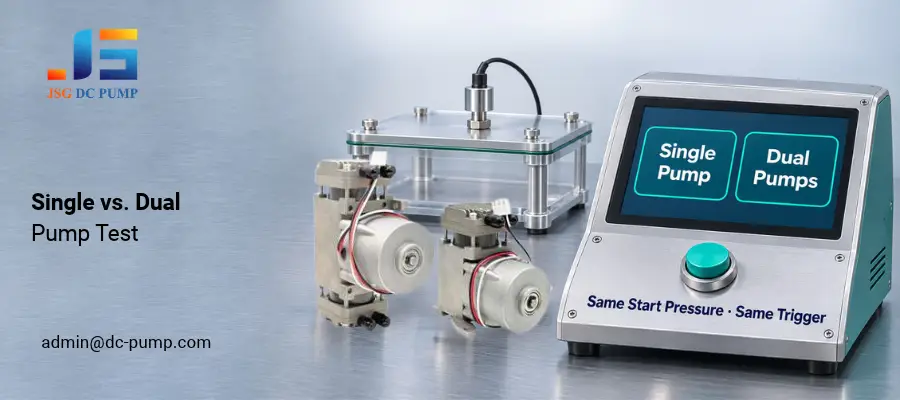
- Use the same timing trigger. Record the full pressure trace from the same control event to the target.
- Repeat at the intended duty cycle. Use the production tubing and valves, and check whether consecutive runs meet the time limit.
When Are Parallel Mini Vacuum Pumps Worth Using?
A second pump can save several seconds on a prototype while adding power demand and taking up installation space. The gain needs to hold up under production conditions.
Use the parallel layout when it consistently meets the cycle target and fits the equipment’s power and space limits. If the test points to a shared restriction, fix it and repeat the single-pump baseline first.
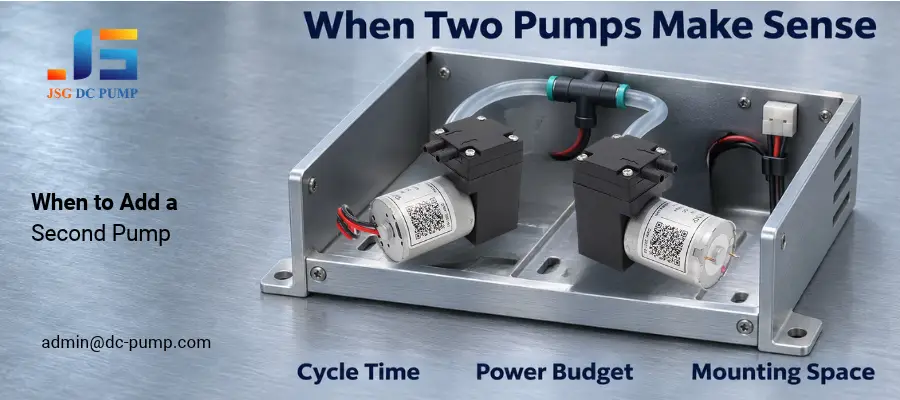
- One pump reaches the target too slowly. Check whether the second pump adds useful flow in the pressure range where the trace slows.
- One pump stalls above the target pressure. Determine whether chamber gas load or the pump’s ultimate pressure is setting the limit.
Conclusion
Two mini vacuum pumps in parallel can shorten evacuation when they increase effective pumping speed across the required pressure range. Compare the time to reach the same target on the same chamber, then use the pressure traces to see where the second pump saves time and where the system still limits flow.
If you’re evaluating a parallel layout, send JSG your chamber volume, starting and target pressures, maximum evacuation time, supply voltage, and a sketch of the suction path. We can help review the operating points and define a comparison test. Email admin@dc-pump.com.
