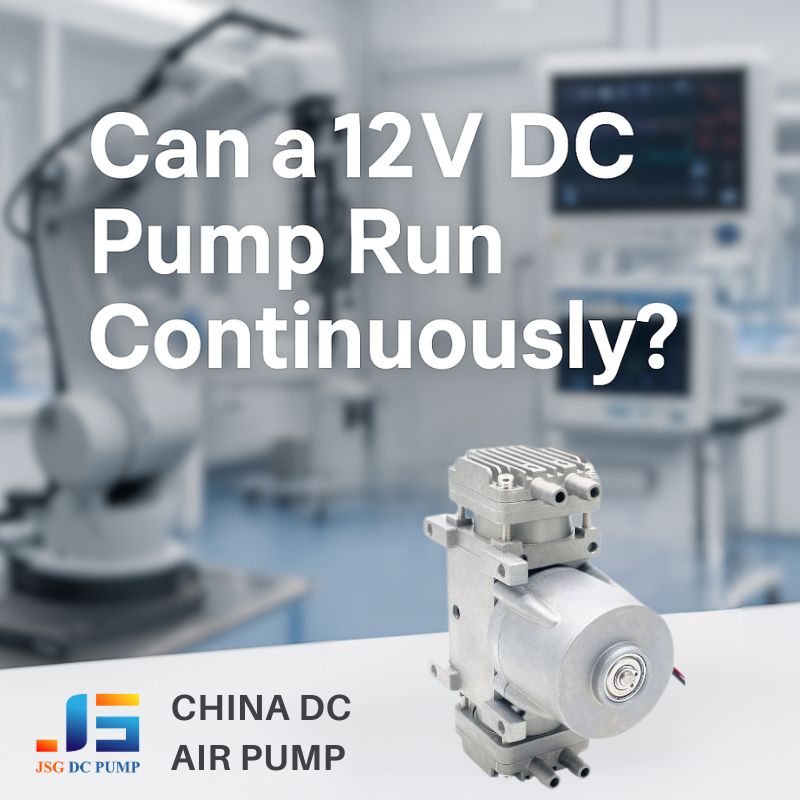
A pump that runs briefly on a bench may behave differently after hours inside an enclosure. For OEM equipment, continuous operation needs to be assessed at the actual flow, pressure or vacuum, supply voltage and ambient temperature.
Yes, a 12V DC pump can run continuously when the specific pump is rated and validated for continuous duty under the intended operating conditions. A brushless motor can reduce brush-related wear, but it does not by itself prove 24/7 suitability or a particular service life.

The 12V rating describes the electrical supply. Continuous duty describes the permitted operating pattern, while service life describes how long the pump meets defined acceptance criteria. These are different specifications. A 100% duty-cycle rating does not mean unlimited life, and maximum pressure is not automatically a continuous working pressure.
For example, operating all day for one year adds up to 8,760 running hours. That is a planning calculation, not a life claim for a JSG pump. Ask for model-specific evidence at your working point before setting a maintenance interval.
Why Choose a Brushless Motor for a Continuously Running 12V DC Pump?
BLDC motors are often preferred for long operating periods because they eliminate the mechanical brushes and commutator contact. Brushed motors can also be rated for continuous operation, but brush wear and the required service interval must be considered.

A brushless pump still contains parts that wear: bearings, diaphragms, valves and the drive mechanism. Electronics and temperature limits also matter. Compare the complete pump at the same working point instead of applying a generic motor-life figure to every pump.
The Fundamental Difference: How They Turn
- Brushed DC motors: Brushes transfer electrical current through the commutator. Wear depends on the motor design, load, speed, temperature and starting pattern.
- Brushless DC motors: Electronic commutation replaces brush contact. Bearings and other moving pump components still require appropriate load and temperature ratings. Rolling bearings have mechanical contact; they are not wear-free.
For the general motor distinction, see maxon’s explanation of brushed and brushless motors. Its motor discussion should not be treated as a service-life rating for a complete JSG pump.
Brushed vs. Brushless for 24/7 Operation
| Selection factor | Brushed 12V DC pump | Brushless 12V DC pump |
|---|---|---|
| Service-life evidence | Confirm brush life and complete-pump test conditions. | Confirm bearing, diaphragm, valve and electronics limits. |
| Wear mechanisms | Brushes, commutator and other moving pump parts. | Bearings and moving pump parts; no commutation brushes. |
| Efficiency | Depends on motor design, speed and load. | Can offer efficiency benefits; compare measured input power at the same working point. |
| Heat generation | Measure current and temperature in the intended installation. | Measure current and temperature; BLDC does not remove the need for cooling. |
| Continuous operation | Possible for a suitably rated model and service interval. | Possible for a suitably rated model; not guaranteed by the motor label. |
How Does Heat Affect a Continuously Running 12V DC Air Pump?
A 12V DC air pump that passes a free-flow bench check may run hotter when tubing, filters and valves add resistance. Check the complete installation, including the warm air surrounding the pump inside the enclosure.
Continuous-duty assessment should measure temperature, current and delivered flow under the intended load. Allow temperatures to stabilize within the model’s specified limits. Do not use the housing being comfortable to touch as the acceptance test.
As an engineering example, a sampling pump inside a closed enclosure may need lower operating speed, a better heat-conduction path or ventilation. These options must be assessed against the required flow and environmental protection. A metal housing or fan alone does not prove that the final installation is suitable.
The Vicious Cycle of Heat
- Motor losses: Copper winding resistance increases with temperature. Current and speed also depend on the load and controller, so an increase in temperature does not imply a universal increase in current.
- Lubrication and bearings: Excessive temperature can shorten lubricant and bearing life. Check the specified operating temperature and loading.
- Diaphragms, valves and housings: Heat and the pumped medium can alter material properties and sealing. Evaluate performance drift and restart behavior, not just whether the motor still turns.
Design Features for Continuous Operation
| Thermal measure | What to verify |
|---|---|
| Efficient motor and operating point | Compare input power at the required delivered flow and pressure or vacuum. |
| Housing and mounting path | Check whether heat can leave the motor and reach the surrounding structure or air. |
| System ventilation | Measure the air temperature around the installed pump, including nearby heat sources. |
| Fan or other active cooling | Use where required by the thermal assessment; account for airflow loss and maintenance. |
Is a 12V DC Diaphragm Air Pump a Good Choice for 24/7 Reliability?
A 12V DC diaphragm air pump can be suitable for continuous gas transfer when its motor, diaphragm, valves and thermal design are validated together. Oil-free operation is useful for many applications, but it does not establish gas purity, chemical compatibility or medical-device compliance.
JSG supports OEM selection of brushless diaphragm pump configurations. For a particular project, confirm the medium, required flow under load, allowable noise and operating pattern before selecting materials and a motor configuration. No universal service-life figure applies to every model.
The Pillars of Diaphragm Pump Reliability
- The motor system: Verify voltage tolerance, starting current, control signals and the permitted operating pattern. Include restart against residual pressure or vacuum if the equipment requires it.
- The mechanical system: Evaluate bearings, eccentric parts, assembly tolerances and vibration under the expected load. Bearing type alone is not an acceptance criterion.
- The pneumatic system: Confirm diaphragm and valve compatibility with the actual gas, humidity, condensate and cleaning exposure. Material names alone do not prove fatigue life or sealing performance.
Lifespan Limiting Factors
| Component | Possible life limitation | Evidence to request |
|---|---|---|
| Motor and controller | Brush wear, bearing wear, electrical or thermal stress. | Complete-pump operating limits and endurance results for the selected configuration. |
| Bearings and drive parts | Wear, excessive loading, temperature or vibration. | Validation under representative speed, load, orientation and ambient conditions. |
| Diaphragm and valves | Fatigue, chemical attack, leakage or contamination. | Material compatibility and flow, vacuum or leakage checks over the test period. |
Can a 12V Vacuum Pump DC Motor Handle Non-Stop Industrial Use?
A 12V vacuum pump in automated equipment may alternate between evacuation, vacuum holding, venting and restart. The factory operating 24 hours a day does not necessarily mean the pump motor runs continuously.
Confirm the actual pump operating cycle and flow at the required vacuum. Ultimate vacuum is an endpoint value and does not establish useful suction flow or restart capability at that vacuum.
For a suction system, evaluate leakage, tubing volume, filters and valves. Where suitable, a reservoir, non-return valve and pressure control may reduce pump running time. Any change must preserve the required holding performance and the equipment’s safety requirements.
What “Industrial Grade” Really Means
- Defined duty rating: A 100% duty-cycle rating means no scheduled off-time under the stated conditions. It does not mean indefinite operation, operation at every pressure, or a certified life.
- Appropriate bearings: Review load, speed, temperature and validation. The bearing supplier’s country is not a substitute for technical evidence.
- Mechanical durability: Check the drive mechanism, mounts, tubing connections and vibration behavior under the actual operating cycle.
- Environmental protection: Confirm any stated IP rating for the exact assembly. Dust, humidity and condensation requirements must be considered separately from the general term industrial.
Specification Checklist for a 24/7 Vacuum Pump
| Specification | Why it matters | Verification |
|---|---|---|
| Motor and complete pump | Motor type influences wear and control options. | Review model-specific duty and life evidence. |
| Duty cycle | Determines whether cooling or recovery intervals are required. | Confirm permitted on-time, off-time, load and ambient temperature. |
| Vacuum working point | Determines delivered flow and evacuation behavior. | Use a flow-vacuum curve and test the assembled circuit. |
| Environment and restart | Affects temperature, sealing and reliable starts. | Check the specified installation and restart at residual load. |
What is the Selection Checklist for a Continuous-Duty Micro Pump?
Use four validation questions: Does the pump meet the working point? Is continuous duty permitted at that load? Does the installed pump stay within thermal limits? Is there relevant endurance evidence?

Missing data is a reason to request clarification and test a sample, not proof that a pump must fail. Define acceptance limits before testing. A pump that still runs but no longer delivers the required flow may already be unsuitable for the equipment.
The Four-Point Validation Checklist
- Working point: Record the exact model, voltage, medium, delivered flow at pressure or vacuum, and the representative tubing, filters and valves.
- Operating pattern: Record continuous on-time, off-time and starts per hour. For intermittent operation, duty cycle is on-time divided by total cycle time. The percentage alone does not describe start frequency or maximum on-time.
- Thermal and restart checks: Test inside the intended enclosure at the relevant ambient temperature. Record current, temperature and performance until stable, then verify restart under the required residual load.
- Endurance and acceptance: Agree on sample count, duration and end-of-life criteria. Record flow or vacuum loss, leakage, noise changes and failure to restart. A short functional test cannot establish a multi-year service life.
If the required on/off pattern is not yet defined, compare intermittent versus continuous pump duty before evaluating a 12V configuration.
Quick Reference Table
| Validation question | Evidence supports selection | Evidence missing or unsuitable |
|---|---|---|
| Working point achieved? | Delivered flow meets the requirement under the actual load. | Request the relevant curve or run a sample test. |
| Continuous duty confirmed? | The rating covers the intended load and ambient conditions. | Confirm the permitted cycle or select another configuration. |
| Thermal behavior acceptable? | Temperature and current remain within specified limits. | Review load, speed, enclosure and cooling. |
| Endurance evidence relevant? | Test conditions and acceptance criteria match the use case. | Define an endurance test and service plan before qualification. |
Prepare your test with the micro pump sample validation checklist. For supplier evaluation, review JSG quality control and applicable certification documentation. Quality-system certification does not establish the service life of an individual pump.
Conclusion
A 12V DC pump can run continuously within a confirmed operating envelope. Select it using flow under load, the duty rating, temperature behavior and complete-pump endurance evidence. A BLDC motor is one useful design choice; it is not a lifetime guarantee.
Request a continuous-duty pump review from JSGDCPUMP. Send the medium, target flow at pressure or vacuum, voltage range, operating cycle, ambient temperature, installation space, expected service life and quantity. Our team can assess an existing platform or the customization and sample validation required.
Send your pump requirements or email admin@dc-pump.com. For development scope, see our OEM and ODM services.