

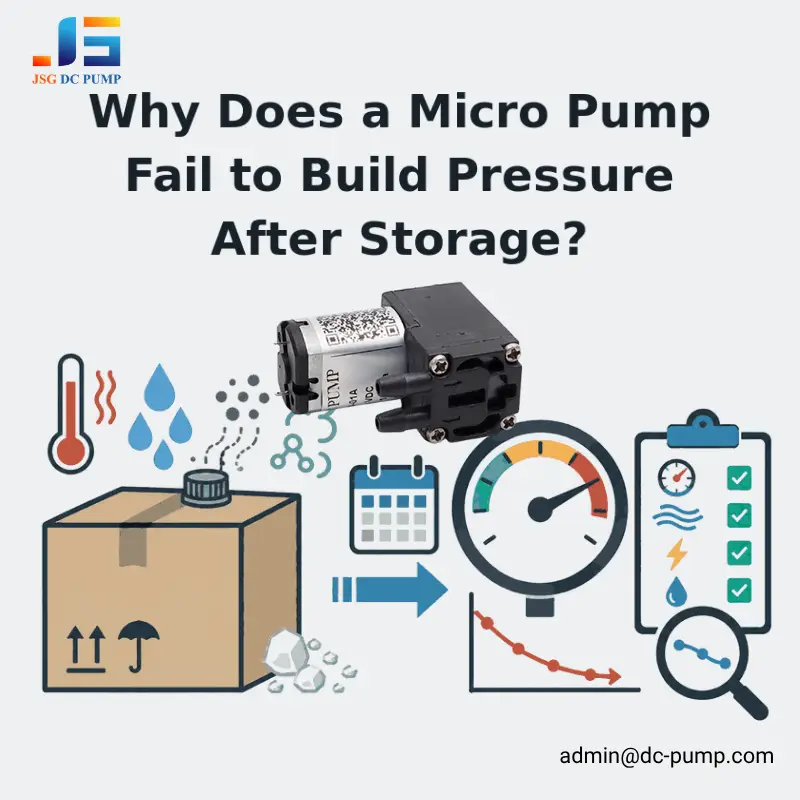
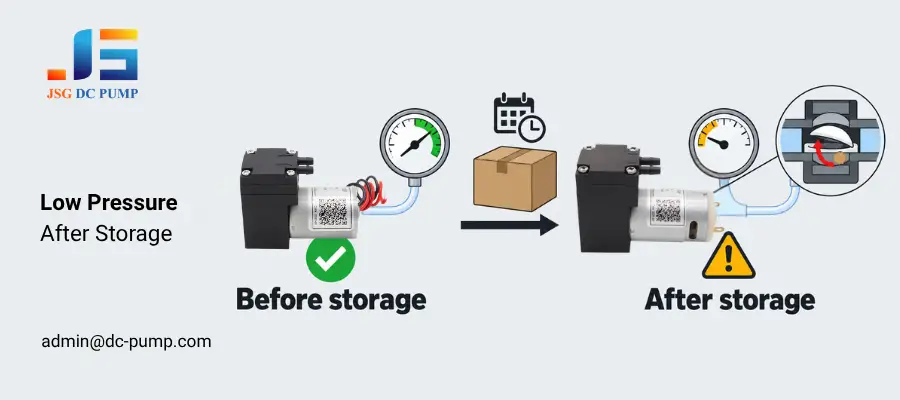
Your micro pump worked before storage, but it now runs without reaching the required pressure. Low pressure after storage can delay commissioning, interrupt production, or make a usable pump appear defective.
A micro pump with inlet and outlet check valves may fail to build pressure after storage when the valves no longer seal consistently. Dried residues, elastomer deformation, condensation, external leakage, or reduced motor speed can produce the same symptom.
From my experience as a JSG engineer, I rarely judge this problem from motor sound alone. Engineers should separate the pump, power supply, tubing, medium, and measurement method before identifying the cause.
What Does Low Pressure After Storage Mean?
The motor may still run and produce some output. This makes storage-related pressure loss easy to overlook during a basic inspection.
Low pressure after storage means the pump cannot reproduce its previous pressure performance under the same test conditions. The failure may affect pressure rise time, working pressure, or maximum pressure.
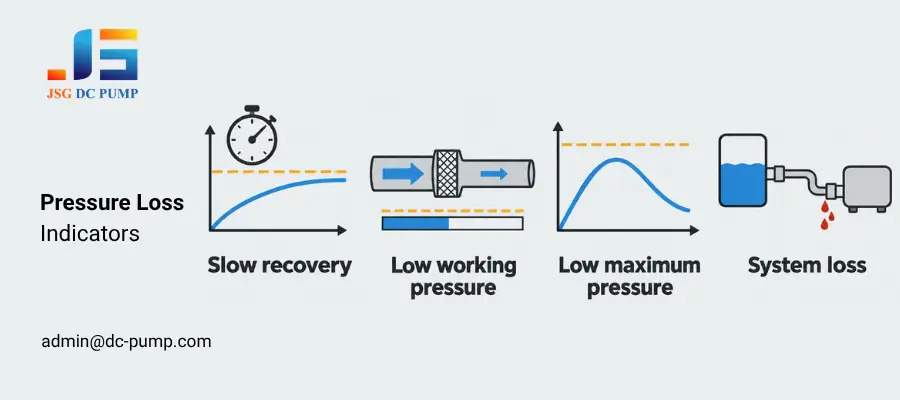
| Pressure condition | Meaning | Engineering relevance |
| Slow pressure recovery | The pump needs more time to reach the target | Check startup response and valve movement |
| Low working pressure | Pressure remains insufficient at the required flow | Compare performance at the real working point |
| Low maximum pressure | Limiting pressure falls below the previous result | Check internal leakage and valve sealing |
| System pressure loss | The pump passes alone but fails after installation | Inspect tubing, fittings, valves, and chambers |
Why Does a Stored Micro Pump Fail to Build Pressure?
A stored pump can look clean and undamaged from the outside. Small internal changes can still prevent its chamber from sealing during each stroke.
The pump fails to build pressure when internal leakage or reduced displacement becomes too large. The motor continues running, but part of each stroke leaks backward instead of contributing to net delivery.
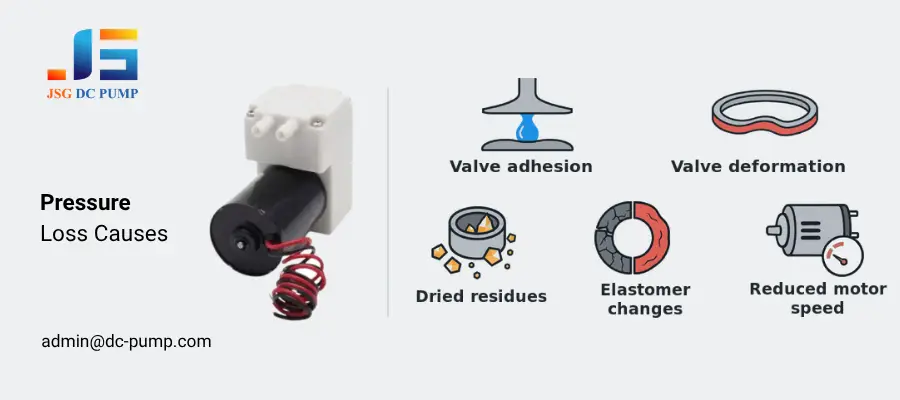
1. Valve adhesion: Residual moisture or media can make a flexible valve stick to its seat during storage.
2. Valve deformation: Long-term contact pressure or excessive heat can change the sealing edge of a valve.
3. Dried residues: Evaporated liquid can leave deposits inside narrow passages or around valve seats.
4. Elastomer changes: Diaphragms, valves, and gaskets may harden, soften, swell, or lose elasticity.
5. Reduced motor speed: Voltage loss, poor electrical contact, or mechanical resistance can reduce the pumping frequency.
Which Conditions Make Pressure After Storage Worse?
A pump may survive several months in controlled packaging but fail after a shorter period in an unsuitable warehouse. Storage duration alone cannot describe the actual risk.
Pressure after storage becomes less stable when heat, humidity, contamination, chemicals, or residual media affect internal components. Temperature cycling can increase the risk further.
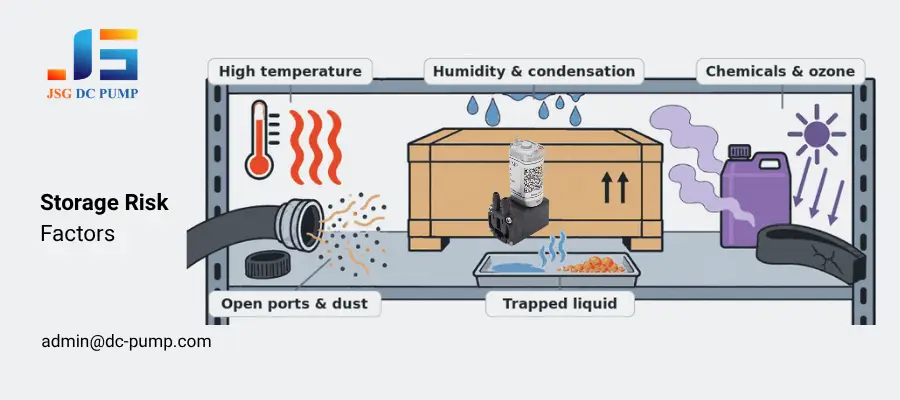
1. High storage temperature: Heat can accelerate elastomer aging, valve deformation, and material adhesion.
2. Humidity and condensation: Temperature changes can create moisture inside the pump head. Our micro pump moisture damage guide explains this process.
3. Unsealed ports: Open ports allow dust, fibers, and other particles to reach small valve surfaces.
4. Trapped working medium: Remaining water or process liquid may evaporate, thicken, crystallize, or react with internal materials.
5. Chemical and ozone exposure: Vapors, sunlight, and ozone can affect some elastomers. ISO 2230:2026 provides general guidance for storing rubber products.
Is the Pressure Failure Inside the Pump or the System?
Replacing the pump immediately may not solve the problem. A leaking connector, restricted filter, weak power supply, or incorrect test method can create the same symptom.
Engineers should test the stored pump separately before deciding that its internal components have failed. The independent test should reproduce the original voltage, medium, tubing, instruments, and working point.
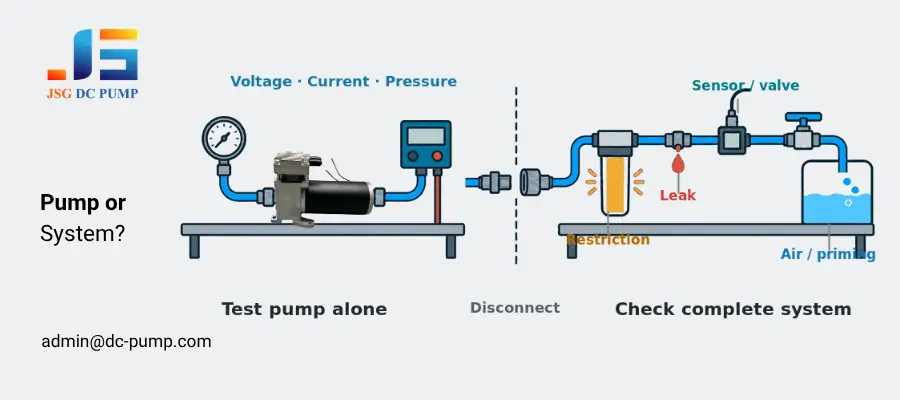
Start by measuring voltage and current directly at the pump during loaded operation. Then test the pump with clean tubing and a calibrated pressure gauge. Normal free flow with low pressure suggests internal sealing leakage. Low flow and low pressure may indicate reduced speed or a restricted path. If the pump passes separately, inspect the complete system for leakage, resistance, sensor error, or incorrect valve operation. Liquid pumps should also be checked for incomplete priming and suction-side air leaks.
What Risks Can Low Pressure After Storage Create?
The equipment may start normally while taking longer to complete its pressure cycle. This delay can appear only after assembly or repeated production testing.
Low pressure after storage can affect response time, working flow, control stability, temperature, and production consistency. The final risk depends on the complete system requirement.
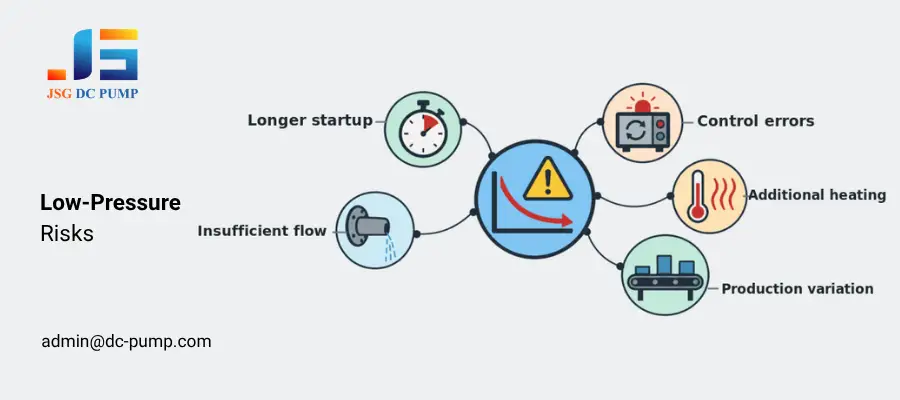
1. Longer startup time: The equipment may exceed its allowed pressure-building or evacuation period.
2. Insufficient working flow: A pump may produce free flow but fail to deliver enough flow against resistance.
3. Control errors: Slow pressure response can trigger alarms, repeated starts, or incorrect valve commands.
4. Additional heating: The controller may keep the pump running longer while attempting to reach the target.
5. Production variation: Stored batches may produce inconsistent results if packaging and storage conditions were uncontrolled.
How Can Engineers Diagnose Low Pressure After Storage?
Changing several components together can hide the real cause. The pump may improve temporarily while the same failure returns after another storage period.
Engineers should record the original condition before attempting recovery. Measure pressure, flow, voltage, current, pressure rise time, and leakage while changing one variable at a time.
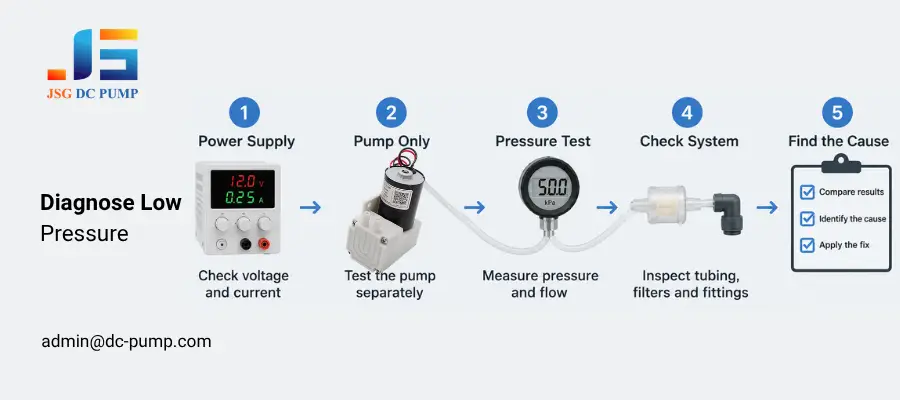
| Test observation | Likely cause | Corrective action |
| Pressure improves after several cycles | Temporary valve adhesion | Rest the pump and repeat the test |
| Free flow is normal, but pressure remains low | Internal valve or pump-head leakage | Perform an approved leakage test |
| Pump passes alone but fails in the equipment | External leakage or excessive resistance | Inspect tubing, filters, fittings, and valves |
| Flow and pressure are both low | Low voltage, reduced speed, or blockage | Measure terminal voltage, current, and speed |
| Liquid contains bubbles and pressure stays low | Suction leakage or incomplete priming | Check inlet tubing, liquid level, and priming |
Conclusion
A micro pump may fail to build pressure after storage because of valve adhesion, elastomer changes, contamination, reduced speed, or external leakage. Engineers should compare controlled pump and system tests before approving the stored unit for production.
Need help diagnosing pressure after storage? Send your pump model, voltage, medium, storage period, working pressure, target flow, and test conditions to admin@dc-pump.com.
