

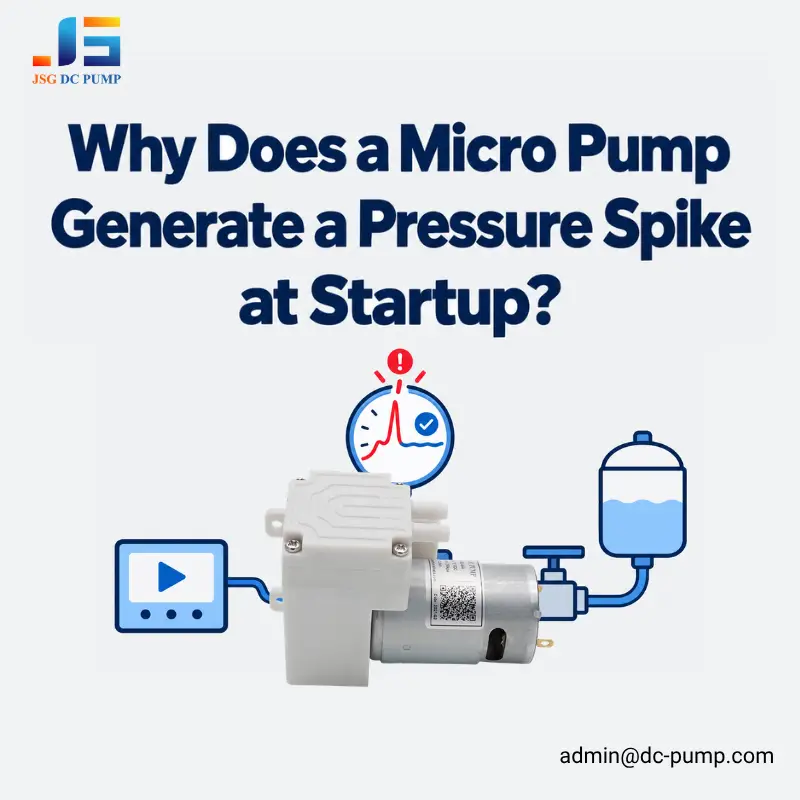
A micro pump pressure spike may appear each time the motor starts, even when the pump reaches the required working pressure. The peak may trigger alarms, disturb dosing, stress valves, or create an unexpected burst at the outlet. A stable final reading can hide this short startup event.
A micro pump generates a pressure spike when its first displacement strokes deliver energy faster than the system absorbs it. Rapid motor acceleration, trapped downstream volume, valve delay, liquid inertia, and slow feedback can push pressure above the steady level. The pump may remain within specification while the complete system still overshoots.
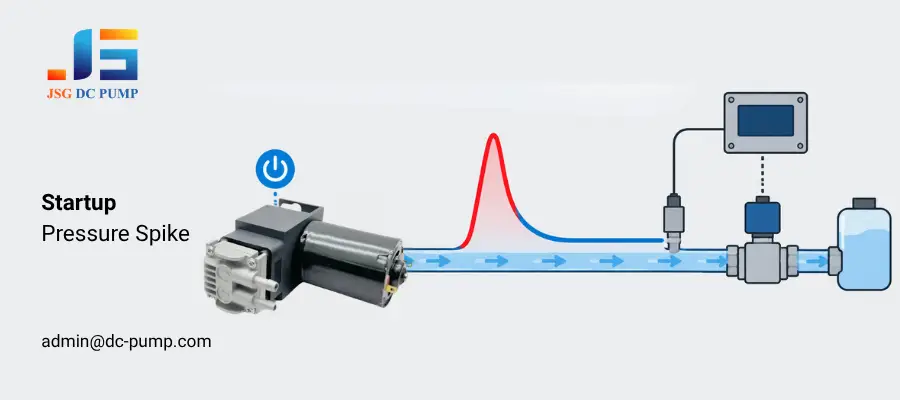
From my experience as a JSG engineer, I rarely treat this as a pump-only defect. The pump, tubing, valves, chamber, sensor, power supply, and control logic form one dynamic system. Engineers must record the startup transient and compare it with the steady working point.
What Is a Micro Pump Pressure Spike at Startup?
Your steady pressure may remain acceptable, while the first peak crosses a valve, sensor, or tubing limit. Checking only the final reading can hide the event causing alarms or inconsistent output.
A startup pressure spike is a brief maximum appearing after energization and before stable operation. It differs from normal pulsation, steady working pressure, and the pump’s maximum pressure rating.
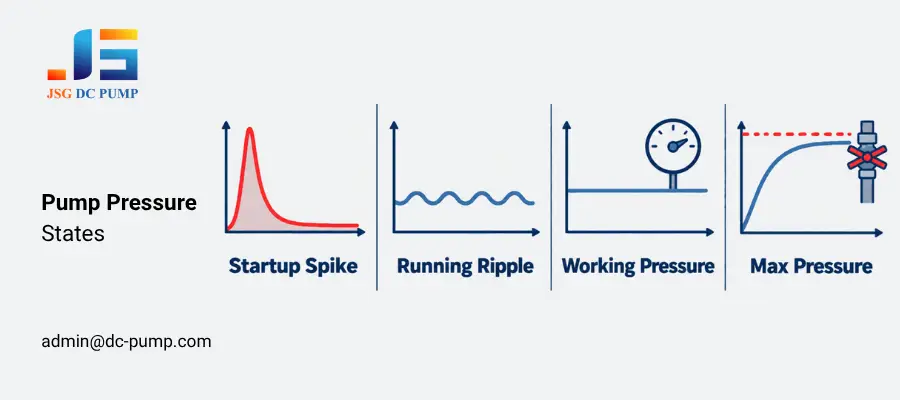
| Pressure condition | Meaning | Engineering relevance |
| Startup pressure spike | A brief peak after the motor starts | Compare it with the weakest component limit |
| Running pressure ripple | Repeated variation during pump strokes | Check its amplitude and frequency |
| Steady working pressure | Stabilized pressure under the actual load | Use it for flow, current, and temperature evaluation |
| Maximum pump pressure | Limiting pressure near zero flow | Do not treat it as the normal working point |
What Causes a Micro Pump Pressure Spike at Startup?
A pump may behave normally with an open outlet but overshoot after installation. The final device changes the load experienced by the first strokes.
The pressure spike forms when initial displacement enters a restricted or low-compliance volume before pressure equalizes. Diaphragm motion is intermittent, so each early compression stroke can add another pressure pulse.
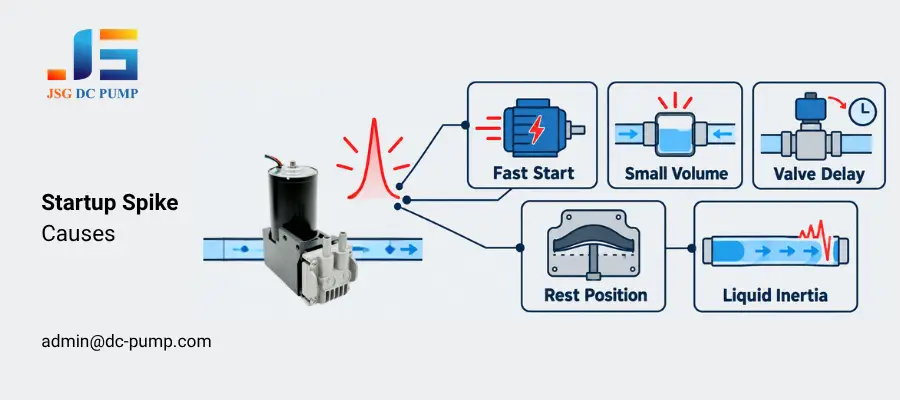
1. Rapid acceleration and control delay: Full startup voltage can drive early strokes too quickly before the controller responds.
2. Small trapped volume: Limited chamber volume allows a small displacement to create a large pressure increase.
3. Valve delay and residual pressure: Delayed opening or trapped pressure increases the initial outlet load.
4. Pump rest position: The diaphragm position changes the effective displacement of the first stroke.
5. Liquid inertia: Rapid liquid acceleration can create a strong hydraulic pressure transient.
Which System Conditions Make a Micro Pump Pressure Spike Worse?
Replacing the pump may not remove the pressure spike. A different tube, valve, chamber, or control program can create a larger change.
The spike becomes larger when compliance is low, resistance is high, or the controller applies maximum startup power. Liquid systems also react strongly because liquids compress much less than gases.
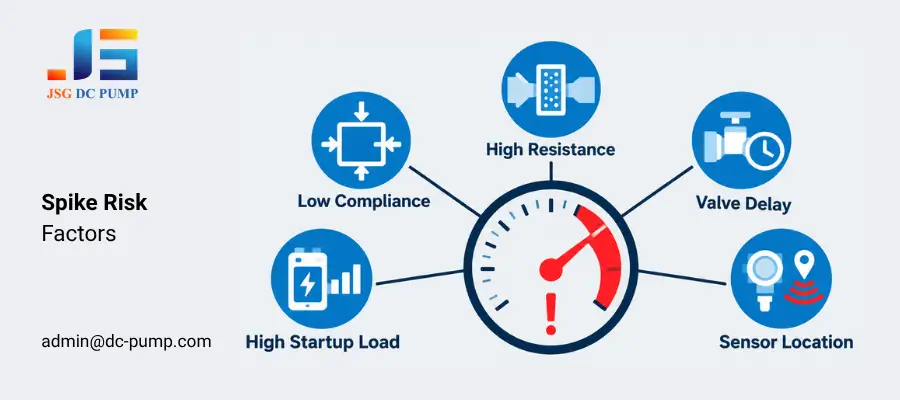
1. Low system compliance: A small sealed chamber or rigid line allows pressure to rise rapidly.
2. High line resistance: Long tubing, clogged filters, or narrow fittings slow pressure equalization.
3. Delayed valve opening: High cracking pressure or slow solenoid action temporarily blocks the outlet.
4. Excessive startup load: Residual pressure, maximum PWM, or an oversized pump increases the initial peak.
5. Sensor location: A sensor near the pump outlet records stronger local pressure pulses.
Is the Pressure Spike Real or a Measurement Error?
An oscilloscope may show a sharp peak that another instrument never detects. Engineers may redesign the system unnecessarily without checking the complete measurement chain.
A true pressure spike changes physical system pressure. A measurement error can originate from sensor response, electrical noise, sampling, filtering, or sensor location.
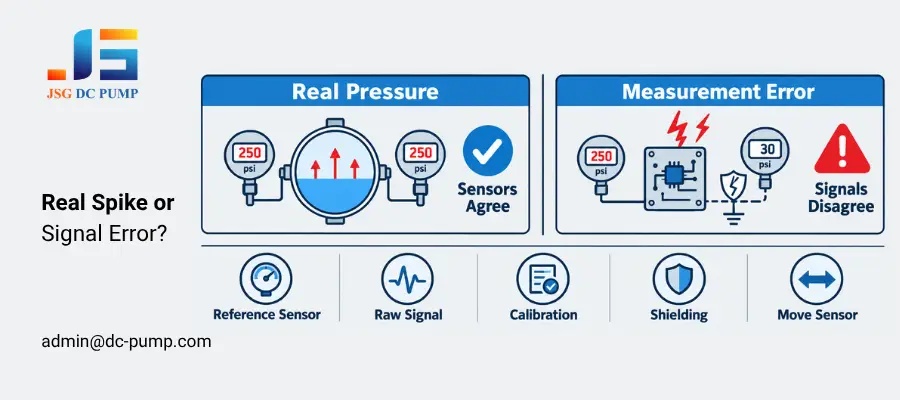
1. Install a second reference transducer at the same pressure point.
2. Record raw pressure with voltage, current, PWM, and valve commands.
3. Confirm sensor range, response time, acquisition rate, and dynamic calibration.
4. Check startup noise, grounding, shielding, and shared supply rails.
5. Move the sensors downstream and repeat the test with a known buffer volume.
What Risks Can a Startup Pressure Spike Create?
The equipment may pass a short bench test but fail after repeated starts. A weak valve, seal, sensor, or dosing process may show the first problem.
Repeated pressure spikes can cause nuisance trips, unstable output, vibration, leakage, and additional downstream stress. One isolated peak does not prove permanent damage, but it still requires limit checking.
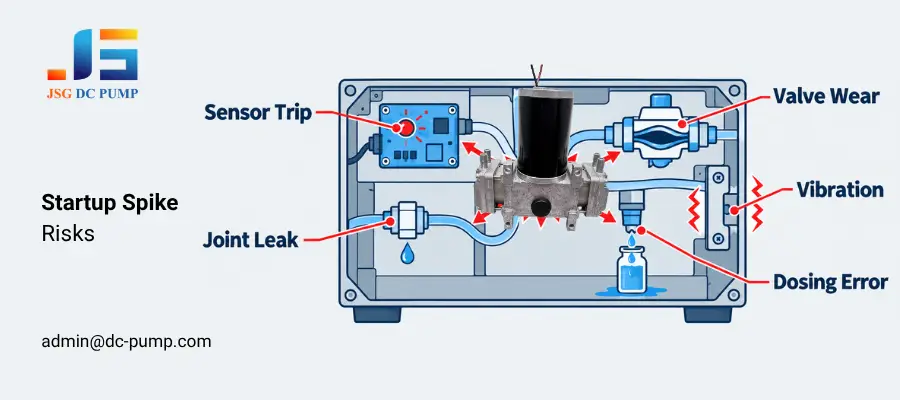
1. Sensors and switches: The peak can exceed sensor limits or trigger an unwanted shutdown.
2. Valves and diaphragms: Repeated pressure impacts can affect sealing and increase mechanical stress.
3. Tubing connections: Pressure spikes can expose loose fittings, weak clamps, or leakage points.
4. Dosing and control systems: The first burst can cause excessive dosing, hunting, restarts, or fault codes.
5. Equipment structures: Pressure pulses can increase noise and transfer vibration into the enclosure.
How Can Engineers Diagnose and Reduce the Pressure Spike?
Changing several components together can hide the actual cause. The prototype may improve temporarily, while the same problem returns during production.
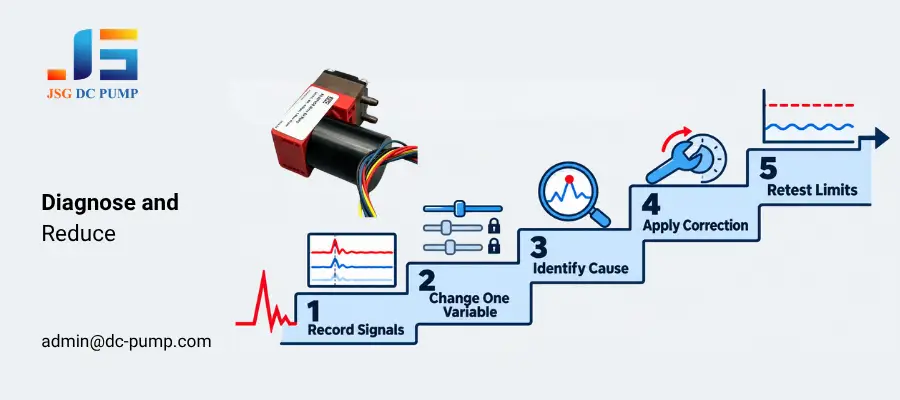
Engineers should record the transient first and then change one system variable at a time. Record pressure, voltage, current, PWM, speed feedback, and valve commands on the same timeline. Compare the results with component limits before selecting a correction.
Engineers comparing pump options can review the JSG04 brushless mini diaphragm pump after defining the working pressure, allowable peak, voltage, and duty cycle.
| Test observation | Likely cause | Corrective action |
| Peak disappears with an open outlet | Restriction or delayed valve | Reduce restriction or adjust valve timing |
| Peak falls with added buffer volume | Low compliance or liquid inertia | Add a buffer or accumulator |
| Peak appears with full startup PWM | Excessive motor acceleration | Apply a controlled soft start |
| Peak changes with sensor position or wiring | Local pulsation or electrical noise | Relocate the sensor and check wiring |
| Peak increases during loaded or boundary starts | Residual pressure or operating limits | Vent the line and validate extreme conditions |
Conclusion
Startup pressure spikes must be evaluated as complete-system transients, not only as pump behavior. Define limits for peak pressure, duration, settling time, and restart performance. Validate voltage, temperature, residual pressure, line resistance, valve timing, and component tolerances before production.
Need help reducing a startup pressure spike or selecting the right micro pump? Send your working pressure, allowable peak, medium, voltage, duty cycle, and system details to admin@dc-pump.com. JSG engineers can support pump selection and sample testing.
