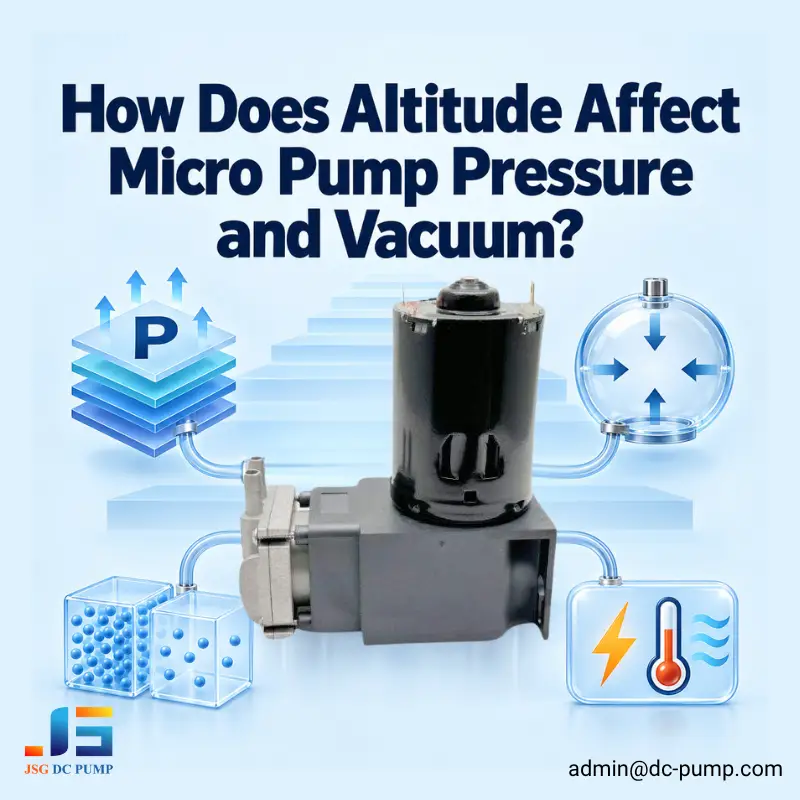
Micro pump pressure and vacuum performance can change when equipment moves from sea level to a high-altitude location.
Altitude lowers local atmospheric pressure and air density. These changes affect pressure references, vacuum readings, gas mass flow, and motor cooling. A pump may run normally but produce a different system result. The difference is not always a pump defect.
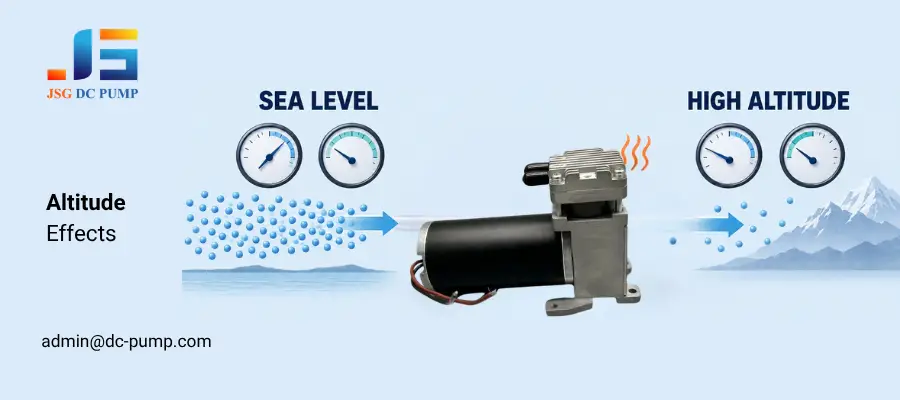
From my experience as a JSG engineer, many altitude problems begin with an incomplete pressure definition. A value in kPa is not enough. Engineers must state whether each target is gauge pressure, absolute pressure, or differential pressure. Flow conditions must also be defined.
Why Does Altitude Change Micro Pump Pressure and Vacuum?
A pump may keep the same speed while the equipment reaches a different pressure endpoint. This can make altitude effects look unpredictable.
Altitude changes pump performance because the pump operates against local atmospheric pressure. Air density also decreases as elevation increases.Atmospheric pressure comes from the weight of the air above a location. Higher locations have less air above them.
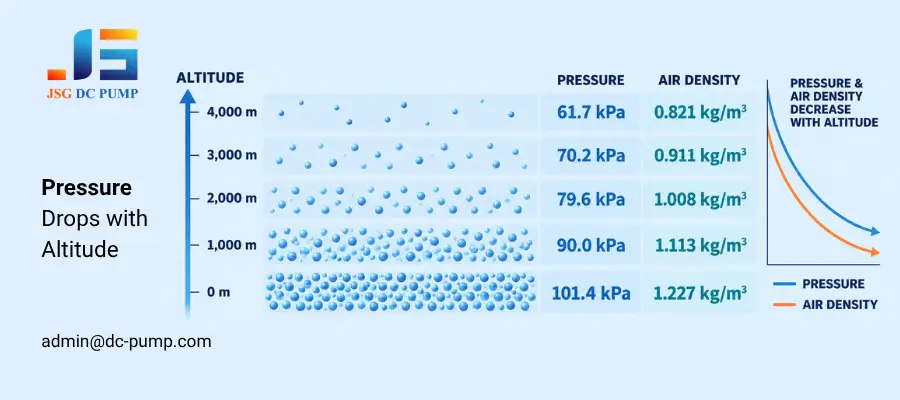
NASA’s standard atmosphere model shows that both pressure and density decrease with altitude. The following values are approximate model values.
| Altitude | Atmospheric Pressure | Air Density |
| 0 m | 101.4 kPa | 1.227 kg/m³ |
| 1,000 m | 90.0 kPa | 1.113 kg/m³ |
| 2,000 m | 79.6 kPa | 1.008 kg/m³ |
| 3,000 m | 70.2 kPa | 0.911 kg/m³ |
| 4,000 m | 61.7 kPa | 0.821 kg/m³ |
What Is the Difference Between Gauge and Absolute Pressure?
Two test reports may show different kPa values for the same physical condition. The difference may come from the pressure reference.
Gauge pressure uses local atmospheric pressure as zero. Absolute pressure uses a perfect vacuum as zero. Differential pressure compares two selected points. It does not require either point to equal local atmospheric pressure.
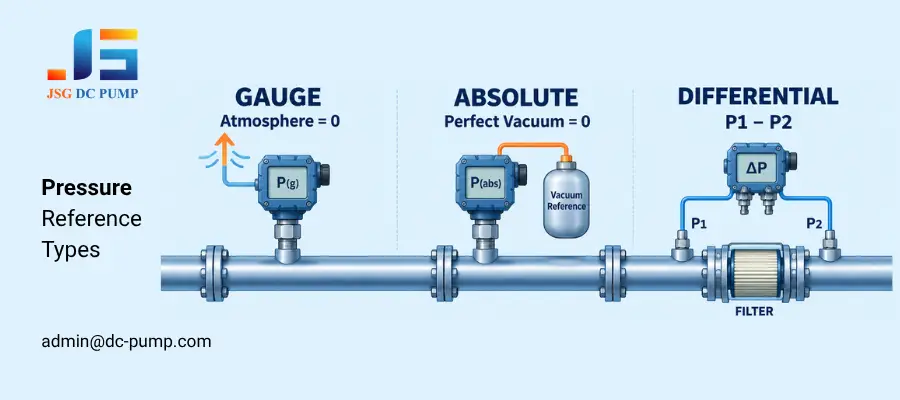
| Pressure Term | Reference Point | Typical Use |
| Gauge pressure | Local atmosphere | Outlet pressure or displayed vacuum |
| Absolute pressure | Perfect vacuum | Vacuum chambers and altitude calculations |
| Differential pressure | A second pressure point | Filters, flow paths, and pump load |
How Does Altitude Affect a Micro Pressure Pump?
A pressure device may keep its gauge setting but deliver a lower absolute outlet pressure at altitude. This can affect the final process.
Altitude affects a pressure pump differently depending on whether the target is gauge pressure or absolute pressure.
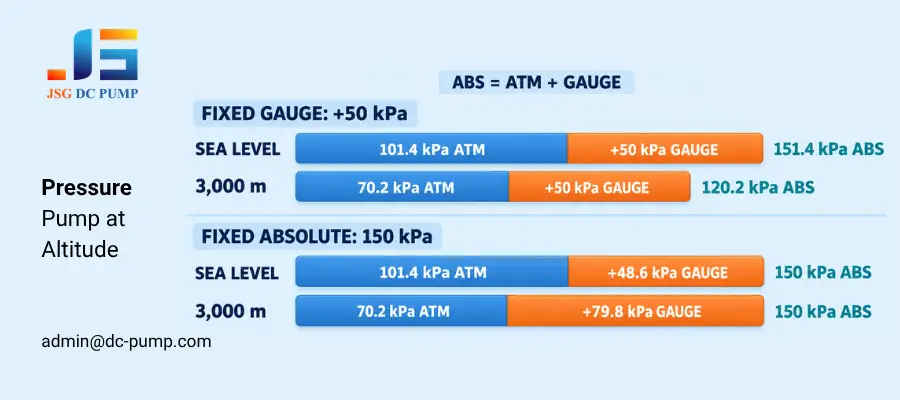
For a +50 kPa gauge target, outlet absolute pressure falls from about 151.4 kPa at sea level to 120.2 kPa at 3,000 m. However, reaching 150 kPa absolute requires about +48.6 kPa gauge at sea level and +79.8 kPa at 3,000 m. This higher differential load can affect pump speed, current, flow, and temperature.
How Does Altitude Affect a Micro Vacuum Pump?
A vacuum pump may appear weaker because its gauge displays a less negative value at altitude. The displayed number can be misleading.
Local atmospheric pressure sets the zero point for a gauge vacuum reading. It also sets the theoretical negative limit.
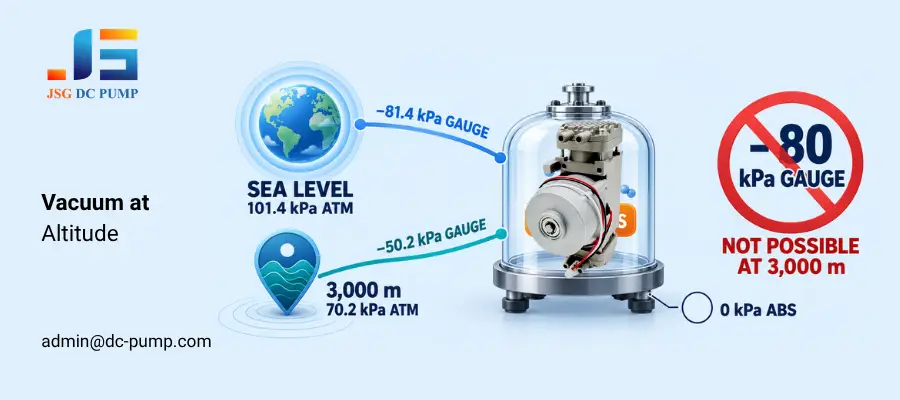
At sea level, the theoretical gauge limit at perfect vacuum is about −101.4 kPa. At 3,000 m, it is only about −70.2 kPa. Therefore, −80 kPa gauge is physically impossible at that altitude. A chamber at 20 kPa absolute corresponds to −81.4 kPa gauge at sea level and −50.2 kPa gauge at 3,000 m. Conversely, a −50 kPa gauge target corresponds to 51.4 kPa absolute at sea level but 20.2 kPa absolute at 3,000 m. The same gauge target therefore represents a much deeper absolute vacuum at altitude and must be revalidated against the pump curve.
Does Altitude Reduce Micro Pump Airflow?
A flow display may remain stable while the instrument receives less air mass. This can change sampling or process performance.
Altitude does not change the pump’s geometric displacement. However, delivered airflow can still change with pressure ratio, valve leakage, motor speed, and pump efficiency.
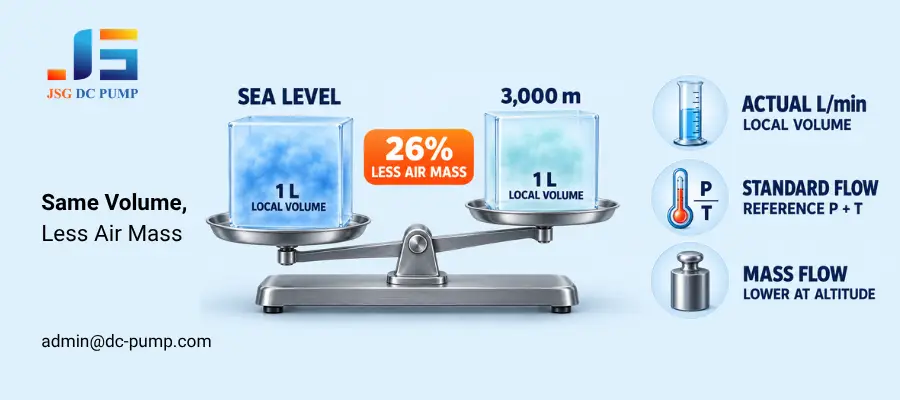
At 3,000 m, the standard atmosphere density is about 26% lower than at sea level. One local liter contains less air mass.This makes the flow unit important.
| Flow Term | What It Describes | Altitude Consideration |
| Actual L/min | Volume at local conditions | May remain near the displacement-based value |
| Standard volumetric flow | Volume converted to stated reference pressure and temperature. | Reference pressure and temperature must be specified because SLPM and NL/min conventions can vary. |
| Mass flow | Gas mass moved each minute | Falls when density falls at the same actual volume |
How Should Engineers Specify a Pump for High-Altitude Equipment?
A pump can match the headline pressure value and still miss the real operating target. Incomplete specifications create this mismatch.
Start with the operating altitude, pressure reference, and required flow basis. Then define the electrical and thermal conditions.
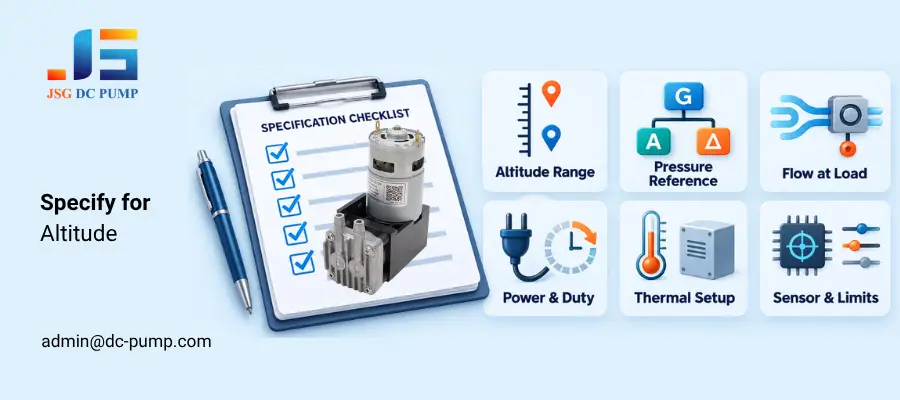
Use the following checklist:
1. Define the minimum and maximum operating altitude and local atmospheric pressure range.
2. Mark each pressure value as gauge, absolute, or differential.
3. Specify the flow basis and required flow at the working pressure or vacuum.
4. Define ambient temperature, enclosure conditions, voltage, control method, and operating cycle.
5. Identify the pressure sensor and calibration reference, then set current, temperature, noise, and response limits.
How Should High-Altitude Pump Performance Be Tested?
A sea-level test can hide errors that only appear after the equipment reaches its deployment location.
High-altitude testing should reproduce the expected ambient pressure and temperature. The measurement reference must remain clear throughout the test.
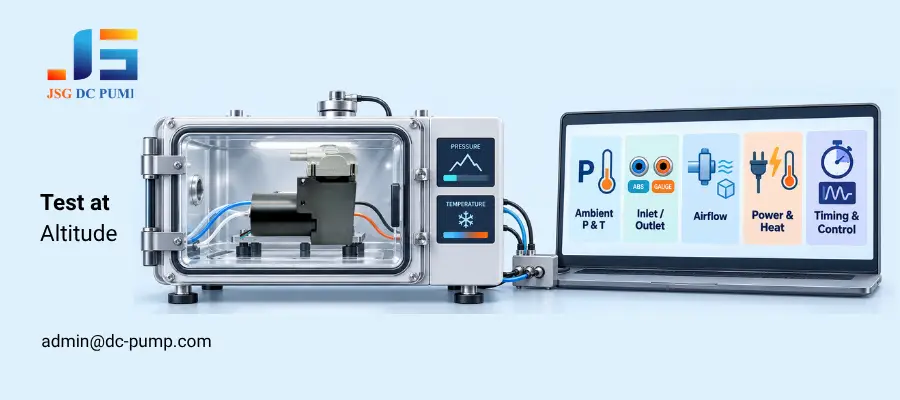
A controlled low-pressure chamber provides the most repeatable method. Field testing can provide additional confirmation at the actual location.
Record the following values at each altitude condition:
1. Record the local atmospheric pressure.
2. Measure the inlet and outlet pressures using both absolute and gauge references.
3. Record both actual and standard airflow.
4. Monitor supply voltage, current, and motor or housing temperature.
5. Record startup time, steady-state time, control output, and sensor readings.
Conclusion
Altitude can affect equipment even when the pump runs normally. Lower atmospheric pressure and air density change micro pump pressure, vacuum, airflow, and cooling. Engineers should therefore define altitude, pressure reference, and flow basis before selecting or testing a pump.
Need help selecting a pump for high-altitude equipment? Send your operating altitude, pressure reference, working flow, voltage, and duty cycle to admin@dc-pump.com.