A miniature vacuum pump can suffer moisture damage even when the equipment never intentionally handles liquid. Warm, moisture-laden gas may cool inside the inlet tubing and form droplets. These droplets can wet small valves, restrict filters, leave residue, reduce working flow, and eventually cause unstable suction or pump failure.
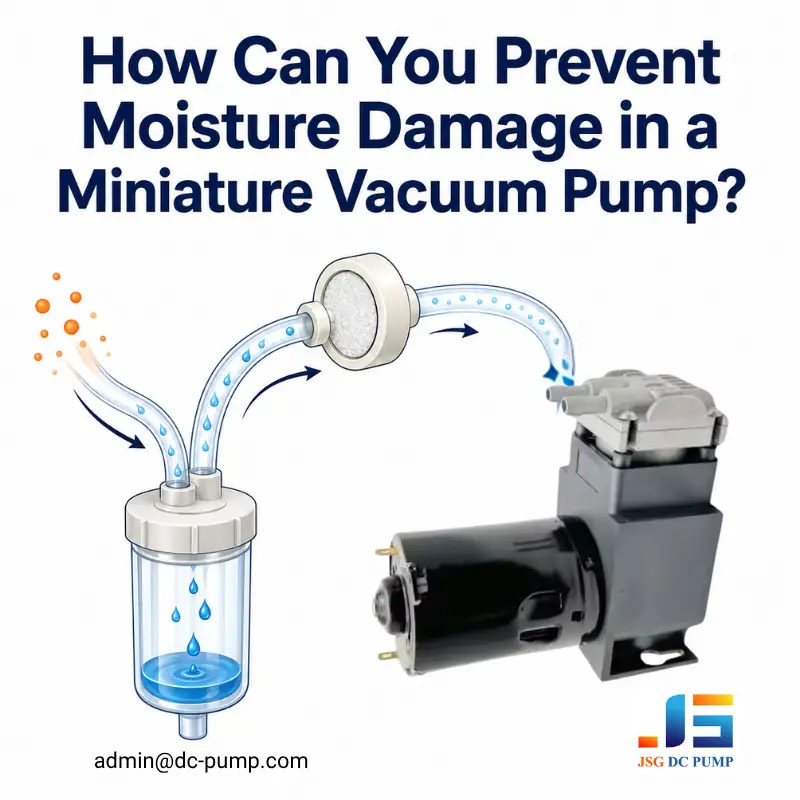
To prevent miniature vacuum pump moisture damage, control where condensation forms and keep liquid away from the pump. Use a correctly sized water trap, a low-restriction hydrophobic filter, properly routed tubing, suitable wetted materials, and a validated operating sequence. The complete device should also be tested under its worst expected humidity and temperature conditions.
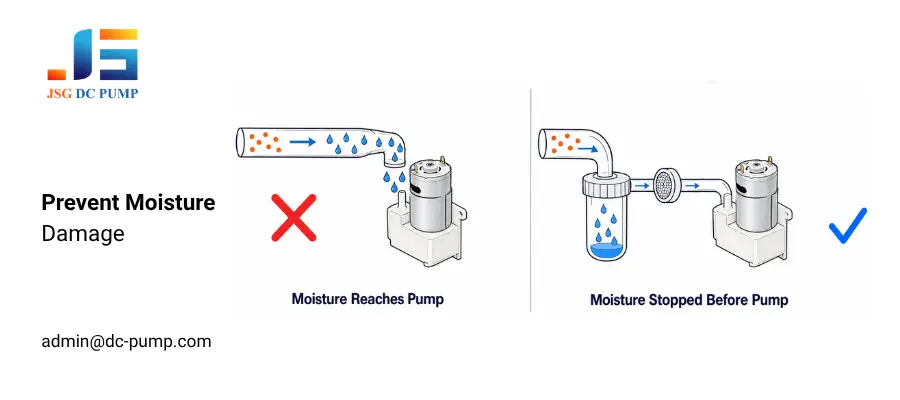
As engineers at JSG DC PUMP, we examine the complete gas path instead of treating moisture as only a pump-material problem. Based on our micro pump engineering and manufacturing experience since 2003, we normally check the source-gas temperature, dew point, coldest tubing location, filter resistance, installation height, shutdown cycle, and working vacuum before recommending a pump.
What Causes Miniature Vacuum Pump Moisture Damage?
Your miniature vacuum pump may operate normally during a dry laboratory test but become slower or less stable after entering a humid application. This difference often causes engineers to suspect the motor or pump head before checking the surrounding pneumatic system.
Moisture can interfere with the small valves, seals, filters, and internal gas passages that control vacuum performance. A thin liquid film may make a valve stick, while a wet filter can produce much more resistance than the same filter in a dry condition.
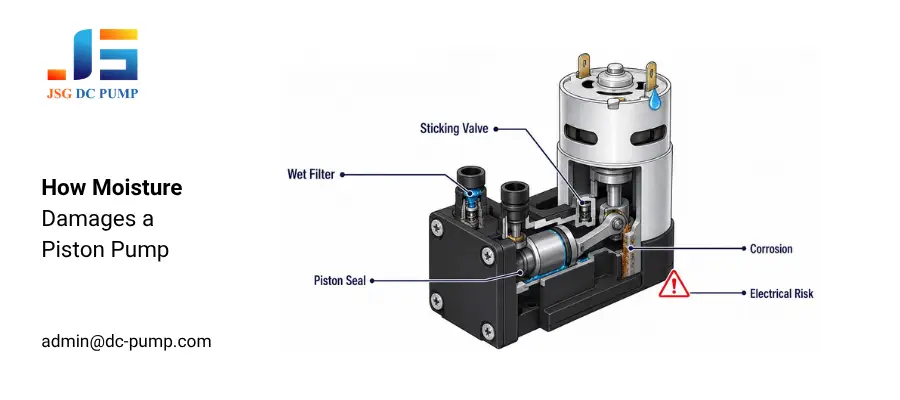
The exact effect depends on the pump structure, condensate composition, exposure time, temperature, and duty cycle.
| Moisture-related effect | Possible system symptom | Engineering concern |
| Valve sticking | Delayed startup or irregular flow | Liquid surface tension may prevent a small valve from opening or closing consistently. |
| Wet or saturated filter | Longer evacuation time | Filter resistance can rise sharply after moisture loading. |
| Internal contamination | Reduced vacuum or slow recovery | Residue may prevent valves and seals from closing correctly. |
| Elastomer degradation | Swelling, softening, or cracking | The liquid may contain cleaners, solvents, oils, salts, or process chemicals. |
| Corrosion | Increasing noise, current, or instability | Water and contaminants may attack unprotected metal components. |
| Electrical exposure | Intermittent operation or failure | Drips and splashes must not reach the motor, connector, or PCB. |
How Does Condensation Form in a Miniature Vacuum Pump System?
Your equipment can experience condensation even when the ambient relative humidity does not appear unusually high. The gas entering the system may be warmer or contain more moisture than the air around the pump.
Condensation begins when humid gas cools to its dew point. The U.S. National Weather Service defines the dew point as the temperature to which air must cool before it becomes saturated. Further cooling forces part of the water vapor to become liquid droplets.
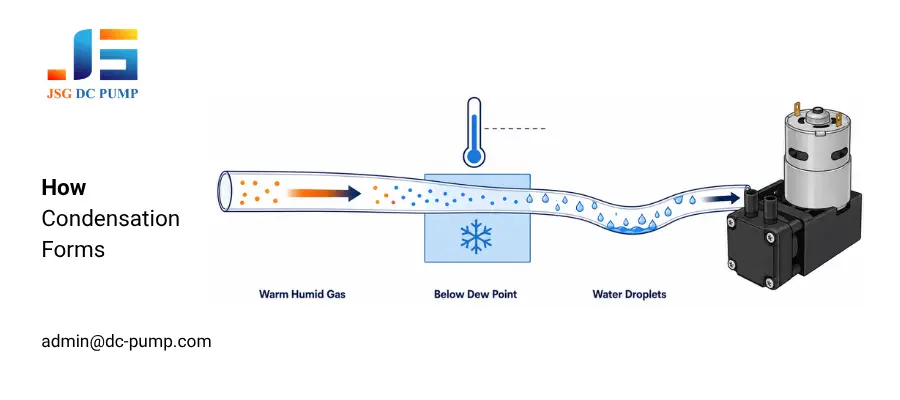
Common condensation sources in miniature vacuum pump systems include:
- Warm, humid sample gas entering a cooler instrument.
- Long inlet tubing touching a cold enclosure or metal chassis.
- Cold-start operation after overnight storage.
- Rapid movement between warm and cold environments.
- Breath, steam, soil gas, cleaning mist, or wet process gas.
- An undersized or incorrectly installed water trap.
- A saturated hydrophobic filter or leaking filter seal.
- Condensate flowing backward after the pump stops.
- Washdown water, rain, spills, or cleaning liquid entering the enclosure.
Room humidity alone is not enough to evaluate the risk. Engineers should record the source-gas temperature, relative humidity or dew point, coldest tubing temperature, gas composition, operating time, system pressure, and shutdown condition.
What Warning Signs Indicate Moisture Rather Than Normal Pump Wear?
Your first warning may not be visible water. Moisture problems often appear as slower evacuation, unstable flow, intermittent startup, or performance that changes with temperature and operating time.
A moisture-related restriction becomes more likely when the pump works normally at the beginning of a cycle but slows after repeated humid-gas sampling. Performance may also recover after the inlet line or filter has dried.
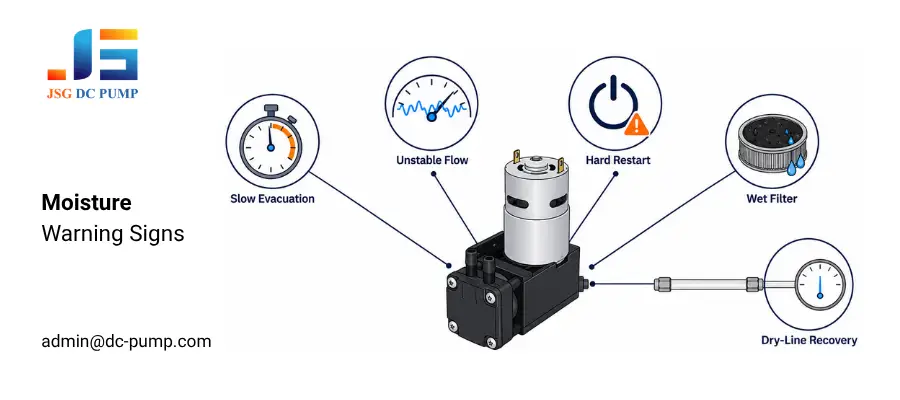
Typical warning signs include:
- Evacuation time increases after several operating cycles.
- The pump struggles to restart after a wet shutdown.
- Vacuum or airflow changes with ambient temperature.
- A transparent trap or tubing section contains droplets.
- The filter appears wet or shows a large pressure drop.
- Motor current, noise, or pump-head temperature changes.
- Performance returns when the pump uses a short, dry reference tube.
- The problem becomes worse during humid weather or cold-start operation.
We normally record working vacuum, airflow, current, temperature, and evacuation time before replacing any component. We then test the pump with a short, dry reference line. If performance returns to its baseline, the restriction is more likely inside the filter, trap, tubing, valve, or fitting.
How Can You Prevent Miniature Vacuum Pump Moisture Damage?
Your most reliable protection comes from combining several control methods. One filter cannot compensate for uncontrolled condensation, poor tubing layout, an overflowing trap, and missing maintenance.
The correct approach is to predict where liquid will form, separate it before the pump, and confirm that every protective component still allows the required airflow at the actual working vacuum.
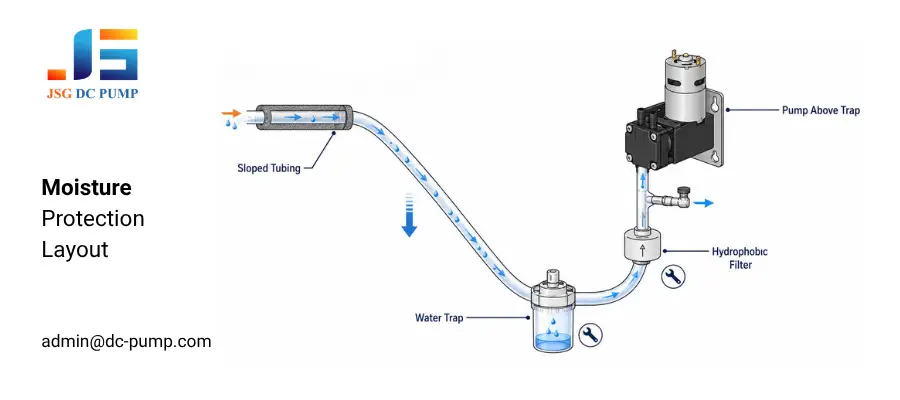
I recommend the following seven-step process:
- Define the worst case. Record the source temperature, dew point, expected condensate volume, gas composition, operating time, and shutdown period.
- Prevent uncontrolled condensation. Keep the inlet path above the source-gas dew point where practical, or intentionally cool the gas upstream so that condensate forms in a controlled separator. Shorten or insulate exposed tubing only after confirming its temperature throughout the full duty cycle.
- Capture bulk liquid. Install a properly sized, vacuum-rated, and accessible water trap before the pump.
- Block fine droplets. Place a low-restriction hydrophobic filter after the trap. Check its dry and wet pressure drop and liquid breakthrough pressure at the required working flow and vacuum. The filter cannot remove water vapor or replace the water trap.
- Use gravity. Slope the tubing toward the trap, avoid low loops, and mount the pump above the collection points when the equipment layout permits.
- Control purging. Validate the purge-gas quality, direction, duration, flow, and pressure before using a purge cycle.
- Protect and maintain. Shield the motor, connector, and PCB from splashes, and establish validated trap-draining and filter-replacement intervals.
How Should You Validate Moisture Protection Before Mass Production?
Your pump passing a dry open-air test does not prove that the finished device is protected. Tubing, filters, traps, temperature changes, equipment movement, and shutdown periods can create conditions that do not exist during a basic pump test.
Validate the complete device at the highest expected source dew point, lowest expected gas-path temperature, longest sampling time, and most restrictive realistic filter condition. Record working airflow, vacuum, evacuation time, current, pump temperature, noise, and any liquid found after the separator.
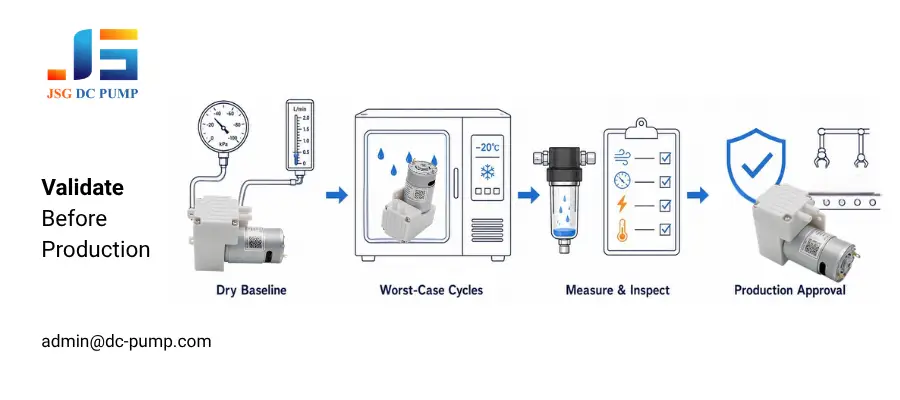
Begin by recording a dry reference baseline for working airflow, vacuum, evacuation time, current, pump temperature, and noise. Repeat the same measurements after humidity exposure, cold starts, warm-to-cold temperature cycles, wet-filter loading, trap-capacity testing, equipment tilting, shutdown, restart, and endurance cycling. Define acceptable performance limits before testing, and confirm that no liquid passes beyond the separator or migrates toward the pump during operation, movement, or storage. If performance falls outside these limits, test the pump with a short, dry reference tube and reconnect the trap, filter, and tubing one at a time to locate the restriction. Approve the design for mass production only after the complete assembly maintains the required vacuum performance and moisture-protection margin throughout repeated worst-case cycles.
How Should You Choose a Miniature Vacuum Pump for Humid Applications?
Moisture protection should be solved through the gas-path design before pump selection. A larger pump cannot compensate for an undersized water trap, a saturated filter, poor tubing layout, or condensate flowing backward after shutdown.
Once the moisture-control layout has been defined, compare the required working airflow at the target vacuum rather than maximum free flow alone. Motor type, duty cycle, power supply, temperature rise, noise, material compatibility, and installation space should also be evaluated. For compact systems with moderate airflow requirements, the JSG04 platform is a practical starting point. The JSG07 platform is better suited to systems requiring higher working airflow or deeper vacuum, while the JSG079 platform may be evaluated when greater airflow is required and the equipment can support its higher power and larger installation space.
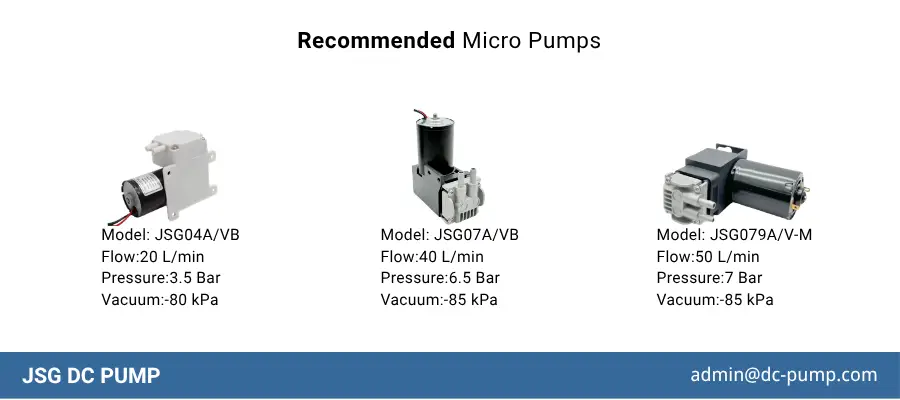
These pump platforms include different pressure and vacuum configurations. Maximum free flow, maximum pressure, and maximum vacuum are endpoint specifications and should not be treated as simultaneous working performance. Final selection should be based on the pump curve and validated with the actual gas, humidity, water trap, filter, tubing, voltage, and duty cycle.
Conclusion
Preventing miniature vacuum pump moisture damage requires controlling condensation throughout the entire gas path. A suitable water trap, low-restriction hydrophobic filter, correct tubing layout, compatible materials, and worst-case testing can help prevent unstable vacuum, restricted flow, contamination, and premature pump failure.
For miniature vacuum pump selection and moisture-protection support, contact JSG DC PUMP at admin@dc-pump.com. Send us your required working flow, target vacuum, gas composition, humidity or dew point, voltage, duty cycle, and installation limits for an application-specific recommendation.