

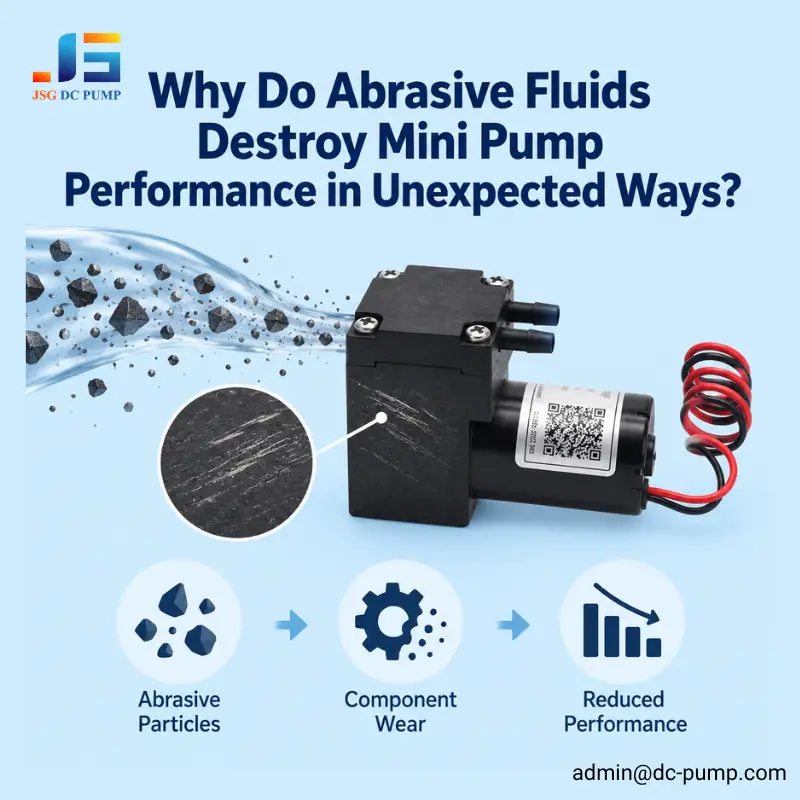
Abrasive wear can cause your mini pump to suddenly lose pressure or deliver a lower flow rate for no obvious reason. The source of the problem may be hidden in the fluid itself.
Abrasive fluids damage mini pump performance through gradual wear. Fine particles act like liquid sandpaper, scratching valves, seals, and internal surfaces. Over time, these small defects create internal leakage, reducing flow, pressure, and efficiency.
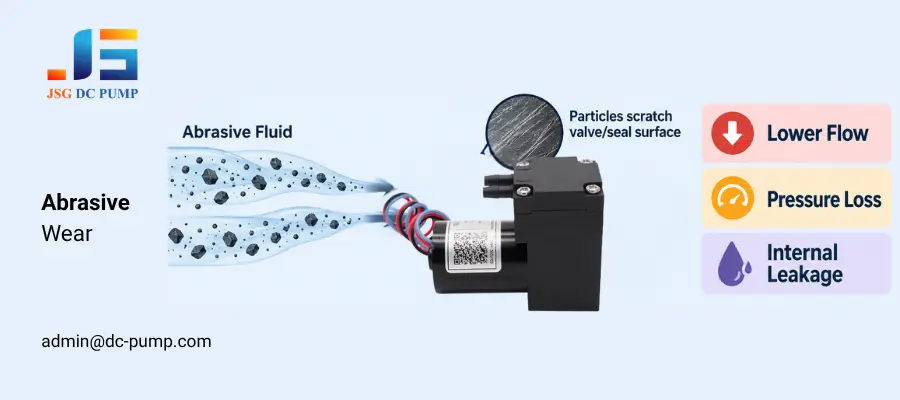
From my experience working with miniature pump applications, I have seen many customers confused by this problem. Their pump may work normally for weeks or months before performance suddenly declines. The failure is often not caused by one major event, but by thousands of tiny scratches accumulating over time. This is why flow and pressure specifications alone are not enough when selecting a pump for abrasive fluids.
What Happens Inside a Mini Pump When Abrasive Fluids Start Circulating?
You’re running a fluid containing tiny solids, and everything appears normal. Inside the pump, however, wear may already have started.
When abrasive fluids circulate, suspended hard particles behave like a grinding medium. They can enter moving and sealing areas, scratching surfaces, wearing valves, and gradually changing the pump’s internal geometry.
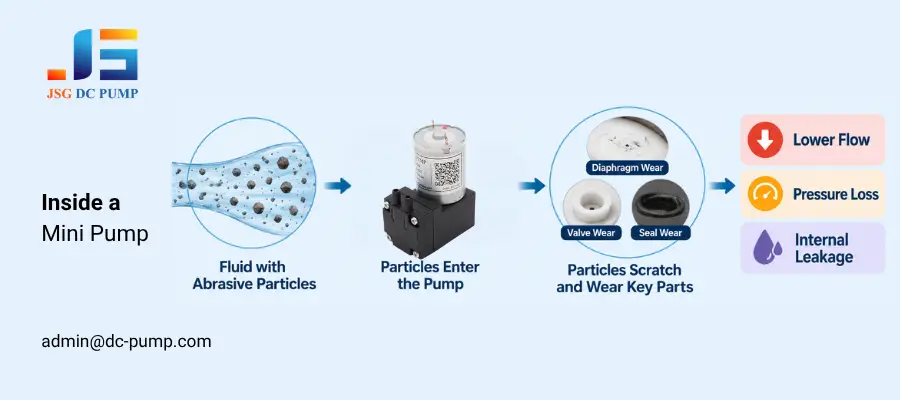
Think of it like having fine sand in engine oil. The machine may continue operating, but internal surfaces are slowly being damaged. In a mini pump, particles can enter the pump chamber, contact the diaphragm, and repeatedly pass across valve seats. In high-velocity areas, they may also cause erosion. The damage is gradual, but eventually it affects pump performance.
Why Do Small Particles Cause Serious Damage to Mini Pump Components?
It seems logical that larger particles would cause the most damage. In mini pumps, however, very small particles can be especially difficult because they can enter narrow internal clearances.
Larger particles may be captured by filtration, while very fine particles can sometimes enter narrow valve and sealing areas and interfere with proper sealing.
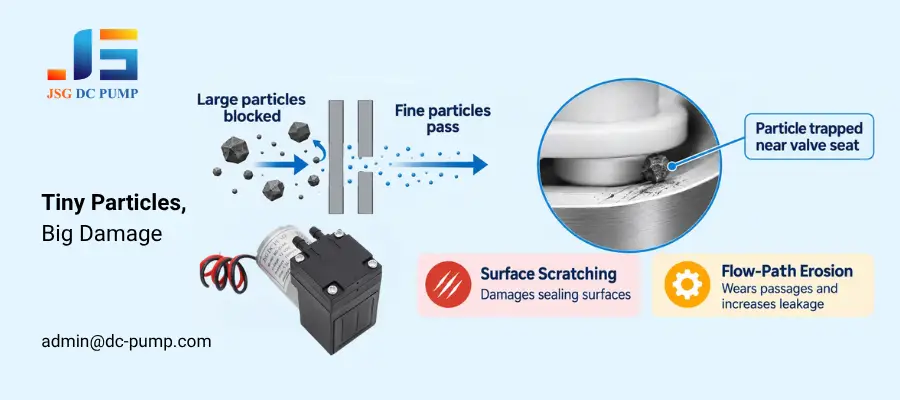
Mini pumps rely on precise sealing and internal geometry, so hard particles can quickly cause two main types of wear.
1. Surface Grinding and Scratching: Trapped particles repeatedly contact valves and sealing surfaces during pump operation, gradually damaging the sealing interface.
2. Erosion of Flow Passages: High-velocity particles can wear internal passages and sealing edges, increasing internal leakage and reducing pump performance.
Which Mini Pump Components Suffer Abrasive Wear First?
Your system is losing performance and you suspect abrasive wear. Where should you inspect first?
In a mini pump handling abrasive fluids, valves and sealing components are usually important areas to inspect because they are directly exposed to the fluid and strongly influence pressure and flow.
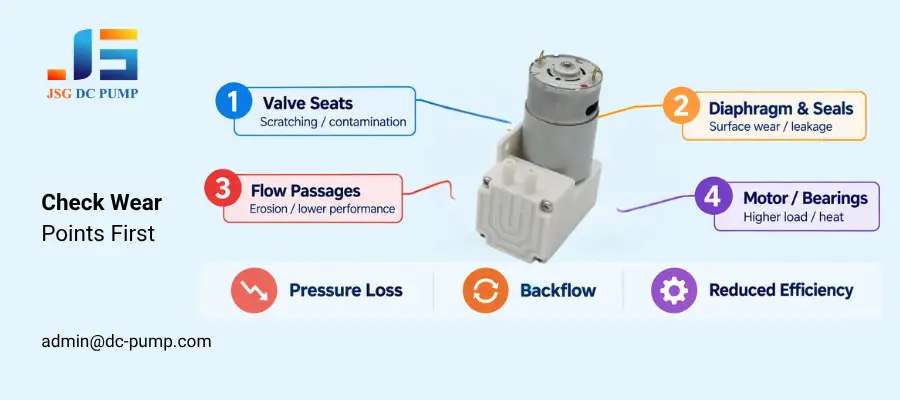
From my experience, abrasive wear usually concentrates around sealing, moving, and high-flow areas, so these components should be checked first.
| Inspection Area | Typical Wear Mechanism | Possible Effect |
|---|---|---|
| Valves / Valve Seats | Particles scratch or contaminate sealing surfaces. | Pressure loss, backflow, unstable flow. |
| Diaphragm / Sealing Areas | Repeated contact with particles causes surface wear. | Leakage and reduced efficiency. |
| Pump Chamber / Flow Passages | Abrasive particles gradually erode wetted surfaces. | Reduced hydraulic performance. |
| Motor / Bearings | Pump-head wear may increase operating load indirectly. | Higher current, heat, or shortened service life. |
How Does Abrasive Wear Reduce Pump Flow, Pressure, and Efficiency?
You notice that the pump no longer delivers its original flow or pressure. The motor or power supply may seem like the obvious cause, but internal wear should also be considered.
Abrasive particles damage sealing surfaces and increase internal leakage. Instead of moving efficiently from inlet to outlet, part of the fluid may move backward inside the pump.
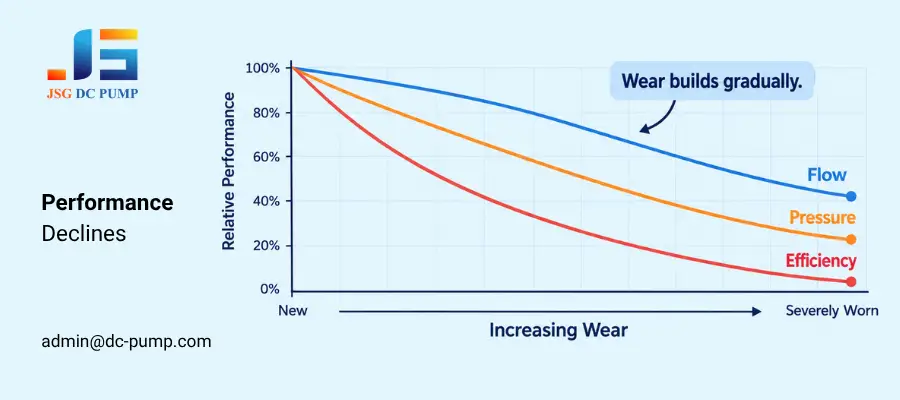
The performance loss usually follows a gradual chain:
1. Valve Wear Begins: Small particles damage valve and valve-seat surfaces.
2. Backflow Increases: Worn valves can no longer seal completely.
3. Sealing Surfaces Continue to Wear: Particles repeatedly contact valves, the diaphragm chamber, and wetted surfaces.
4. Internal Leakage Increases: More fluid circulates internally instead of reaching the outlet.
5. Flow Rate Drops: Less useful fluid is delivered during each cycle.
6. Overall Efficiency Declines: The motor continues consuming energy while hydraulic output decreases.
How Do Particle Size, Concentration, and Pump Materials Affect Pump Life?
Your pump may fail much earlier than another pump in a similar application. The difference can come from the fluid itself and the operating conditions.
Service life depends on particle characteristics, wetted materials, pressure, speed, temperature, and duty cycle. Hard particles, high concentrations, unsuitable materials, and poor filtration can all accelerate wear.
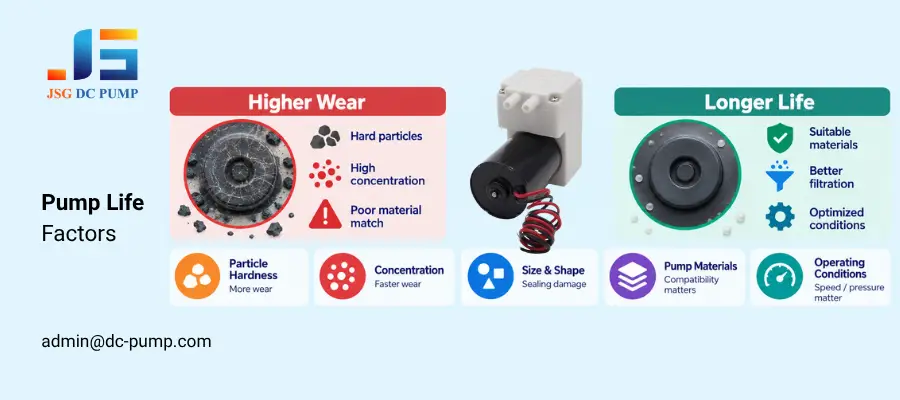
Choosing the right pump means considering not only flow and pressure, but also particle characteristics and their interaction with wetted materials—key factors we evaluate at JSGDCPUMP.
| Factor | Wear Impact | Recommendation |
| Particle Hardness | Hard particles increase wear. | Use suitable wetted materials. |
| Particle Concentration | More particles accelerate wear. | Consider filtration. |
| Particle Size & Shape | Sharp or fine particles damage sealing areas. | Check particle distribution. |
| Pump Materials | Materials affect wear and compatibility. | Match materials to the fluid. |
| Fluid & Operating Conditions | High speed or viscosity increases load. | Optimize pump speed and sizing. |
How to Reduce Abrasive Wear and Select the Right Mini Pump?
You know your fluid contains abrasive particles. How can you reduce premature pump wear?
The best approach usually combines fluid analysis, filtration, suitable wetted materials, correct pump sizing, and appropriate operating conditions.
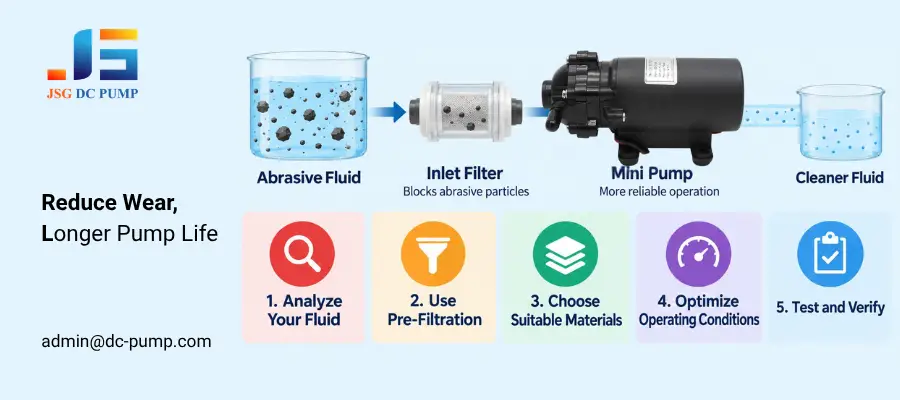
At JSGDCPUMP, we recommend evaluating the complete pumping system rather than simply replacing one pump with another.
1. Analyze Your Fluid:Identify particle size, concentration, viscosity, temperature, chemical composition, required flow, pressure, and duty cycle.
2. Consider Pre-Filtration:Use a suitable inlet filter to reduce abrasive particles without creating excessive flow restriction.
3. Select Suitable Wetted Materials:Choose valves, diaphragms, seals, pump heads, tubing, and fittings for both chemical compatibility and wear resistance.
4. Optimize Operating Parameters:Avoid unnecessary maximum speed or pressure to reduce mechanical and erosive stress.
5. Test the Real Fluid:Test with the actual or representative fluid and monitor flow, pressure, current, temperature, leakage, wear, and long-term stability.
Conclusion
Abrasive fluids rarely damage a mini pump all at once. Instead, particles gradually wear valves, seals, diaphragms, and internal flow paths, leading to lower flow, unstable pressure, internal leakage, and reduced service life. That is why particle size, concentration, fluid properties, wetted materials, filtration, and operating conditions should all be considered when selecting a pump.
If you are unsure which mini pump is suitable for your abrasive or particle-containing fluid, send us your fluid information, target flow, pressure, voltage, and duty cycle. Our team can help evaluate the application and recommend a suitable pump and testing direction.Contact: admin@dc-pump.com
