


A micro pump should be selected by its task, medium and operating cycle. Industrial, medical and smart home equipment may use similar pumping technologies, while requiring different evidence that the pump will work in the finished device.
Start with the flow required at the working pressure or vacuum. If flow is unknown, describe the chamber or transfer volume and required response time. Then define the running cycle and the tubing, filters, valves or leakage the pump must work with. This guide maps application functions to the first checks that matter before comparing individual models.
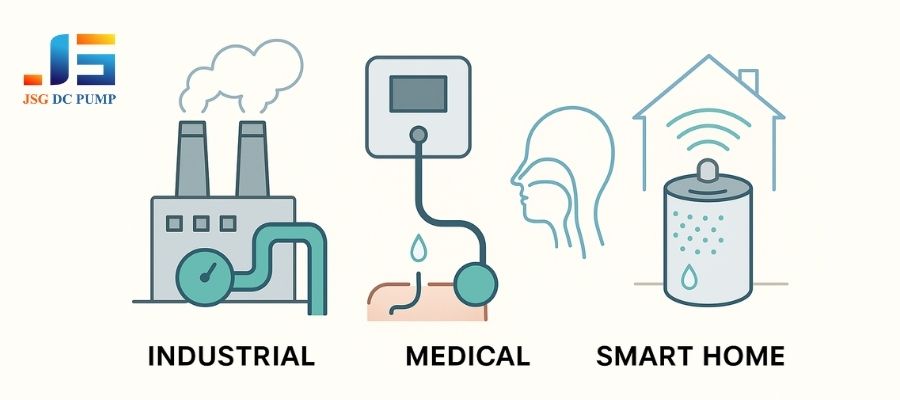
How Do Pump Requirements Differ by Application?
Industry labels describe the setting; the function identifies what must be tested. Maintaining suction in a fixture differs from moving a measured gas sample, even when both systems use a vacuum pump. These are general engineering examples, not customer projects or measured results for a particular JSGDCPUMP model.
| Application function | Define first | Validate in the system | Avoid this shortcut |
|---|---|---|---|
| Industrial vacuum holding | Working vacuum, leakage, hold duration and restart conditions | Vacuum at the fixture and stability throughout the cycle | Choosing only by ultimate vacuum |
| Industrial air delivery | Flow at backpressure, chamber volume and cycle time | Pressure rise, current, temperature and repeated starts | Treating free flow as loaded flow |
| Medical or laboratory gas sampling | Sample flow through the complete path, gas, moisture and filter resistance | Flow stability and compatibility throughout the sample path | Assuming oil-free means suitable for every gas |
| Medical pneumatic control | Pressure response, operating cycle and acceptable overshoot | Response with the actual sensor, valves and controller | Assuming the pump alone determines accuracy |
| Smart-home liquid transfer | Liquid properties, suction height, priming and volume per cycle | Delivery repeatability, air-bubble recovery and restart after idle periods | Using water free-flow data for a different liquid |
| Portable or quiet equipment | Operating load, run time, supply and mounting position | Current and noise inside the final enclosure | Comparing noise measurements taken under different conditions |
For instrument fluid circuits, see the laboratory micro diaphragm pump selection guide. For air-quality monitoring, distinguish the sampling pump from the purifier’s main airflow system.
How Do You Match Pump Parameters to the Task?
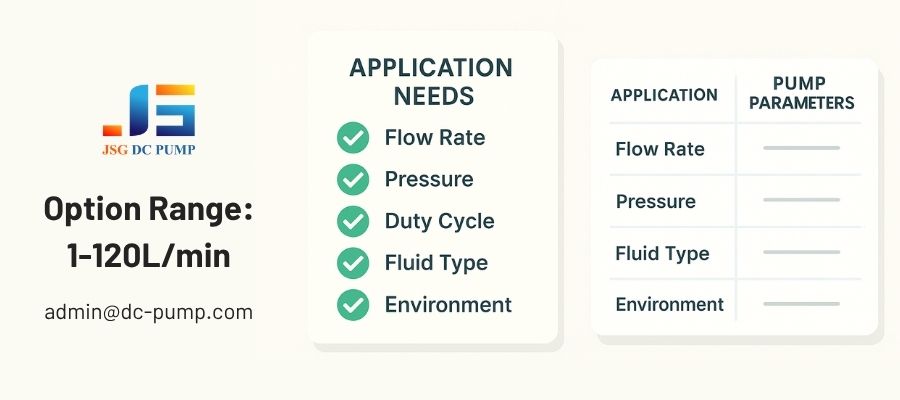
Write the requirement as an operating condition. A flow requirement needs an associated pressure or vacuum, and a pressure requirement needs an associated flow or response time. Maximum flow and maximum pressure are separate endpoints, not a promise that both are available together.
For a vacuum system, specify whether pressure is absolute or relative to atmosphere. Include expected leakage and measure at the point where suction is needed. For liquid transfer, also identify viscosity, temperature, inlet conditions and whether the pump must prime from dry.
Describe the longest run, pause between runs, starts per hour and whether the pump restarts against residual pressure or vacuum. Motor type alone does not establish continuous-duty capability. Use the micro pump selection guide to compare the required working point with candidate pump information.
When Is Customization Useful?
Customization is useful when the performance is suitable but the interface or operating conditions need adjustment. Examples include port orientation, mounting, electrical connections, materials exposed to the medium or an appropriate control interface. Availability must be confirmed for the exact platform.
Separate a packaging problem from a performance problem. A different bracket may resolve installation; changing a connector will not recover flow lost through a restrictive filter. Check the system restriction before asking for a larger motor or pump.
Document the change and repeat the relevant checks on the revised configuration. A material or control change can alter behaviour even when the external dimensions remain the same. An earlier test on a different version is not proof for the updated pump.

What Material and Compliance Evidence Should You Request?
Request documentation for the exact pump configuration and intended medium. Identify which components contact the gas or liquid, how cleaning is performed if relevant, and whether contamination, swelling or leakage would affect the equipment.
Separate component requirements from those of the finished device. A material designation, oil-free construction or component certificate does not by itself establish complete-device safety or compliance. Requirements depend on intended use, contact pathway, environment and market. Confirm that essential supporting evidence applies to the supplied configuration.
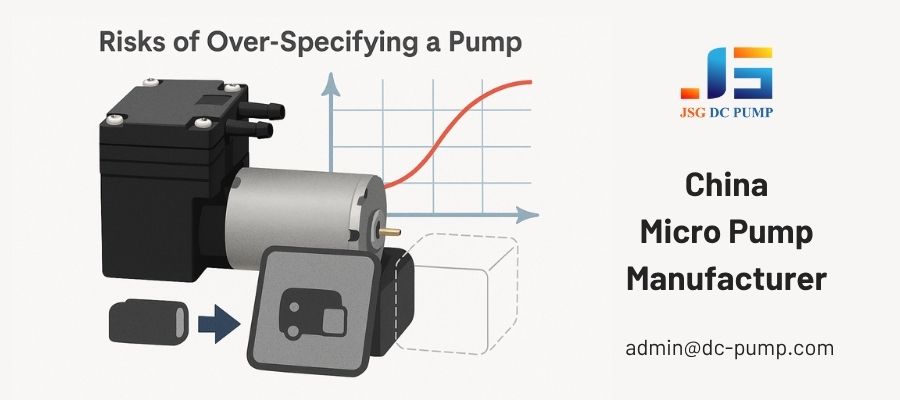
Can a Larger Pump Create New Problems?
Extra capacity can provide useful margin when it covers a defined uncertainty, such as filter loading or supply variation. Unexplained oversizing may add current, noise, space requirements or control complexity. The effect depends on the pump and operating method.
Compare candidates over the operating range the device will actually use. Confirm controllable output, stable starting, electrical load and temperature. For miniature positive-displacement pumps, evaluate the model’s pressure-flow characteristics and operating limits rather than applying a generic best-efficiency-point rule from another pump technology.
Test margin against an identified condition. A higher maximum pressure, larger motor or brushless design does not automatically establish longer service life.

How Do You Turn the Application into a Selection Brief?
- Describe what must move, inflate, evacuate or remain under suction.
- Provide flow at pressure or vacuum, or volume and required response time if flow is unknown.
- Explain run duration, restart conditions, medium, tubing, filters, valves and likely leakage.
- Add integration limits such as voltage, dimensions, noise, control and connectors.
- Compare candidates using the same supply, plumbing and measurement conditions. Record acceptance criteria before testing.
Discuss Your Application with JSGDCPUMP
Tell us what your equipment needs to do. If you know them, include the working point, operating cycle and medium or system conditions. If specifications are not yet defined, a short description is enough to start the discussion.
Send Inquiry — emily@dc-pump.com
