

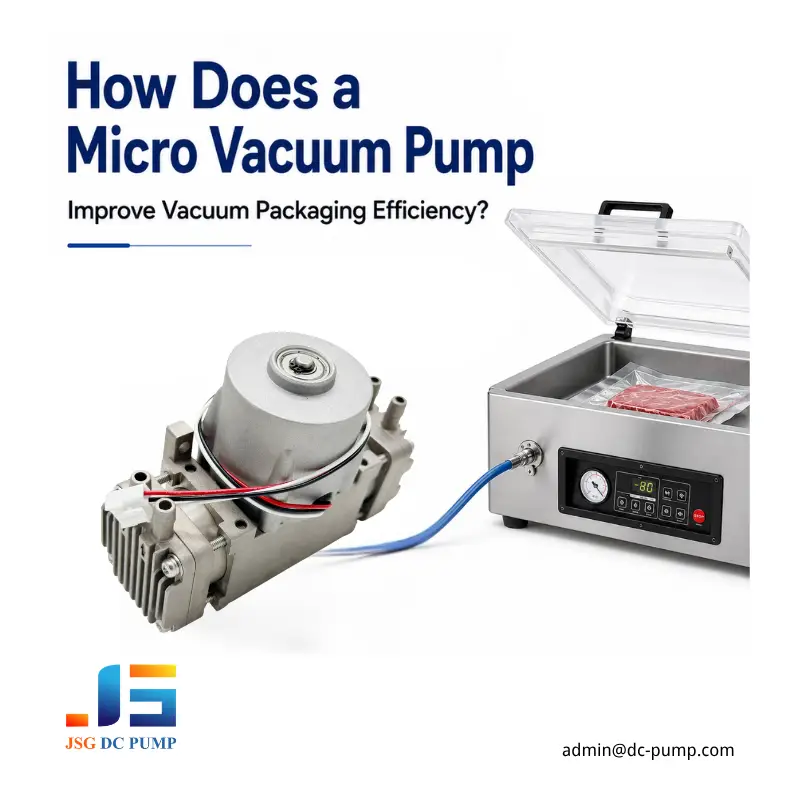
A micro vacuum pump for vacuum packaging can shorten evacuation time and improve cycle consistency when it is correctly matched to the package or chamber volume, target pressure, and duty cycle. If evacuation is slow or unstable, the machine may produce fewer packages per hour and less consistent package quality, even when the sealing bar and packaging film are correctly configured.
The performance benefit depends on correct pump sizing. Selection must be based on the package or chamber volume, target absolute pressure, airflow at the working pressure, acceptable evacuation time, tubing losses, and required duty cycle.
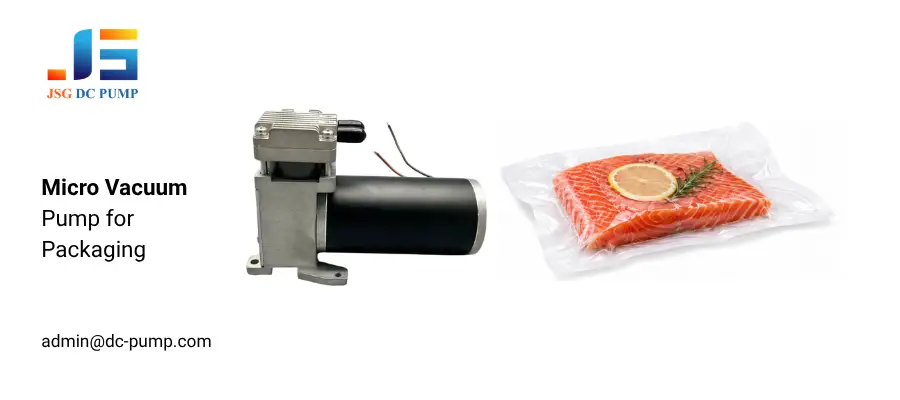
As engineers at JSG with many years of experience supporting vacuum-packaging applications, we have seen customers focus on the sealing bar or packaging film when the vacuum system was actually limiting cycle speed and consistency. A correctly selected micro piston vacuum pump can help remove this bottleneck, but it is not suitable for every machine. These pumps are generally best suited to external-suction systems, small vacuum chambers, and other OEM packaging equipment with moderate vacuum requirements. Large chamber machines or processes requiring a deeper final pressure may need greater pumping capacity or a different pump technology. Before recommending a model, we always check the package or chamber volume, target absolute pressure, required evacuation time, and airflow available on the pump’s P-Q curve at the actual working pressure.
How Does a Micro Piston Vacuum Pump Work in Vacuum Packaging?
Vacuum packaging may appear complicated, but the vacuum-generation process is straightforward. A micro vacuum pump creates a pressure difference between the inside of the package and the surrounding atmosphere.
The pump draws air from the package or vacuum chamber through its inlet and discharges it through the outlet. As air is removed, the pressure inside the package decreases until the machine reaches its target absolute pressure.
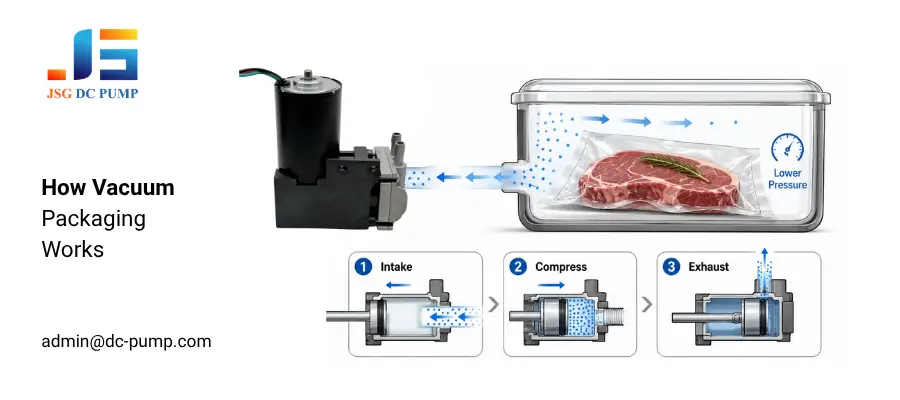
In a micro piston vacuum pump, a DC motor drives an eccentric mechanism connected to a piston. As the piston moves away from the chamber, chamber volume increases and pressure falls, drawing air through the inlet. When the piston returns, chamber volume decreases; the extracted air is compressed and discharged through the outlet.
The Three Steps of a Piston Vacuum Pump Cycle
| Step | Piston Movement | Chamber Action | Result |
| Intake | The piston moves away from the chamber | Chamber volume increases and pressure decreases | Air is drawn from the package |
| Compression | The piston moves toward the chamber | Chamber volume decreases and pressure rises | The extracted air is compressed |
| Exhaust | The piston completes the compression stroke | The exhaust path opens | Compressed air is discharged |
How Can Faster Air Removal Shorten Packaging Cycles?
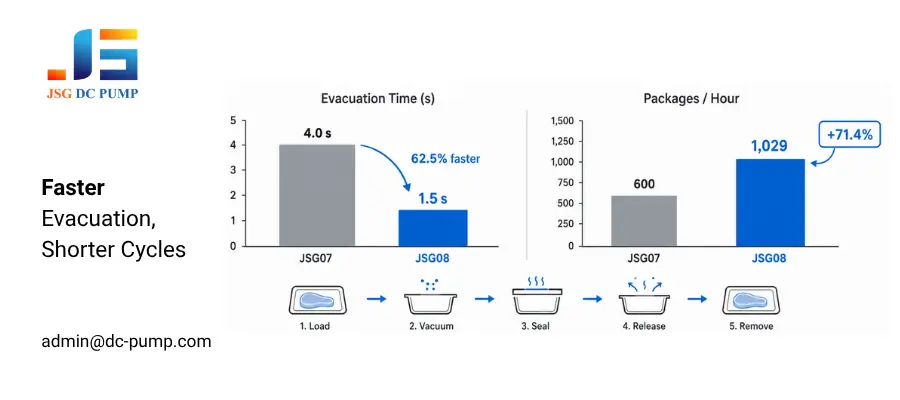
Every vacuum-packaging cycle normally includes product loading, air evacuation, sealing, pressure release, and package removal. The pump directly affects the evacuation stage.
A pump with sufficient airflow can remove the required volume of air more quickly and help the machine reach its target vacuum sooner. The machine can then begin sealing and move to the next package.
However, maximum free flow alone does not determine evacuation speed. The actual evacuation time also depends on:
- Package or chamber volume
- Target absolute pressure
- Pump airflow at the working vacuum
- Tubing length and internal diameter
- Valve and filter resistance
- System leakage
- Product shape and compressibility
Pump airflow normally decreases as inlet pressure falls. Engineers should therefore review the full P-Q curve and confirm the available flow at the required absolute pressure. Do not select a pump only from its free-flow rating at atmospheric inlet pressure or from its ultimate-vacuum figure, where useful flow may be close to zero.
Hypothetical Impact of Evacuation Time on Throughput
The following calculation is a theoretical example rather than a measured performance claim.
Theoretical packages per hour = 3,600 ÷ total cycle time in seconds.
| Parameter | Standard Pump | Higher-Flow Micro Pump | Difference |
| Evacuation Time | 4.0 seconds | 1.5 seconds | 2.5 seconds shorter |
| Other Cycle Stages | 2.0 seconds | 2.0 seconds | No change |
| Total Cycle Time | 6.0 seconds | 3.5 seconds | 41.7% shorter |
| Theoretical Packages per Hour | 600 | Approximately 1,029 | Approximately 71.4% higher |
This comparison assumes that all stages operate sequentially, the remaining cycle stages do not change, and the machine experiences no loading delays, downtime, or rejected packages. Actual production output must be verified under normal operating conditions.
Why Does Stable Vacuum Performance Improve Packaging Consistency?
Inconsistent vacuum performance can cause one package to reach the required vacuum quickly while the next package takes longer or stops at a different pressure.
This variation can affect residual air, package appearance, and cycle time. A correctly sized pump, combined with pressure feedback and correctly timed valves, helps the machine reach its target pressure more predictably. Film positioning and seal formation still depend on the machine’s clamping system, sealing-bar setup, product placement, and control sequence.
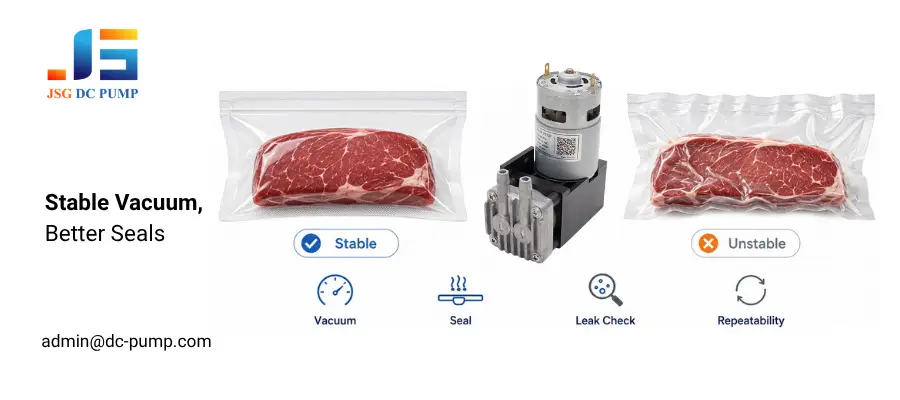
Vacuum stability is only one part of seal quality. A strong seal also depends on:
- Correct sealing temperature
- Suitable sealing pressure
- Sufficient sealing time
- Clean sealing surfaces
- Compatible packaging film
- Accurate sealing-bar alignment
- Proper product placement
A vacuum pump cannot independently guarantee a leak-proof or hermetic seal. However, consistent evacuation can reduce one source of process variation and support more repeatable sealing conditions.
Common Packaging Problems Related to Vacuum Performance
| Packaging Problem | Possible Vacuum-Related Cause | Recommended Check |
| Long Evacuation Time | Insufficient airflow under load | Check the P-Q curve, chamber volume, tubing, and filters |
| Vacuum Cannot Reach the Target | Pump capacity is insufficient or the system leaks | Perform a leakage test and confirm the pump’s ultimate pressure and airflow at the target pressure. |
| Cycle Time Varies | Unstable power supply, leakage, or changing system resistance | Check voltage, current, valves, tubing, and controller settings |
| Film Wrinkles Near the Seal | Film position changes before sealing | Check vacuum timing, product placement, and sealing-bar setup |
| Vacuum Drops After Pump Shutdown | Valve leakage or chamber leakage | Test check valves, fittings, tubing, and chamber seals |
How Can a Micro Vacuum Pump Reduce Energy and Operating Costs?
A dedicated micro vacuum pump may reduce runtime when the machine controller operates it only during the evacuation stage. Short tubing can also reduce dead volume, pressure loss, and potential leakage points.
However, a central vacuum system can also operate efficiently when it uses pressure-controlled storage or variable-speed control. Compare the alternatives at the same target pressure, throughput, and operating schedule. Energy use should be reported in watt-hours per 1,000 completed packages rather than assuming that one system architecture is always more efficient.
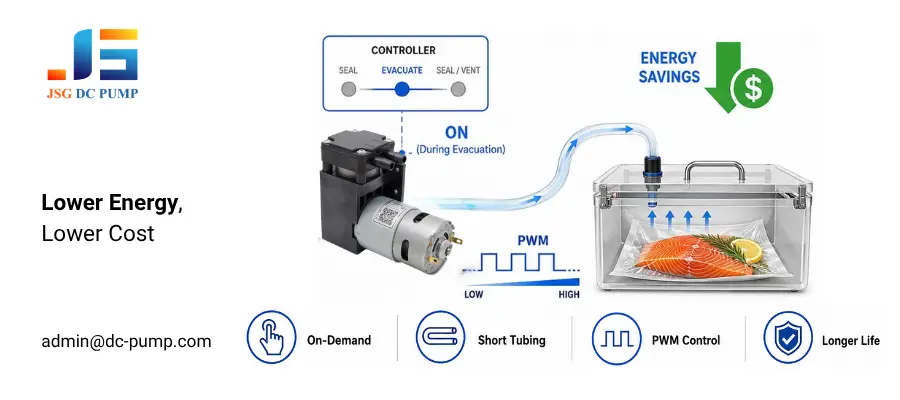
For pump models equipped with PWM speed control, the controller can use a higher speed during initial evacuation and reduce speed as the target pressure is approached. The available speed range and signal requirements depend on the exact motor and pump variant and must be confirmed from its datasheet and validated on the machine.
How Can You Choose the Right Micro Vacuum Pump for Packaging?
The correct pump is not necessarily the model with the highest maximum flow or deepest maximum vacuum. It is the model that reaches the required working point within the available cycle time while remaining within its electrical, thermal, and duty-cycle limits.
Before selecting between the JSG07 micro piston vacuum pump and the JSG08 micro piston vacuum pump, confirm the following information:
- Package or chamber volume
- Required target absolute pressure
- Maximum acceptable evacuation time
- Expected cycles per hour
- Operating voltage
- Available starting current
- Tubing length and internal diameter
- Filter, valve, and silencer resistance
- Permitted noise level
- Installation dimensions
- Motor-control requirements
- Ambient operating temperature
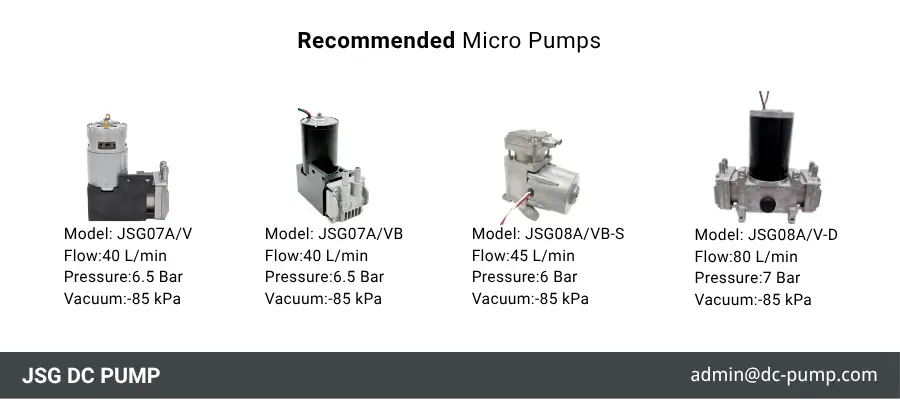
Brushed and Brushless Motor Comparison
| Motor Type | Suitable Use | Main Characteristic | Packaging Consideration |
| Brushed DC | Short, intermittent packaging cycles | Lower initial cost and simpler control | Brush wear limits expected service life |
| Brushless DC | Higher cycle counts or longer individual operating periods | Longer expected life and electronic control options | Higher initial cost but lower brush-related maintenance |
|
Brushless with PWM |
Packaging machines requiring adjustable pump speed | Controller can adjust motor speed | Requires correct control signal and system testing |
Conclusion
A properly sized micro piston vacuum pump can shorten evacuation time, improve cycle repeatability, and simplify integration in suitable vacuum-packaging equipment. Select the pump according to its airflow at the target absolute pressure—not from free-flow or ultimate-vacuum figures alone—and validate it with the actual tubing, filters, temperature, product, and duty cycle.
For an application-specific recommendation, email JSG DC PUMP at admin@dc-pump.com with your package or chamber volume, target absolute pressure, required evacuation time, operating voltage, tubing dimensions, and expected duty cycle. Our engineering team will review the operating point and recommend a suitable model for sample testing.
